
Cataclysmic megaflood refilled the Mediterranean Sea 5.33 million years ago
New research confirms that a massive flood event, known as the Zanclean Megaflood, rapidly refilled the Mediterranean Sea approximately 5.33 million years ago.
Scientists have identified geological formations in Southeast Sicily that provide the most detailed evidence yet of the cataclysmic event that ended the Messinian Salinity Crisis and reshaped the region.
Their study revealed compelling geological and numerical modeling evidence confirming that the Mediterranean Sea was refilled in a matter of years by a massive flood approximately 5.33 million years ago — an event known as the Zanclean Megaflood that ended the Messinian Salinity Crisis, a period when the Mediterranean had largely evaporated, leaving behind vast salt deposits.
Researchers, including those from the University of Southampton and the Monterey Bay Aquarium Research Institute, have identified over 300 streamlined ridges and a vast underwater channel in Southeast Sicily, all pointing to an immense surge of water reshaping the landscape.
“The Zanclean megaflood was an awe-inspiring natural phenomenon, with discharge rates and flow velocities dwarfing any other known floods in Earth’s history,” Dr. Aaron Micallef, lead author of the study and researcher at the Monterey Bay Aquarium Research Institute in California said.
“Our research provides the most compelling evidence yet of this extraordinary event.”
The Messinian Salinity crisis and the formation of salt flats
The Mediterranean Sea became isolated from the Atlantic Ocean between 5.97 and 5.33 million years ago after evaporation caused a drop in sea levels with no continuous influx of water which led to the deposition of vast salt layers.
The period was known as the Messinian Salinity Crisis which drastically altered the region’s landscape, with thick evaporite deposits covering the seabed. The prevailing theory had suggested that the Mediterranean refilled gradually over approximately 10 000 years but emerging evidence has challenged the view.
Discovery of geological evidence in Southeast Sicily
Now, an international team of researchers discovered geological formations in Southeast Sicily that support the theory of a rapid flooding event. These include more than 300 streamlined ridges and an erosional shelf channel extending from the Sicily Sill into the Noto Canyon.
The formations indicate the presence of a large-scale turbulent water flow moving northeastward.
“The morphology of these ridges is compatible with erosion by large-scale, turbulent water flow with a predominantly north-easterly direction. They reveal the immense power of the Zanclean Megaflood and how it reshaped the landscape, leaving lasting imprints on the geological record,” Professor Paul Carling, an emeritus professor at the University of Southampton and co-author of the study, noted.
Researchers found evidence of poorly sorted breccia by analyzing samples from the ridges, consisting of large rock fragments deposited with immense force. The deposits were located precisely at the boundary between the Messinian and Zanclean periods, providing a direct indicator of the flood’s timing and magnitude.
Unprecedented flow rates and water speeds
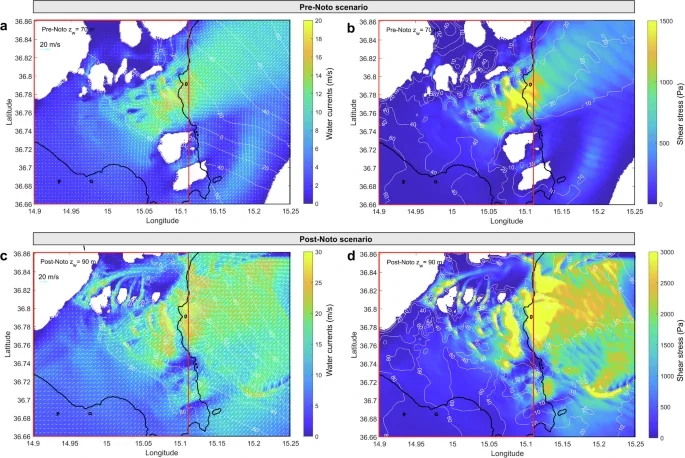
Numerical modeling of the flood event estimates a discharge rate between 68 and 100 Sverdrups (Sv) where one Sverdrup equals one million m3/s.
For comparison, the combined discharge of all modern rivers on Earth is approximately one Sverdrup. Water speeds reached 32 m/s (72 mi/h) at peak intensity by forcefully eroding the seabed and transporting massive amounts of sediment.
Seismic reflection data, a geophysical technique akin to geological ultrasound, revealed a distinct “W-shaped channel” on the continental shelf east of the Sicily Sill.
The channel is up to 20 km (12 miles) wide and 270 m (886 feet) deep and it directs floodwaters into the Noto Canyon which is an underwater valley in the eastern Mediterranean. Its shape and depth indicate it was formed quickly rather than through slow erosion.
The role of the Strait of Gibraltar in the flood event
Scientists believe that the Zanclean Megaflood was triggered by the Atlantic Ocean breaching a land barrier near the modern-day Strait of Gibraltar. The water poured into the Mediterranean basin with overwhelming force once the barrier collapsed.
The initial inflow filled the western Mediterranean before spilling over Sicily Sill flooded the eastern Mediterranean and terminated the Messinian Salinity Crisis.
The erosion of the Sicily Sill and the formation of the Noto Canyon played an important role in directing floodwaters. Computer simulations indicate that as the channel deepened the flow of water intensified, altering direction and accelerating sediment transport.
The estimated volume of rock eroded from the sill, the shelf channel, and the Noto Canyon is 67.6 km³ (16.2 mi³), but this represents only a fraction of the sediment transported to the western Ionian Basin.
Lasting geological impact
The Zanclean Megaflood left behind enduring geological features that persist in the Mediterranean landscape over 5 million years later. The discovery of the formations provides new data into large-scale flood events on Earth and raises the possibility of similar megafloods occurring on other planetary bodies.
“These findings not only shed light on a critical moment in Earth’s geological history but also demonstrate the persistence of landforms over five million years,” Dr. Micallef stated.
“It opens the door to further research along the Mediterranean margins.”
The research combines field studies, geophysical imaging, and hydrodynamic modeling to reconstruct a detailed timeline of the event.
The results suggest that the Messinian Salinity Crisis ended not through slow, gradual flooding, but rather through an extraordinary, high-velocity flood that reshaped the Mediterranean region in just a few years.
References:
1 Land-to-sea indicators of the Zanclean megaflood – Aaron Micallef, Giovanni Barreca, Christian Hübscher, Angelo Camerlenghi, et. al. – Nature – Communications Earth & Environment – December 28, 2024 – https://doi.org/10.1038/s43247-024-01972-w – OPEN ACCESS
Featured image credit: Location map and digital elevation model of SE Sicily and adjacent seafloor. The front of the Sicilian Fold and Thrust Belt, the Malta Escarpment, Noto Canyon, and the inferred buried megaflood deposit are labeled. Credit: SITR, EMODnet

Rishika holds a Master’s in International Studies from Stella Maris College, Chennai, India, where she earned a gold medal, and an MCA from the University of Mysore, Karnataka, India. Previously, she served as a Research Assistant at the National Institute of Advanced Studies, Indian Institute of Science, Bengaluru, India. During her tenure, she contributed as a Junior Writer for Europe Monitor on the Global Politics website and as an Assistant Editor for The World This Week. Her work has also been published in The Hindu newspaper, showing her expertise in global affairs. Rishika is also a recipient of the Women Empowerment Award at the district level in Haryana, India, in 2022.

Commenting rules and guidelines
We value the thoughts and opinions of our readers and welcome healthy discussions on our website. In order to maintain a respectful and positive community, we ask that all commenters follow these rules.