
Powerful earthquake swarm begins in Bardarbunga caldera, Iceland
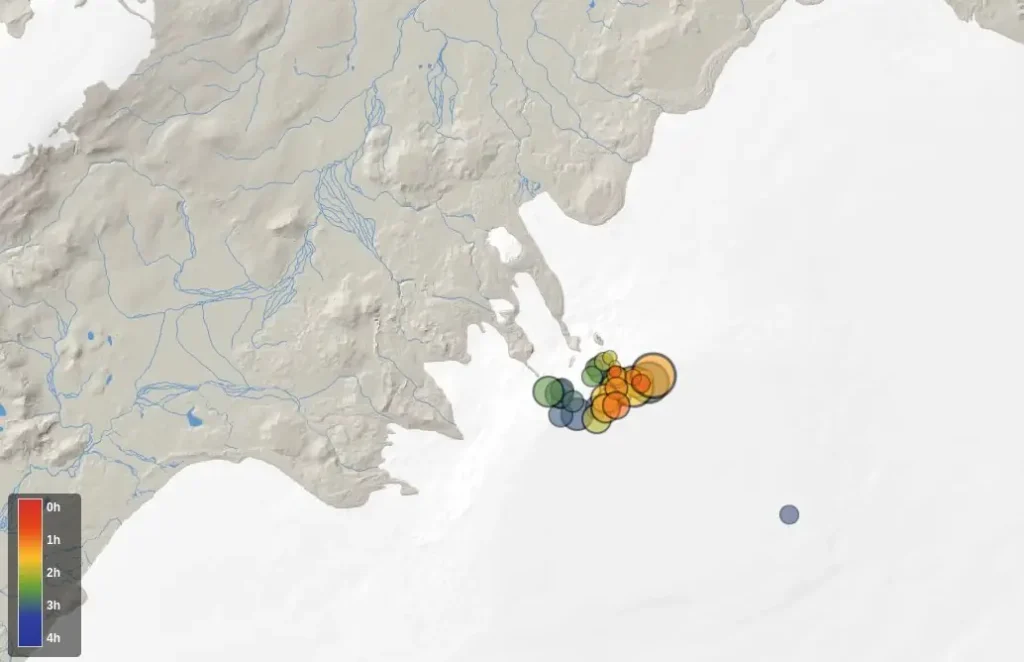
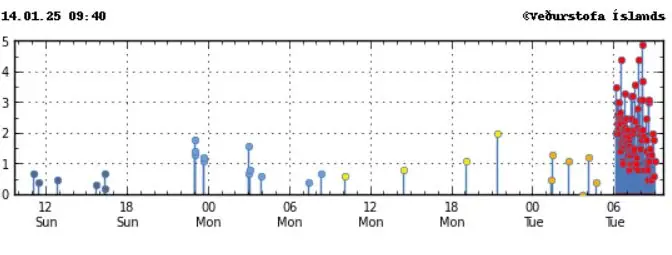
A powerful earthquake swarm started in the NW part of Bárðarbunga caldera, Iceland at 06:08 UTC on January 14, 2025. Initial data indicate that dozens of quakes occurred in rapid succession, hinting at possible volcanic or tectonic unrest deep beneath the ice. The current activity may be similar to the beginning of the swarm that occurred before the 2014 Holuhraun eruption. The Aviation Color Code for Bárðarbunga has been changed to Yellow.

Image credit: TW/SAM, Google
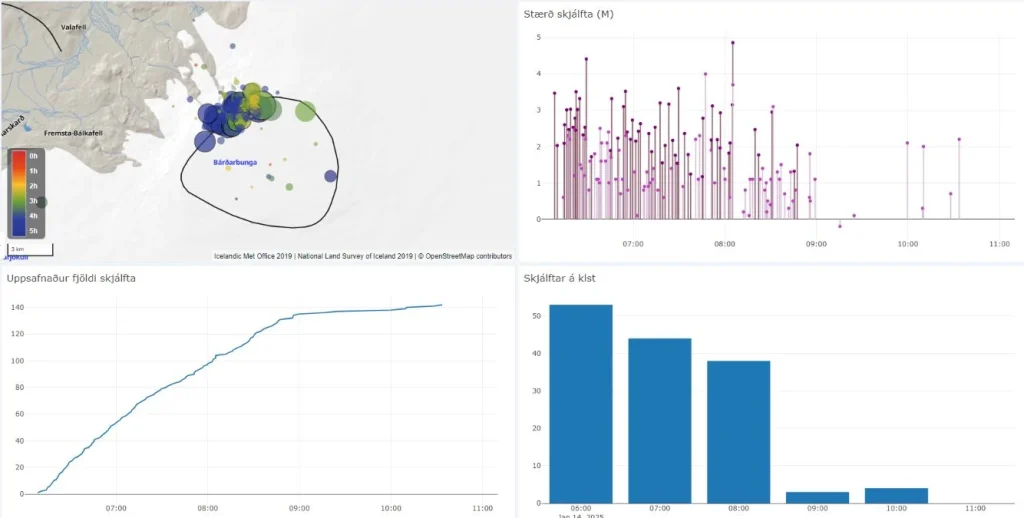
Instruments recorded dozens of events in quick succession under Iceland’s Bardarbunga volcano, starting at 06:08 UTC on January 14. Among the more significant early quakes was a M4.4 event at 06:29 UTC, with the epicenter located about 3.6 km (2.2 miles) northeast of Bárðarbunga at a depth of 4.9 km (3 miles).
However, the largest recorded earthquake so far was M5.1 at 08:05 UTC. The quake had a very shallow depth of just 0.1 km (0.06 miles) and was located roughly 3.9 km (2.4 miles) northeast of Bárðarbunga.
Such shallow seismicity may suggest localized magma intrusion or sudden stress redistribution close to the surface.
While most events fall in the magnitude range of 1.0 to 3.0, the swarm has now produced quakes beyond magnitude 4.0. Depths typically extend from about 0.1 km (0.06 miles) down to nearly 9.7 km (6 miles) below ground level.
The volcano’s last eruption occurred in 2014/15, beginning as a fissure eruption at the Holuhraun vent on August 29, 2014, about 45 km (28 miles) northeast of the subglacial caldera. Lava emission continued until February 28, 2015, creating a lava field that spanned nearly 85 km² (32.8 mi²).
In an interview with RUV early Tuesday morning, Einar Bessi Gestsson, a natural hazard expert at the Icelandic Meteorological Office (IMO), said it is difficult to say at this point whether the swarm resembles the beginning of a new eruption.
“Well, it’s a bit difficult to say exactly at this point,” Gestsson said.
“The swarm has started relatively recently. But this is an unusually intense seismic activity that we are seeing right now in Bárðarbunga, compared to recent years. So we just have to keep a close eye on the development of this and then start predicting what will happen next.”
“When there was an eruption in Holuhraun that started in the fall of 2014, there was a fairly long earthquake swarm that preceded that eruption. It lasted for a week or between one and two weeks. And this could possibly be similar to the beginning of that swarm. We’ll have to look at the data a little more closely now, this has just started. But this is an unusually dense earthquake swarm, yes.”
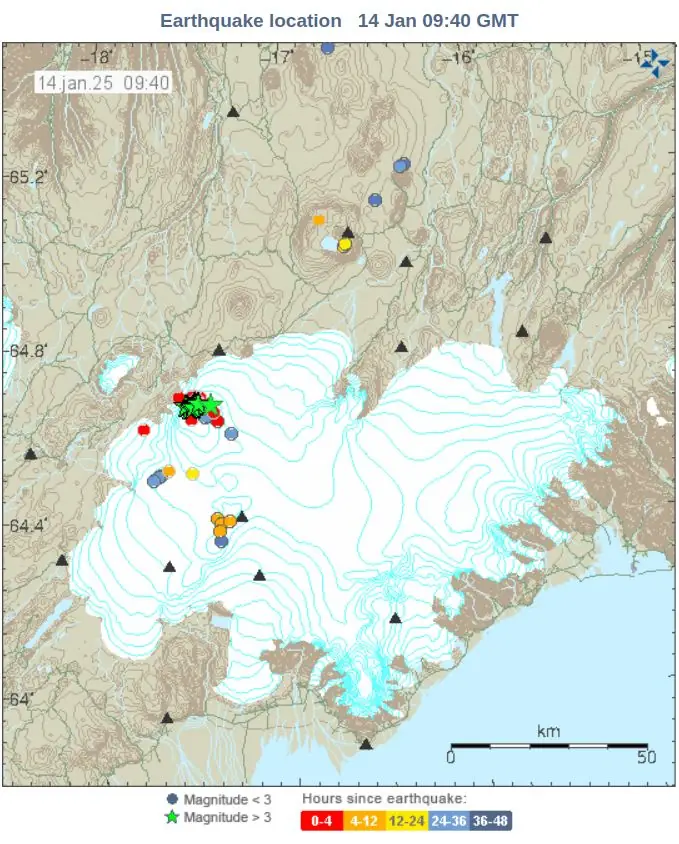
The large central volcano of Bárðarbunga lies beneath the northwestern part of the Vatnajökull icecap, northwest of Grímsvötn volcano, and contains a subglacial caldera 700 m (2 297 feet) deep.
Related fissure systems include the Veidivötn and Trollagigar fissures, which extend approximately 100 km (62 miles) southwest to near Torfajökull volcano and 50 km (31 miles) northeast to near Askja volcano, respectively.
Voluminous fissure eruptions, including one at Thjorsarhraun that produced the largest known Holocene lava flow on Earth with a volume exceeding 21 km³ (5 cubic miles), have occurred throughout the Holocene and into historical times from the Veidivötn fissure system. The last major eruption of Veidivötn, in 1477, also produced a large tephra deposit.
The subglacial Loki-Fögrufjöll volcanic system to the southwest is also part of the Bárðarbunga volcanic system and contains two subglacial ridges extending from the largely subglacial Hamarinn central volcano: the Loki ridge trends northeast, and the Fögrufjöll ridge trends southwest.
Jökulhlaups (glacier-outburst floods) from eruptions at Bárðarbunga potentially affect drainages in all directions.
Notably, a small glacial outburst flood started at Grímsvötn volcano on January 13, 2025. Grímsvatn floods have occurred almost annually since November 2021. There are examples of volcanic eruptions occurring due to pressure relief in Grímsvötn after water gushes from there. However, glacial outburst floods have occurred much more frequently without volcanic eruptions.
Read more about it:
Update
13:02 UTC, January 14
“A more detailed review of the earthquakes will be carried out and these numbers may change,” IMO specialists said.
The swarm was quite intense until around 09:00 UTC this morning when the intensity began to decrease, but tremors are still being measured in the area and it is too early to say whether the swarm is waning.
This earthquake swarm is the most powerful since the last volcanic eruptions in Bárðarbunga from 2014 to 2015 and the eruption of Holuhraun, IMO said.
The earthquake movements are consistent with the increased expansion due to magma accumulation that has been ongoing since the last volcanic eruptions in 2015.
Seismic activity has been increasing in Bárðarbunga in recent months, including four earthquakes of magnitude M5 or above in 2024. At the same time, an increased rate of deformation due to magma inflow has been observed at depth beneath Bárðarbunga.
“The activity will be closely monitored, but it is difficult to predict what the development will be at this point,” IMO said in an update.
Bárðarbunga is special in that it is an unusually large volcano, partially covered by a glacier, and many scenarios are possible.
Extensive research, including risk assessments and response plans, was conducted around the 2014-2015 wildfires, which will be useful in the event of further wildfires.
There are examples of magma tunnels forming from the caldera and volcanic eruptions occurring outside it, such as in Holuhraun in 2014-2015 and in the eruption of Gjálp in 1996.
“However, it cannot be ruled out that a volcanic eruption occurs within the caldera. If an eruption occurs under a glacier, there is a risk of ash eruptions and glacier flows under Vatnajökull, but if an eruption occurs outside the glacier, it would be a lava eruption.”
The Aviation Color Code for Bárðarbunga has been changed to Yellow, which is done when volcanoes show signs of activity that is considered to be above normal conditions.
References:
1 Earthquake swarm in Bardarbunga caldera, Iceland – IMO – January 14, 2025
2 Earthquakes in Bárðarbunga remind us of the lead-up to an eruption in Holuhraun – RUV – January 14, 2025
3 Powerful earthquake swarm in Bárðarbunga. The largest earthquake was M5.1 – IMO – January 14, 2025

I'm a dedicated researcher, journalist, and editor at The Watchers. With over 20 years of experience in the media industry, I specialize in hard science news, focusing on extreme weather, seismic and volcanic activity, space weather, and astronomy, including near-Earth objects and planetary defense strategies. You can reach me at teo /at/ watchers.news.

Mother Earth can be unpredictable. I have lived through two 6.0+ earthquakes, so far no volcanic eruptions here in the Lower 48.