
Glacial outburst flood at Grímsvötn volcano, Iceland
Seismic readings indicated the onset of a glacial outburst flood from Grímsvötn volcano on January 13, 2025. Grímsvatn floods have occurred almost annually since November 2021. There are examples of volcanic eruptions occurring due to pressure relief in Grímsvötn after water gushes from there. However, glacial outburst floods have occurred much more frequently without volcanic eruptions.

Image credit: IMO
A glacial outburst flood began on January 13 at Grímsvötn, one of Iceland’s central and highly active volcanoes situated beneath the Vatnajökull ice sheet.
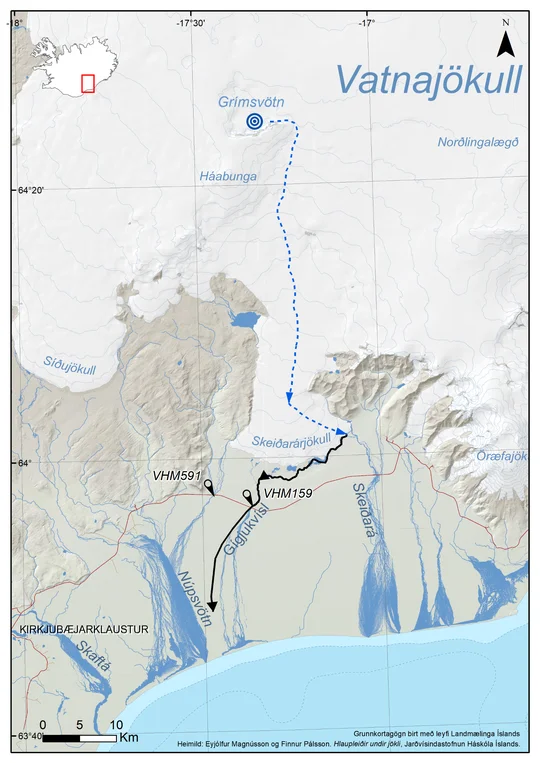
Seismic activity on Grímsvötn has been rising steadily in recent days which signaled the movement of water beneath the glacier. The floodwaters flow from Grímsvötn through Skeiðarárjökull and enter Gígjukvísl, a glacial river south of the glacier.
The turbulence graph from Grímsfjall shows consistent growth in seismic signals within the 2 to 4 Hz frequency range.
“The Institute of Earth Sciences’ GPS device on the ice shelf in Grímsvötn cannot be contacted, making it more difficult to assess how quickly the water is flowing from the lakes and down the channel under Skeiðarárjökull, but turbulence measurements on Grímsfjall provide indications of the development of the flow,” IMO noted on January 13.
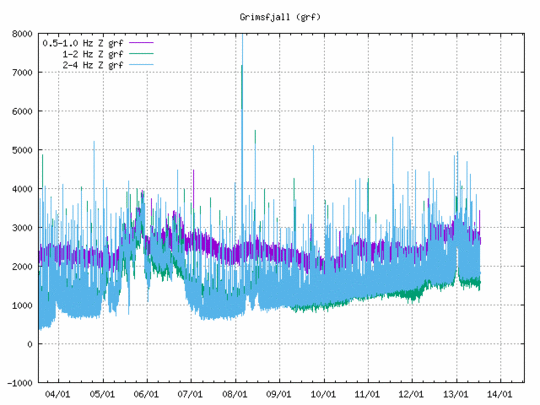
The measurements were combined with hydrological data and indicate that the glacial flood is in its early stages. The current water volume in Grímsvötn is estimated to be approximately 0.25 km3 (0.06 mi3) which is about one-third of the volume recorded before the outburst in 2021.
Past patterns suggest that peak flow rates could occur in the latter half of the week. The maximum water discharge at National Road 1 in Gígjukvísl is projected to reach approximately 1 000 m3/s (35 315 feet3/s).
Experts believe it will not pose a threat to infrastructure such as roads and bridges in the region despite the substantial flow.
Grímsvötn is known for frequent glacial outburst floods with occurrences almost every year since November 2021. Such events were less regular before this period with the last major outburst before 2021 recorded in 2018.
The floods have been associated with volcanic activity because of pressure relief caused by rapidly falling water levels. 13 floods since 2004 have occurred without subsequent eruptions. The most recent volcanic eruption at Grímsvötn took place in 2011 and was unrelated to a jökulhlaup.
The IMO has warned travelers to Vatnajökull to exercise caution near Grímsfjall as new ice cauldrons often form above the active geothermal zones. There is also a potential risk of gas pollution near the Skeiðarárjökull glacier outlet.
Seismic activity in Grímsvötn remains within normal limits for now but minor earthquakes may accompany the current flood as water pressure shifts beneath the glacier. IMO geologists and experts from the Institute of Earth Sciences are monitoring the event around the clock and will issue updates as conditions evolve.
The IMO will review if the Aviation Color Code for Grímsvötn should have any indications of volcanic activity arising during the event. Current assessments have placed the color code at Green which indicates no immediate threat to air travel.
Notably, early on January 14, a powerful earthquake swarm started under Bardarbunga caldera, located just about 30 km (18 miles) N of Grímsvötn volcano. To read more about it, visit:
Grímsvötn is Iceland’s most active volcano. It lies beneath the vast Vatnajökull ice cap in the Neovolcanic Rift Volcanic Province, with its caldera largely covered by a 200 m (656 feet) thick ice shelf and only the southern rim exposed.
Frequent geothermal activity beneath the glacier creates a subglacial lake leading to periodic jökulhlaups or glacial outburst floods as rising water levels breach the ice dam.
Grímsvötn’s eruptive history spans over 8 000 years with 76 confirmed eruptions during the Holocene period. The eruptions often originate from fissures extending from the central caldera including the Laki fissure which produced the largest known historical lava flow in 1783.
The event released 15 km3 (3.6 mi3) of basaltic lava over 7 months devastated Iceland’s agriculture and caused a famine that killed one-fifth of the population.
Grímsvötn has a documented history of 20 eruptions in the last 200 years. The most recent eruption occurred in May 2011 which reached a Volcanic Explosivity Index (VEI) of 4 characterized by explosive activity and sulfur dioxide (SO2) emissions.
Other notable eruptions include those in 2004, 1998, and 1996, often accompanied by jökulhlaups. The volcano’s setting within a rift zone atop oceanic crust under 15 km (9.3 miles) thick enhances its frequent activity making it a critical site for studying the interactions between glacial and volcanic systems.
References:
1 Grímsvatn flood begins – IMO – January 13, 2025
2 Grímsvötn – GVP – Accessed on January 13, 2025
3 Powerful earthquake swarm begins in Bardarbunga caldera, Iceland – The Watchers – January 14, 2025

Rishika holds a Master’s in International Studies from Stella Maris College, Chennai, India, where she earned a gold medal, and an MCA from the University of Mysore, Karnataka, India. Previously, she served as a Research Assistant at the National Institute of Advanced Studies, Indian Institute of Science, Bengaluru, India. During her tenure, she contributed as a Junior Writer for Europe Monitor on the Global Politics website and as an Assistant Editor for The World This Week. Her work has also been published in The Hindu newspaper, showing her expertise in global affairs. Rishika is also a recipient of the Women Empowerment Award at the district level in Haryana, India, in 2022.

Commenting rules and guidelines
We value the thoughts and opinions of our readers and welcome healthy discussions on our website. In order to maintain a respectful and positive community, we ask that all commenters follow these rules.