
Steady uplift in Svartsengi raises likelihood of magma intrusion by late November, Iceland
With the end of October, uplift and magma accumulation continued steadily in Iceland’s Svartsengi volcanic region, increasing the likelihood of an intrusion or possible eruption toward late November. Seismic activity near the Sundhnúkar crater remains low, with only minor daily tremors recorded.
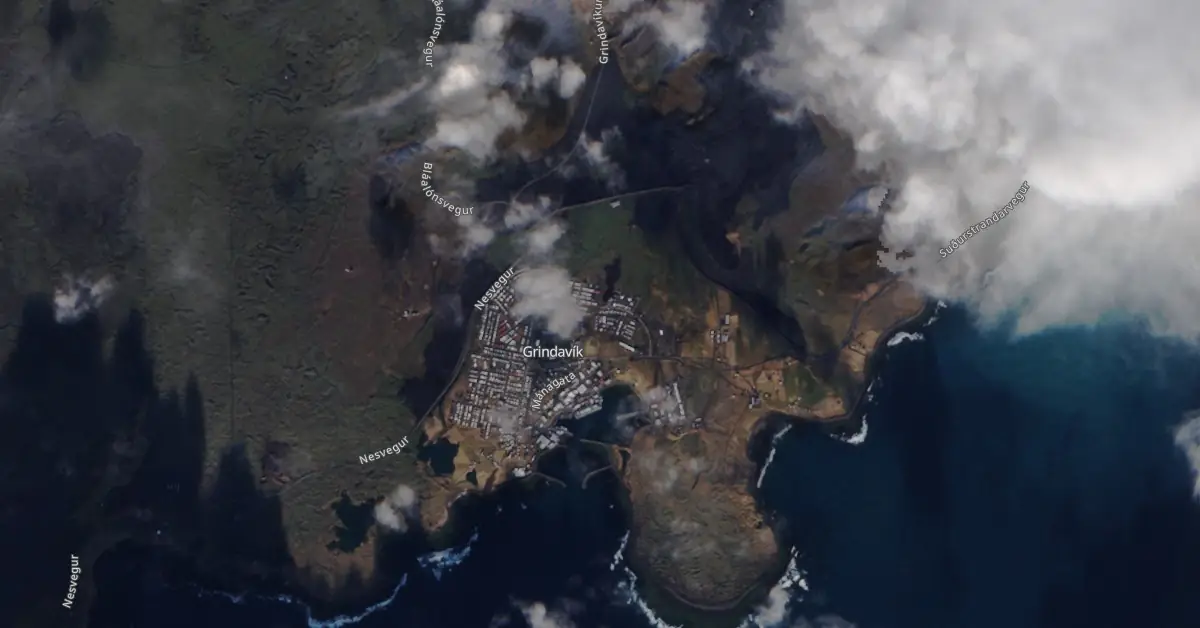
Satellite image of Grindavik, Iceland on October 20, 2024. Credit: Copernicus EU/Sentinel-2, EO Browser, The Watchers
Magma accumulation in the Svartsengi area has shown consistent levels of uplift over recent weeks, indicating a gradual buildup in the magma reservoir beneath the site.
This slow but steady uplift is accompanied by minimal seismic activity around the Sundhnúkar crater row, with only minor quakes detected each day.
Monitoring agencies are closely observing the area to determine the likelihood of a potential eruption as magma volumes approach estimated thresholds that may prompt an event.
Based on updated model calculations and deformation data collected from GPS stations near Svartsengi, the IMO reports an increased probability of new magma intrusion as late November approaches.
This increase is contingent on continuous uplift at the current rate.
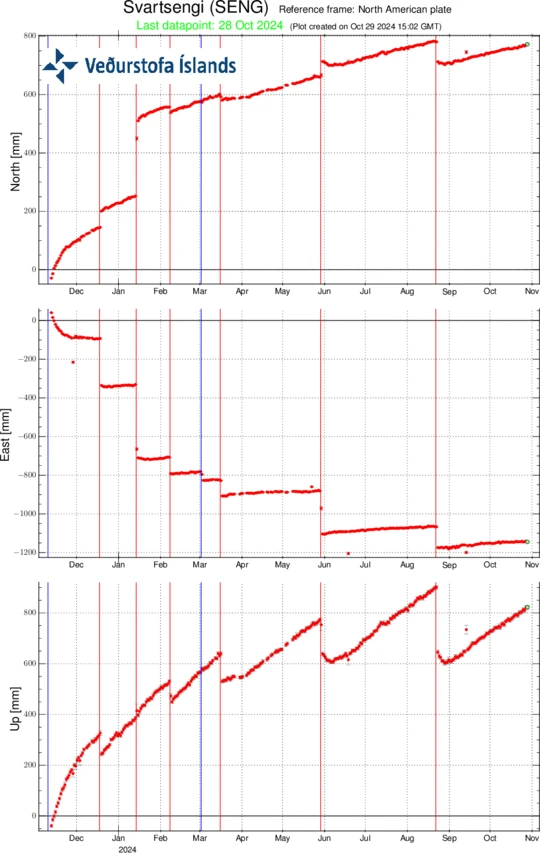
Historical analysis of past eruptions and intrusions in the area provides a framework for assessing the amount of magma required to trigger the next event.
In previous cases, seismic activity in the area northwest of Grindavík intensified in the weeks preceding eruptions, signaling a rise in pressure in the magma reservoir. Should this pattern of increased seismic activity reappear, it may indicate a similar escalation in the lead-up to an event in Svartsengi.
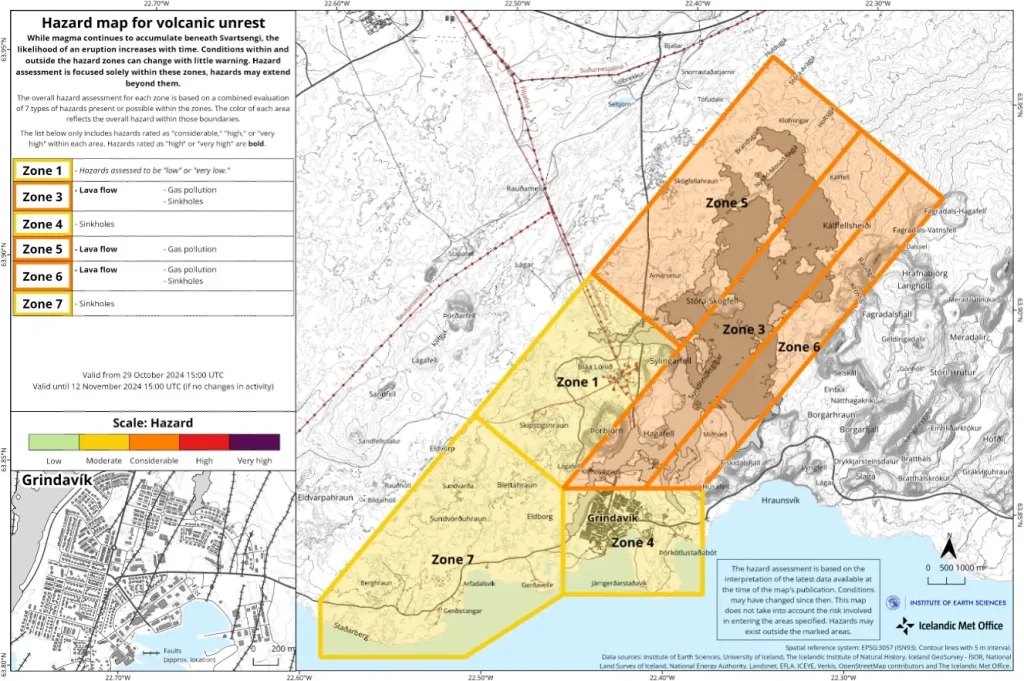
The IMO’s current hazard assessment will remain unchanged through November 12, 2024, barring significant shifts in activity levels. Further updates will be made in response to any notable changes in uplift or seismicity trends.
Svartsengi is a volcanic area within the Reykjanes volcanic system — part of a series of four interconnected fissure systems aligned NE-SW across the Reykjanes Peninsula.
Svartsengi shares the same tectonic setting along the Mid-Atlantic Ridge, with the characteristic volcanic activity of the Reykjanes system, including basaltic eruptions along fissure rows and frequent geothermal activity.
Svartsengi is also notable for its geothermal reservoir, which has been harnessed for energy production, supplying geothermal energy to Iceland’s Blue Lagoon and nearby areas.
References:
1 Uplift and Magma Accumulation Continue in Svartsengi at a Steady Rate – IMO – October 29, 2024

Teo Blašković founded The Watchers in 2011 and edited it until 2026, covering seismic and volcanic activity, extreme weather, space weather and near-Earth objects. Articles on this page are his archive.
More reporting
- Extreme weather exposes weak points in global oil and natural gas shipping, IEA finds
- Projected high landslide-susceptibility area roughly doubles in Tehri Garhwal by late century
- Hotter summers could deepen aircraft takeoff weight restrictions at Euro-Mediterranean airports
- WMO expands El Niño preparedness as event nears late-2026 peak
