
United States sees record-breaking 24 billion-dollar weather disasters in 2024, with 418 fatalities
The United States experienced a record-breaking 24 “billion-dollar” weather and climate disasters thus far in 2024, each incurring significant economic damage and resulting in the loss of 418 lives. This year’s toll greatly exceeds the long-term annual average of 8.5 events recorded between 1980 and 2023 and surpasses the recent five-year average of 20.4 events.

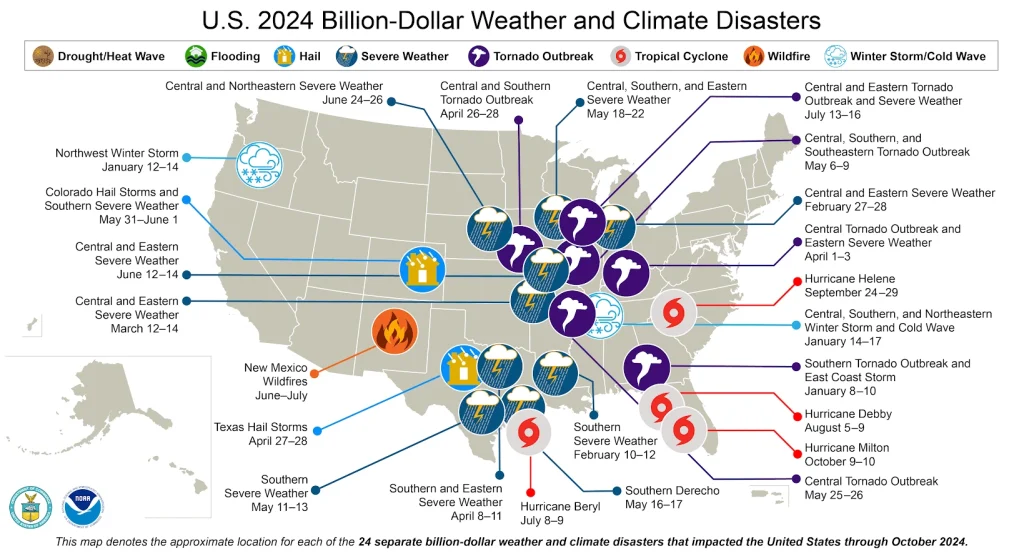
Map showing all 24 "billion-dollar" disaster events in United States, as of November 2024. Image credit: NOAA
According to the National Oceanic and Atmospheric Administration (NOAA), as of November 2024, the U.S. has experienced 24 climate and weather disaster events, each resulting in economic losses exceeding USD 1 billion.
Among these billion-dollar disasters, 17 were severe storms, four were tropical cyclones, one was a wildfire, and two were winter storms.
These disasters claimed 418 lives and caused damages totaling approximately USD 61.6 billion, nearly matching the annual average from 1980 to 2023 of USD 62 billion.
The average number of billion-dollar disaster events per year from 1980 to 2023 was 8.5, with the average for the past five years (2019 – 2023) rising to 20.4 events annually. This makes 2024 a record-breaking year in terms of billion-dollar disasters, with two full months still to go.
Since 1980, including 2024, the U.S. has experienced 400 such billion-dollar disasters, with total losses exceeding USD 2.785 trillion.

The National Centers for Environmental Information (NCEI), part of NOAA, plays a central role in tracking severe weather and climate events across the United States.
As the nation’s primary source for climate and weather-related data, NCEI compiles extensive datasets to assess the economic and societal impacts of these disasters. Billion-dollar disaster counting in the United States started in 1980.
Based on this dataset, and according to available data as of October 30, the costliest disaster in 2024 was the “Central, Southern, Southeastern Tornado Outbreak,” which incurred an estimated USD 6.6 billion in damages. This event, occurring in May, generated an extensive tornado outbreak across central, southern, and southeastern U.S. states, including Oklahoma, Kansas, and Nebraska.
The event produced over 165 tornadoes, including high-intensity EF-3 and EF-4 classifications, which caused widespread destruction to homes, businesses, and infrastructure. In Oklahoma, towns like Barnsdall and Bartlesville were particularly hard-hit by violent EF-4 tornadoes, leading to substantial losses.
The next costliest event, the “Central and Southern Severe Weather,” took place in March, resulting in approximately USD 6.0 billion in damages.
This severe weather system affected numerous states, including Kansas, Oklahoma, and Missouri, where hail, high winds, and tornadoes caused substantial damage to buildings and vehicles. Ohio was also impacted, with an EF-3 tornado striking the northwestern region, contributing to the economic and infrastructural damage toll.
Hurricane “Helene” ranks as one of the most destructive hurricanes in 2024, with its full economic cost yet to be confirmed but expected to be substantial. Helene struck Florida’s Big Bend region in September as a Category 4 hurricane with 225 km/h (140 mph) winds.
Helene’s impact extended far beyond landfall, triggering catastrophic flooding across western North Carolina, southwestern Virginia, and eastern Tennessee. In North Carolina, rainfall totals exceeded 762 mm (30 inches), surpassing historic flood records set in 1916. The flooding, along with associated landslides and debris flows, destroyed homes, businesses, and critical infrastructure, making Helene one of the deadliest storms since Hurricane “Katrina,” with 225 recorded fatalities.
Hurricane “Beryl,” another high-impact storm, made landfall in Texas in July, causing USD 7.2 billion in damages. Beryl’s landfall brought intense winds, leading to widespread power outages that affected millions. Eastern Texas, Louisiana, and Arkansas experienced over 50 tornadoes spawned by Beryl’s passage, compounding the destruction.
Significantly, Beryl was the earliest Category 5 hurricane recorded in the Atlantic in July, intensifying the storm’s unprecedented impact on the Gulf Coast.
In May, “Central, Southern, and Eastern Severe Weather” led to losses totaling USD 4.9 billion, impacting states from Nebraska to Wisconsin. An EF-4 tornado with peak winds of 300 km/h (185 mph) struck Iowa, carving a 70 km (44 miles) path and leaving extensive damage in its wake. Several states experienced high wind and hail damage during this multi-day event, further adding to the losses.
The “Central Tornado Outbreak” followed shortly after, bringing USD 3.4 billion in damages and resulting in 16 fatalities. Over 110 tornadoes tore through central states like Missouri, Texas, and Illinois, including an EF-3 tornado that cut through Montague, Cooke, and Denton counties in Texas, with winds reaching 225 km/h (140 mph). This outbreak caused extensive damage to homes, businesses, and agricultural assets.
In Colorado, “Severe Hail Storms and Southern Severe Weather” in May resulted in USD 3.0 billion in damages, with no fatalities reported. Eastern Colorado experienced some of the largest hail recorded this year, with golf ball- to baseball-sized hail causing considerable damage to property and infrastructure. Southern regions, particularly in Texas, also faced high wind damage.
The “Southern Tornado Outbreak and East Coast Storm” in January inflicted damages of USD 2.7 billion and resulted in three fatalities. This event included at least 39 tornadoes, with the most intense tornado, an EF-3, striking Panama City Beach, Florida. The storm’s impact extended up the East Coast, with widespread wind damage affecting multiple states.
April’s “Southern and Eastern Severe Weather” produced widespread impacts across Texas, Louisiana, Mississippi, Alabama, and Florida. This severe weather outbreak, which resulted in USD 2.7 billion in damages, included hail, tornadoes, and high winds that caused significant damage to Gulf Coast communities.
Hurricane “Debby” was another billion-dollar event in 2024, with damages totaling USD 2.5 billion. Debby, a Category 1 hurricane, made landfall in Florida in August, bringing heavy rain and strong winds. Its remnants traveled up the East Coast, resulting in flash floods and property damage as far north as New York. Debby’s impact was felt across multiple states, underscoring the far-reaching consequences of even lower-category hurricanes.
In July, a “Central and Eastern Tornado Outbreak and Severe Weather” caused USD 2.4 billion in damages across multiple states, including Illinois and New York. This outbreak produced 79 tornadoes, with the Chicago area experiencing a record 32 tornadoes in a single day.
The “Texas Hail Storms” in May inflicted USD 2.3 billion in damage, particularly impacting Dallas and Houston, where softball-sized hail damaged buildings, vehicles, and infrastructure. In April, another “Central and Eastern Severe Weather” event caused USD 2.4 billion in damages, marked by 85 tornadoes that impacted the Ohio River Valley.
A “New Mexico Wildfire” in June resulted in USD 1.7 billion in damages, with the South Fork Fire near Ruidoso destroying over 1 000 structures. Additional severe storms and hail events, such as the “Central and Northeast Severe Weather” in June and the “Colorado Hail Storms” in May, each caused over USD 1 billion in losses across multiple states.
Winter storms also contributed to the year’s toll, including a “Central, Southern, Northeastern Winter Storm and Cold Wave” in January, which caused USD 1.9 billion in damages and claimed 41 lives, as well as a “Northwest Winter Storm” in January that led to USD 1.7 billion in damages and 20 fatalities due to freezing rain and high winds across Oregon and Washington.
References:
1 Billion-Dollar Weather and Climate Disasters – NOAA – Accessed on October 29, 2024.

I am an Assistant Editor and Severe Weather & Science Journalist at The Watchers, specializing in real-time severe weather coverage, geophysical event reporting, and research-driven scientific analysis. You can reach me at rishav(at)watchers(.)news.

Boots on the ground report in North Carolina.
One coroners office has over 1200 bodies. Nuclear containment barrels found in debris. Cadaver dogs dying. https://www.youtube.com/watch?v=ukdvcQu9Xmg
Just the Helene devastation alone exceeds 2000 dead in NC and Tennessee. A very sad situation. Not much time left to prepare.
BRT 3:54 … Let men become brothers, as
they await the day of the Awakener. Tell me, good Master, when shall the
end be?
BRT:3:55 Jesus answered. “There will be an end to the beginning, and
men will know this by the spirit of the times. Men will no longer be as
brothers; nor will they be manly. Women will be as men and men as women.
Adultery will not be condemned, nor will fornication; therefore, these will
flourish. Men will not honour their homelands, and there will be no
discrimination among them, nor will they maintain the purity of their races.
Fathers will not be honoured, nor mothers respected, and children will be
raised to be wayward. Perversions will be encouraged, and criminals will
mock the law. There will be incest and rape and it will be unsafe to walk
abroad. Floods, famines, droughts and earthquakes will cause death and
destruction: Strange sicknesses will smite the people, and there will be a
denial of God. Babes will be slain in the womb.”
BRT:3:56 “Men will lust after the wives of other men, and marriage shall
lose its meaning. Women will go to the marriage table unchaste and with
deceit in their hearts. Their husbands, creatures of pity, will hear the mocking
voices of laughing men. Priests will defile their altars with their impurity, and
the rulers will be held in little repute. It is not God who marks the end days,
but men who lives as though setting a pitfall for himself.”