
Earth encircled by a ring system during middle Ordovician period
Earth may have had a ring system during the middle Ordovician period, approximately 466 million years ago. According to researchers, the ring formed when a massive asteroid came within Earth’s Roche limit and broke apart.
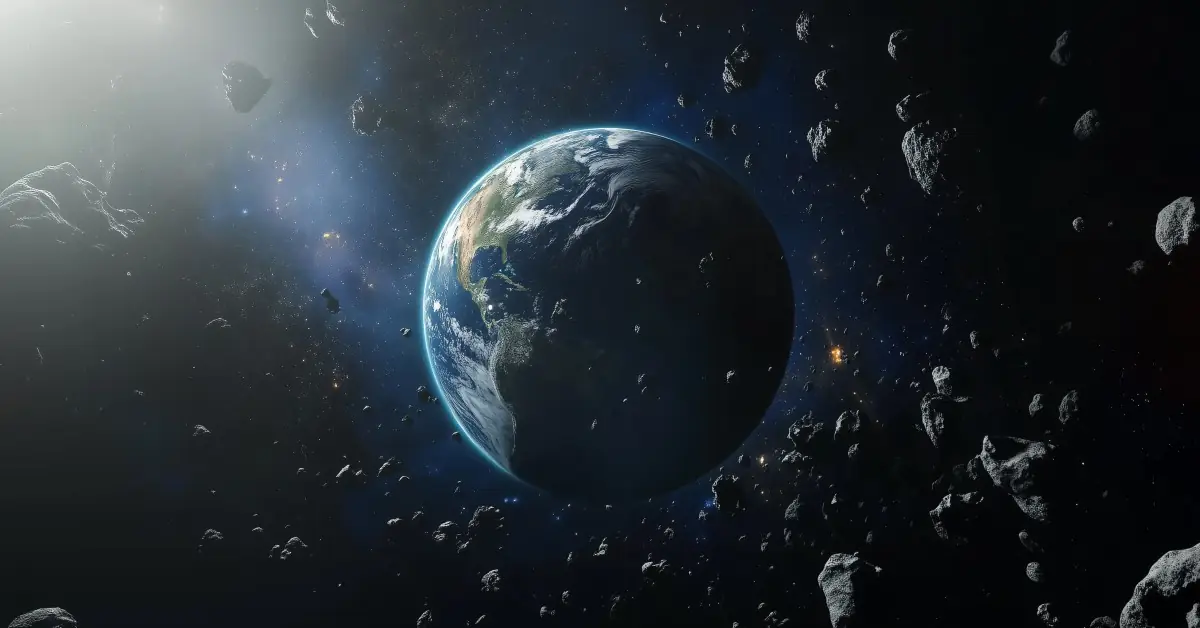
Image credit: TW
- Evidence included a band of impact craters focused near the equator, which could have been caused by ring material slowly falling to Earth.
- The ring’s shadowing effect may have induced global cooling, contributing to the commencement of the Hirnantian Icehouse period, one of Earth’s coldest.
According to a study conducted by researchers from Monash University, Earth may have had a ring system developed 466 million years ago due to the breakup of a big L chondrite asteroid that passed close to the planet. The asteroid that got too close to Earth would have broken apart and formed a debris ring after passing through the planet’s Roche limit.
This ring could have gradually disintegrated over millions of years, causing increased impacts on Earth’s surface known as the Ordovician impact spike. This time period is notable for the meteorite bombardment and the Great Ordovician Biodiversification Event (GOBE), a significant period of evolutionary expansion.
“Over millions of years, material from this ring gradually fell to Earth, creating the spike in meteorite impacts observed in the geological record,” said lead study author Professor Andy Tomkins. “We also see that layers in sedimentary rocks from this period contain extraordinary amounts of meteorite debris.”
During the Ordovician epoch, the craters connected with this impact spike were primarily located near the equator. This comprises portions of present-day North America and Europe. Interestingly, researchers discovered that all of these craters were within 30 degrees of the ancient equator, even though more than 70% of the Earth’s crust was outside this zone at the time. The pattern of strikes is highly concentrated in these equatorial regions, challenging conventional asteroid impact theories and pointing to a more local source of debris.
The scientists’ hypothesis is based on evidence such as an increase in L chondrite debris found in sedimentary strata and a high concentration of craters from the same period around the ancient equator. In 2024, the researchers published their findings in the journal Earth and Planetary Science Letters, linking meteorite strikes to geological records and ancient climate change.
Andrew G. Tomkins, along with Erin L. Martin and Peter A. Cawood of the School of Earth, Atmosphere and Environment, Monash University has offered this new theory concerning Earth’s early history. Their study, which looked at impact cratering during the Ordovician period, revealed that a ring system like Saturn’s may have rung Earth.
The localized nature of the impact craters is an essential factor in this idea. Commonly, asteroid strikes spread randomly throughout the planet. This implies that the debris that caused the impacts came from a nearby source—possibly a ring system that eventually rained meteorites down onto the Earth.
Furthermore, the researchers believe the ring may have had substantial climate ramifications, casting a shadow that contributed to global cooling during the Hirnantian Icehouse period, one of the coldest in Earth’s history.
“We suggest that the ~8℃ of global cooling for this period could be used to calculate how much of the Sun’s energy was blocked by the ring and how diffuse the ring was. Furthermore, the dissipation of a ring would cease the cooling effect and cause global warming back to typical global temperatures, and we suggest that this might explain the rapid warming from 444 to 437 Ma. The average global temperature curve might thereby date the duration of the ring (which would be ~22 m.y.), and this could be tested through climate modeling,” the researchers concluded.
References:
¹ Evidence suggesting that Earth had a ring in the Ordovician – Andrew G. Tomkins, Erin L. Martin, Peter A. Cawood – Earth and Planetary Science Letters, Volume 646, 2024, 118991, ISSN 0012-821X – November 15, 2024 – https://doi.org/10.1016/j.epsl.2024.118991
² Earth may have had a ring system 466 million years ago – Silvia Dropulich – Monash University – September 16, 2024

Harsha Borah is an experienced content writer with a proven track record in the industry. Harsha has worked with LitSpark Solutions and Whateveryourdose, honing skills in creating engaging content across various platforms. A gold medalist in a state-level writing competition organized by Assam Tourism, Harsha’s travelogue on Tezpur was widely appreciated. Harsha’s article, "The Dark Tale of the Only Judge in India to Be Hanged," ranks second on Google and has garnered over 11 000 views and 8 900 reads on Medium. Outside of writing, Harsha enjoys reading books and solving jigsaw puzzles.

Commenting rules and guidelines
We value the thoughts and opinions of our readers and welcome healthy discussions on our website. In order to maintain a respectful and positive community, we ask that all commenters follow these rules.