
Staircase pattern discovered in Earth’s rotational deceleration evolution
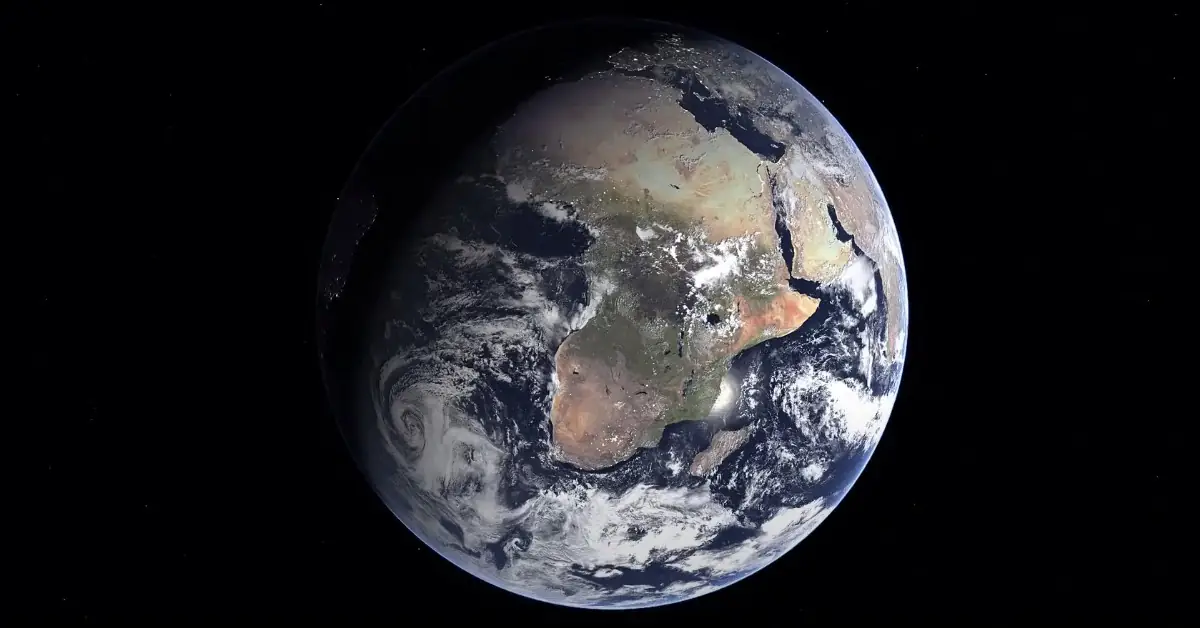
Image credit: Martin Kornmesser, Luis Calcada, NASA, ESA/Hubble
Researchers discovered that Earth’s rotational slowing occurs in a staircase pattern rather than a flat drop. This pattern, discovered after intensive geological and astronomical investigation, shows alternating periods of stability and fast change in Earth’s rotation over the last 650 million years.
- The study, led by He Huang of Chengdu University of Technology, examined Earth’s rotational history using sediment samples and cyclostratigraphy data, identifying two important stable periods that coincided with significant evolutionary and environmental events.
- The findings, published in August 2024 in the Journal of Geophysical Research and Proceedings of the National Academy of Sciences, shed light on how tidal dissipation and other forces shaped Earth’s rotation, with implications for future changes in day length, ocean currents, and planetary dynamics.
He Huang, a geoscientist from the Chengdu University of Technology led a team of researchers to study the Earth’s rotating history. The research also included collaboration with worldwide geodynamics, geology, and planetary science experts. Their research has provided new information into the intricate systems that drive Earth’s rotation.
The study found that the Earth’s rotation decelerated in a staircase pattern rather than a smooth, continuous process. This pattern was discovered after an extensive investigation of geological records, tidal forces, and other astronomical data. The Earth’s rotation, which has steadily slowed over millions of years, alternates between periods of stability and rapid fluctuations, suggesting a “staircase” rather than a smooth slope.
The researchers examined sediment samples stretching back more than a half-billion years and discovered two unusually stable periods that coincided with key evolutionary and environmental events.
The findings were published in the August 2024 issue of the Proceedings of the National Academy of Sciences. The study lasted several years, during which the researchers methodically examined geological and astronomical data stretching back 650 million years. The timing of the study was especially pertinent, considering the growing scientific interest in comprehending Earth’s dynamic systems in the face of present environmental change.
Understanding the slowing of the Earth’s rotation is critical for a variety of reasons. First, it gave information about the planet’s long-term geological and climatic history. Factors influencing Earth’s rotation include the Moon’s gravitational pull and the redistribution of mass caused by melting glaciers and moving tectonic plates.
The study’s discovery of a staircase pattern of deceleration aids scientists in better understanding the interconnections of these forces and their role in forming Earth’s past and present. The research team also discovered that during the period under study, the Moon was around 20,000 km (12,427 miles) further from Earth than it is today, and Earth days were about 2.2 hours longer.
Additionally, the results have consequences for the future. As the Earth’s rotation slows, although intermittently, it may alter day duration, ocean currents, and weather systems. The findings have far-reaching implications for understanding the rotational dynamics of other planets in our solar system and beyond.
“Astronomically forced climate change is recorded in the Earth’s cyclic sedimentary record (“cyclostratigraphy”). These records can inform on past dynamics of the Solar system and Earth’s rotation. Here, we reconstruct the evolution of Earth’s rotational deceleration during the Paleozoic Era based on a new analysis of selected high-quality cyclostratigraphy datasets. A staircase pattern in deceleration from 650 to 280 Mya is identified and attributed to the occurrence of tidal dissipation resonance,” the researchers stated.
To reconstruct the history of Earth’s rotation, the researchers used a multidisciplinary approach that included geological records, tidal data, and computer simulations. They examined eight geological datasets accumulated over decades, spanning the era from 280 to 650 million years ago.
The study also looked at the gravitational interactions between Earth and the moon. Previous studies have demonstrated that Earth’s axial spin is decreasing primarily due to tidal dissipation—the dissipation of orbital and rotational energy as heat in the planet’s surface water, interior, or Moon.
However, this analysis discovered that the staircase pattern deceleration was evident in two prominent steady phases occurring during significant events in Earth’s history: the Cambrian explosion and the largest known mass extinction. These data indicate that the times following the two slowdowns may have been more than coincidental.
“Modeling indicates that, except for the very recent time, tidal dissipation is the main driver for decelerating Earth rotation. One potential implication of our findings is that the Earth’s tidal dissipation, along with Earth’s rotation deceleration, may play a role in the evolving Earth,” the researchers concluded.
References:
¹ Geological evidence reveals a staircase pattern in Earth’s rotational deceleration evolution – He Huang et al. – Proceedings of the National Academy of Sciences (2024) – August 6, 2024 – https://doi.org/10.1073/pnas.2317051121 – OPEN ACCESS

Harsha Borah is an experienced content writer with a proven track record in the industry. Harsha has worked with LitSpark Solutions and Whateveryourdose, honing skills in creating engaging content across various platforms. A gold medalist in a state-level writing competition organized by Assam Tourism, Harsha’s travelogue on Tezpur was widely appreciated. Harsha’s article, "The Dark Tale of the Only Judge in India to Be Hanged," ranks second on Google and has garnered over 11 000 views and 8 900 reads on Medium. Outside of writing, Harsha enjoys reading books and solving jigsaw puzzles.

Commenting rules and guidelines
We value the thoughts and opinions of our readers and welcome healthy discussions on our website. In order to maintain a respectful and positive community, we ask that all commenters follow these rules.