
Vigorous steaming at White Island volcano, New Zealand

Image credit: GeoNet
Vigorous steaming was observed at the Whakaari / White Island volcano on July 3, 2024. The steaming increased during the morning hours (LT) and is now more visible from the coast.
New Zealand’s GeoNet said this activity is not unexpected, as the volcano remains in a heightened state of unrest.
The Volcanic Alert Level remains at 2 (moderate to heightened volcanic unrest). Under this level, an eruption may occur at any level, and levels may not move in sequence as activity can change rapidly.
Eruption hazards depend on the volcano and eruption style and may include explosions, ballistics, pyroclastic density currents, lava flows, lava domes, landslides, ash, volcanic gases, lightning, lahars, tsunamis, and/or earthquakes.
The Aviation Color Code is Yellow. This is currently the only volcano in New Zealand with a color code above Green.


The latest Volcanic Activity Bulletin for White Island was released on June 5, 2024, following close monitoring of the volcano since its most recent eruption on May 25.
Analysis of data collected during the gas flight on May 31 showed the volcano continued to emit elevated levels of magmatic gas compared to observations prior to the eruptions in May.
“In particular, emissions of sulfur dioxide (SO2) are at some of the highest levels since measurements began at Whakaari/White Island in 2003. The measured gas compositions indicate that magma (molten rock) is degassing beneath the volcano,” GeoNet said.
Satellite imagery captured on May 27 showed there has been no significant ground deformation in the crater, indicating that magma is not accumulating in the shallow subsurface.

A powerful explosive eruption on December 9, 2019, claimed the lives of 22 people (visitors and tourist guides) of nearly 50 who were on the volcano when the eruption took place, at 14:11 LT.
The eruption removed the crater lake, formed new vents and generated landslides into the active crater area.
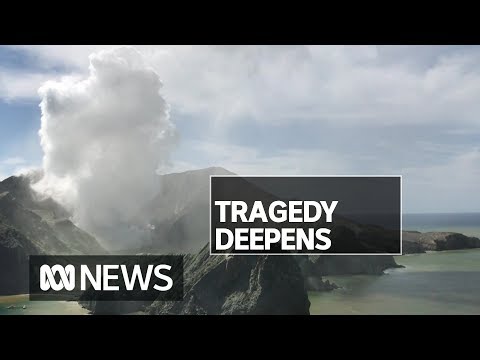
White Island, officially named Whakaari/White Island, is New Zealand’s most active volcano. It is located in the Bay of Plenty, approximately 50 km (31 miles) offshore of North Island, New Zealand.
This uninhabited island is the emergent summit of a submarine volcano that measures 10 x 11 miles (16 x 18 km), with the island itself being 1.2 x 1.5 miles (2 x 2.4 km). The volcanic structure comprises two overlapping andesitic-to-dacitic stratovolcanoes.
The southeastern side of the crater opens at sea level, with recent volcanic activity focused around 1 km (0.6 miles) from the shore, near the rear crater wall.
Since 1826, documented volcanic activity has included intermittent moderate phreatic, phreatomagmatic, and Strombolian eruptions. This volcanic activity also features prominently in Maori legends.
A significant event in the island’s history occurred in 1914 when a collapse of the crater wall triggered a debris avalanche, burying buildings and workers involved in a sulfur-mining operation.
The name Whakaari/White Island combines the Maori name Te Puia o Whakaari, meaning “The Dramatic Volcano,” and the name White Island, given by Captain James Cook in 1769, referencing the island’s constant steam plume.
References:
1 Volcanic unrest continues at Whakaari/White Island. Volcanic Alert Level remains at Level 2 and Aviation Colour Code remains Yellow – GeoNet – June 5, 2024
2 Geological summary – Whakaari/White Island – GVP – Accessed July 3, 2024

Teo Blašković founded The Watchers in 2011 and edited it until 2026, covering seismic and volcanic activity, extreme weather, space weather and near-Earth objects. Articles on this page are his archive.
Published in the last 24 hours
- Flying glass cut a teacher in Russia but none of her 44 pupils, because when a meteor flashed across the sky in 2013, she told them to get under their desks Epicenter
- A South Dakota man put the widest and heaviest hailstone on US record in his freezer, and a power cut melted part of it before NOAA measured it at 8 inches across and nearly 2 pounds in 2010 Epicenter
- Black kites and brown falcons in northern Australia have been seen snatching smoldering sticks from wildfires, flying them into unburned grass and dropping them, starting new fires that send lizards, rodents and insects running straight toward the waiting birds Epicenter
- A levee protecting a highway north of San Francisco is pocked with animal burrows and only 3 feet wide in places, and a report warns this winter's El Niño could push water over the top Epicenter
