
California braces for record-breaking heat wave with temperatures over 43 °C (110 °F)

Image credit: GFS/TropicalTidbits
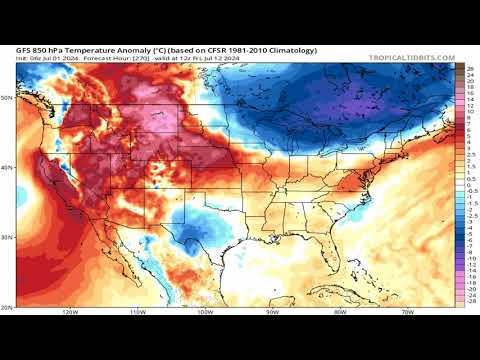
California is bracing for a potentially record-breaking heat wave during the first week of July, with temperatures expected to soar past 43 °C (110 °F) in the hottest areas. The intense heat will impact a significant portion of the state, including the Sacramento Valley, San Joaquin Valley, and parts of Southern California, Nevada, and northwestern Arizona.
Starting over the weekend and gradually intensifying, a heat dome will bring dangerously high temperatures to these regions.
The National Weather Service (NWS) has issued an Excessive Heat Warning for the Sacramento and San Joaquin valleys, and areas away from the coast from the San Francisco Bay Area through Central California, from July 2, through July 6. This warning includes Independence Day.
Excessive Heat Warnings have also been issued for interior sections of Southern California, much of southern Nevada, and far northwestern Arizona. These warnings are set to begin on July 3 or 4 and will last through late July 8. Poor air quality is also a concern, as pollutants like ozone can accumulate in the stagnant air.
The forecast predicts that some of California’s most densely populated areas will avoid the extreme heat. Cities closer to the coast, such as Oakland and San Francisco, will benefit from the cooling influence of Pacific waters, keeping afternoon temperatures between 27 °C and 32 °C (81 °F and 90 °F).
Fresno, California, is expected to be one of the hottest cities, with temperatures potentially reaching or exceeding 43 °C (110 °F) for several consecutive days.
“The forecast high of 46 °C (115 °F) in Fresno on July 6 would tie the record high from July 8, 1905,” AccuWeather Senior Meteorologist Scott Homan said.
According to the AccuWeather HeatWave Counter and Severity Index, which considers the length and intensity of heat waves in a historical context, this impending heat wave is anticipated to be significantly worse than the two heat waves in Fresno in 2023, and the one in September 2022, when temperatures climbed above 40 °C (105 °F) for nine consecutive days.
Death Valley, known for its extreme heat, holds the world record for the highest temperature ever recorded at 57 °C (134 °F), set on July 10, 1913. Temperatures could approach 54 °C (130 °F) near the end of the week, a benchmark rarely achieved in this location. Since record-keeping began in the early 1900s, the mercury has climbed to 54 °C (130 °F) only a few times: in 1913, 2020, and 2021.
According to NOAA, heat is the leading cause of weather-related fatalities in the United States, and experts are urging Californians to take precautions during this heat wave.
“Extreme caution should be taken to protect yourself from the heat and blazing sun if you have to be outside for an extended period, especially during the afternoon and early evening hours,” Anderson advised.
The heat wave will put a serious strain on California’s energy grid as residents will increase their use of air conditioning. The stagnant air associated with the high-pressure system will also lead to poorer air quality in vulnerable areas. “The higher the heat, the more pollutants in the air,” Homan said. “That will be a problem as we head into the weekend.”
California’s heat wave is part of a greater summer heat surge affecting seven western states, including Arizona, Utah, Nevada, Oregon, Washington, and Idaho. Medford, Oregon, for example, could see temperatures rise above 38 °C (100 °F) for the holiday and beyond.
References:
1 Weather Related Fatality and Injury Statistics – NWS – Accessed July 1, 2024
2 California heat wave: Temperatures to top 110 as July begins – AccuWeather – July 1, 2024
3 California to bake under ‘pretty intense’ heat wave this week – USA Today – June 30, 2024

Rishav Kothari is Editor-in-Chief of The Watchers, where he runs the newsroom and covers earthquakes, volcanoes, severe weather and space weather.
Published in the last 24 hours
- In September 1859, a solar storm lit up the night sky so brightly that gold miners in the Rocky Mountains woke up after midnight and started cooking breakfast, convinced the aurora glowing over their camp was the sunrise Epicenter
- A patch of warm Pacific water that could become the strongest El Niño in more than 70 years sits thousands of miles from any American town, yet it is already the main reason NOAA expects a wetter winter across the South and a milder one across the North
- A 19-year-old Nebraska teacher reportedly tied her pupils together with twine and led them to safety through a blizzard in January 1888 Epicenter
- NASA built the Opportunity rover to last 90 days on Mars, and Martian winds helped keep it alive for nearly 15 years by blowing dust off its solar panels, until a planet-wide dust storm in 2018 blocked sunlight and silenced the rover Epicenter
