
Shallow M6.1 earthquake hits near the north coast of Papua, Indonesia
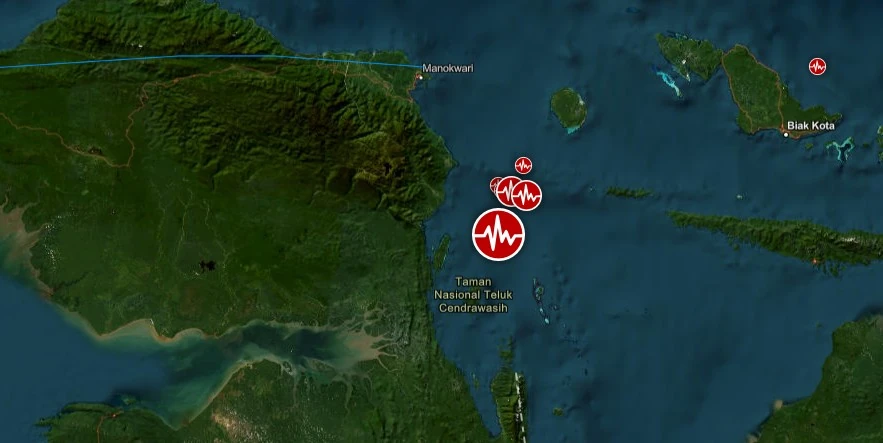
Image credit: TW/SAM, ESRI
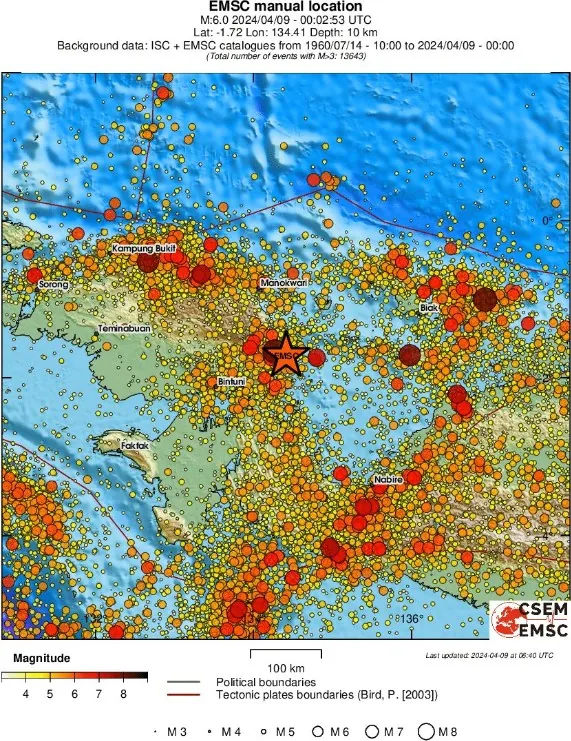
A strong and shallow earthquake registered by the BMKG as M6.1 hit near the north coast of Papua, Indonesia at 00:02 UTC (07:02 LT) on April 9, 2024. The agency is reporting a depth of 10 km (6.2 miles). USGS is reporting M6.0 at a depth of 9 km (5.6 miles); EMSC M6.0 at a depth of 10 km (6.2 miles).
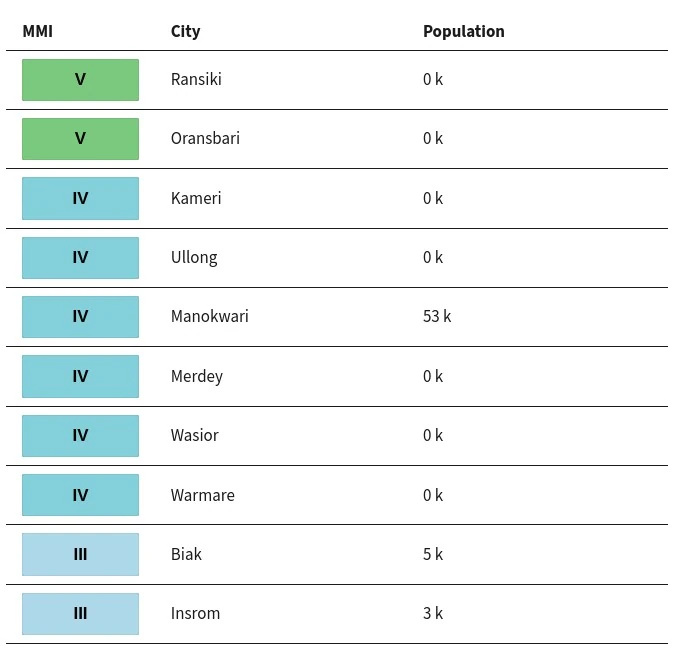
The epicenter was located 35.8 km (22.2 miles) ESE of Ransiki (population 16 245) and 100.5 km (62.5 miles) SSE of Manokwari (population 107 325), West Papua, Indonesia.
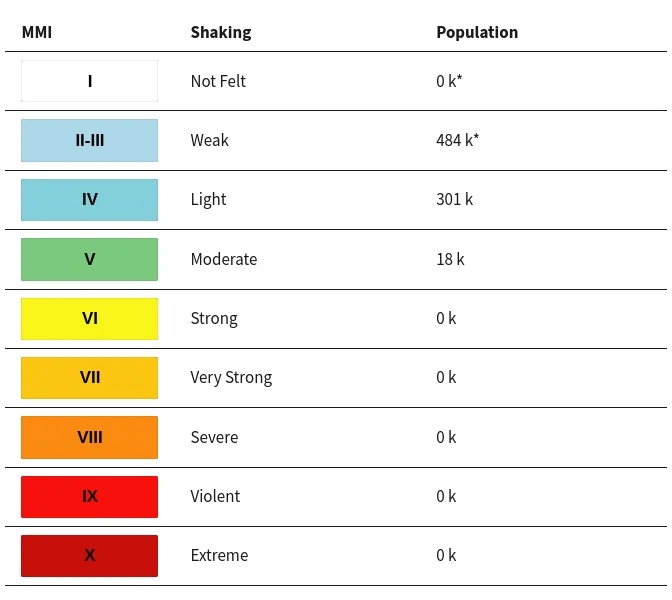
18 000 people are estimated to have felt moderate shaking and 301 000 light.
There is no tsunami threat from this earthquake.
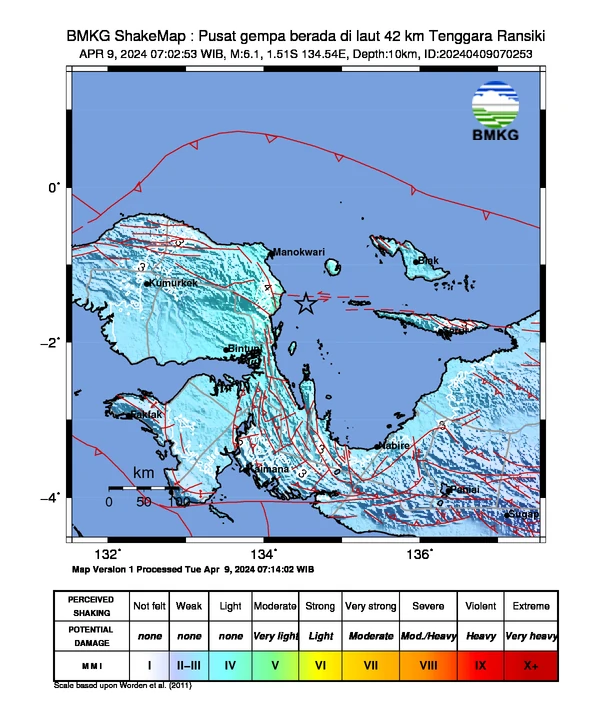
The USGS issued a Green alert for shaking-related fatalities and economic losses. There is a low likelihood of casualties and damage.
Overall, the population in this region resides in structures that are vulnerable to earthquake shaking, though resistant structures exist. The predominant vulnerable building types are unreinforced brick with concrete floor and precast concrete frame with wall construction.
Recent earthquakes in this area have caused secondary hazards such as landslides, fires, and liquefaction that might have contributed to losses.
According to the BMKG, the quake was preceded by M3.4 at 18:10 UTC on April 8 and followed by M3.9 at 00:16 UTC on April 9, M2.7 at 00:30 UTC, M3.7 at 03:43 UTC, M4.3 at 04:29 UTC and M4.9 at 05:14 UTC.
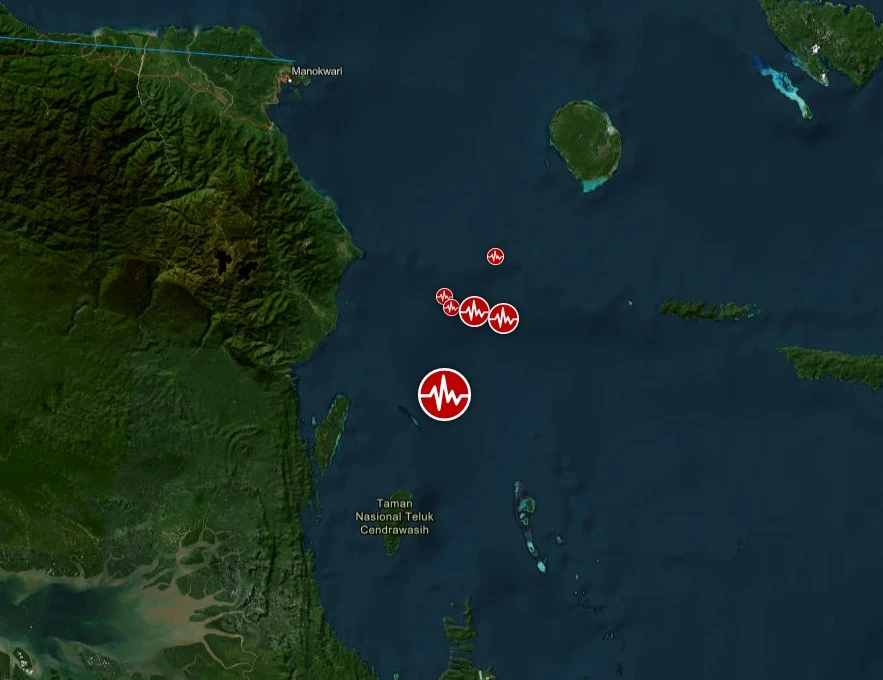
Estimated population exposure to earthquake shaking
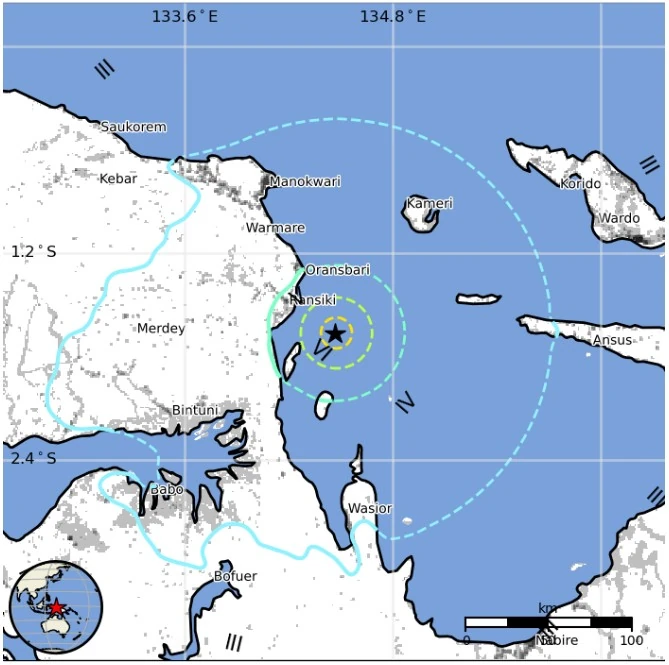
Selected cities exposed
Regional seismicity

Teo Blašković founded The Watchers in 2011 and edited it until 2026, covering seismic and volcanic activity, extreme weather, space weather and near-Earth objects. Articles on this page are his archive.
Published in the last 24 hours
- A 19-year-old Nebraska teacher reportedly tied her pupils together with twine and led them to safety through a blizzard in January 1888 Epicenter
- NASA built the Opportunity rover to last 90 days on Mars, and Martian winds helped keep it alive for nearly 15 years by blowing dust off its solar panels, until a planet-wide dust storm in 2018 blocked sunlight and silenced the rover Epicenter
- In the winter of 1811–12, earthquakes near New Madrid, Missouri, shook so hard that witnesses saw the Mississippi River flow backward, and the shaking left a brand-new lake in Tennessee Epicenter
- On 28 August 1859 a solar storm shocked telegraph operators and threw sparks on other lines, and on 2 September Boston to Portland clerks unhooked their batteries and kept sending for more than two hours on the aurora's current alone. Epicenter
