
Strong M6.1 earthquake hits near Simeulue, Indonesia
A strong and shallow earthquake registered by the USGS as M6.1 hit near Simeulue, Indonesia, at 04:56 UTC (11:56 local time) on March 3, 2026. The agency is reporting a depth of 26.2 km (16 miles). EMSC is reporting the same magnitude and depth.
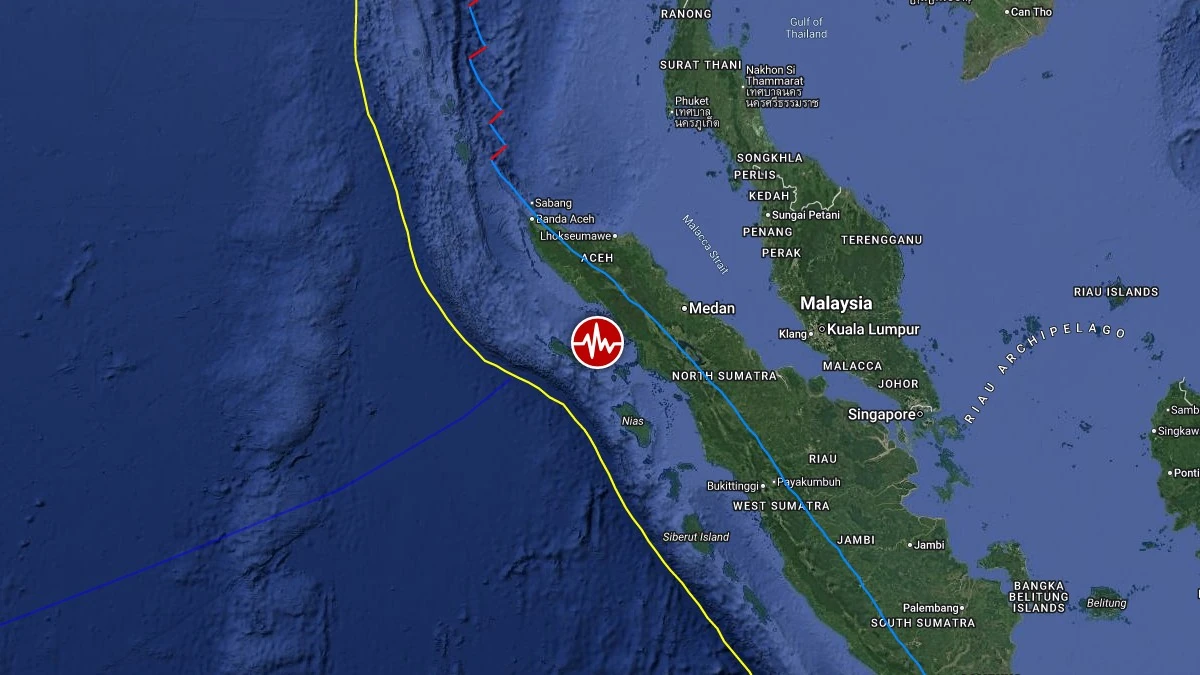
Epicenter of M6.1 earthquake in Simeulue, Indonesia on March 3, 2026. Credit: TW/SAM, Google
The epicenter was located 66 km (41 miles) SE of Sinabang (population 15 000), 116 km (72 miles) WSW of Singkil (population 46 800), and 125 km (78 miles) NW of Gunungsitoli (population 136 707), Indonesia.
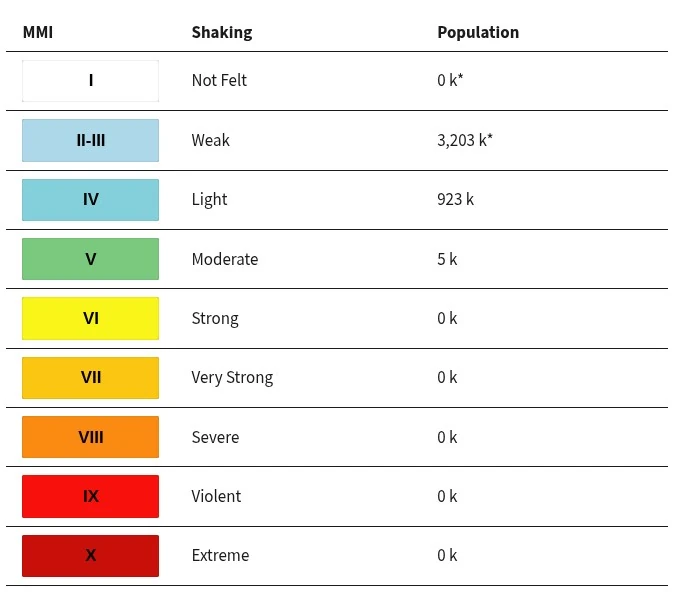
3 203 000 people are estimated to have felt weak shaking, 923 000 light, and 5 000 moderate.
There is no tsunami threat from this earthquake.
The USGS issued a Green alert for shaking-related fatalities and economic losses. There is a low likelihood of casualties and damage.
Overall, the population in this region resides in structures that are moderately resistant to earthquake shaking. The predominant vulnerable building types are reinforced concrete frames with unreinforced brick infill. No significant secondary hazards are expected from this event.
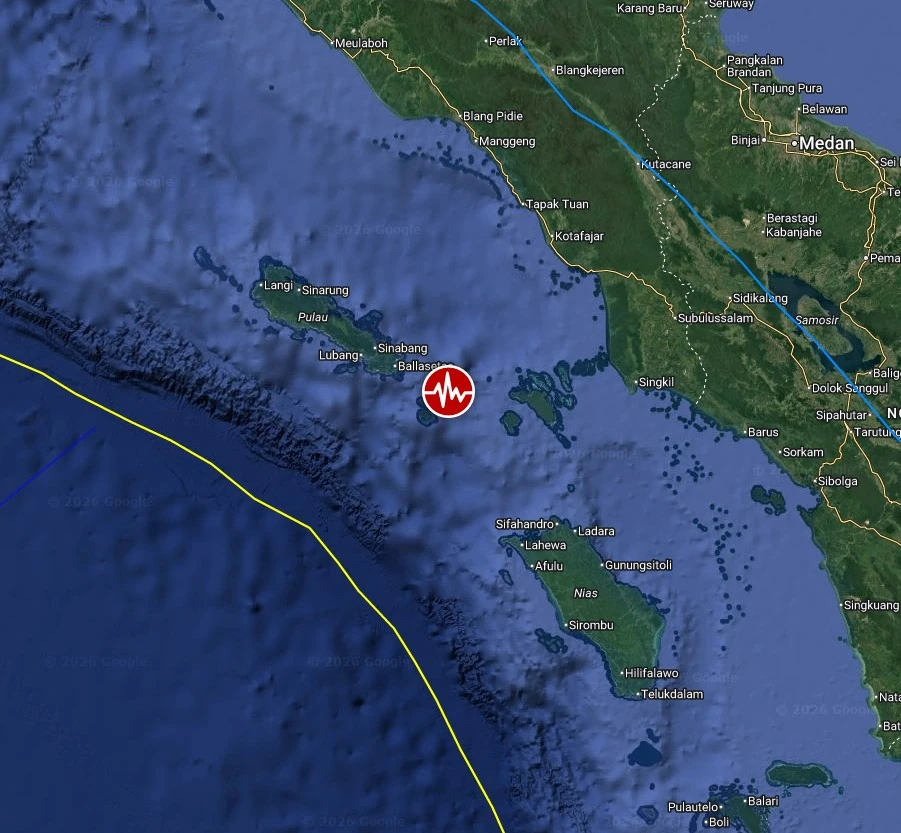
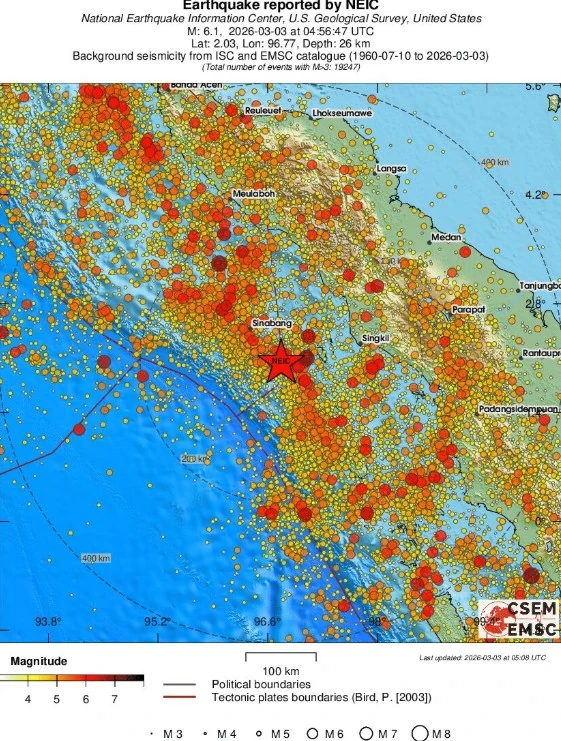
The island of Simeulue lies along one of Earth’s most active convergent plate boundaries, the Sunda megathrust, where the Indo-Australian Plate is being subducted beneath the Sunda Plate.
This subduction zone, which forms the Sumatra–Andaman arc, is part of an approximately 8 000 km (4 970 miles)-long collision system extending from Papua in the east to the Himalayan front in the west.
The convergence rate between the two plates decreases from roughly 63 mm/year (2.5 inches/year) near southern Sumatra to about 44 mm/year (1.7 inches/year) northward toward the Andaman Islands, with the motion becoming progressively more oblique to the trench.
Oblique convergence produces a combination of megathrust slip along the subduction interface and strike-slip motion on upper-plate faults, most notably the Sumatra Fault, which runs the length of the island and accommodates the lateral component of plate motion.
Most strain accumulation and release occur along the shallow portion of the Sunda megathrust, down to depths of about 60 km (37 miles), while intermediate-depth earthquakes within the subducting slab extend to roughly 300 km (186 miles) beneath Sumatra.
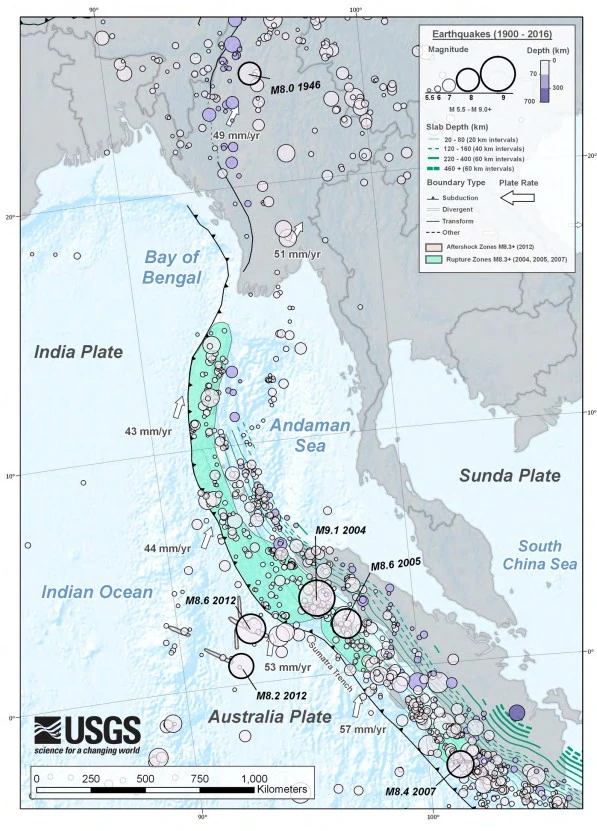
This tectonic setting has generated a long history of great earthquakes. Prior to 2004, large ruptures were documented in 1797 (M8.7–8.9), 1833 (M8.9–9.1), and 1861 (M8.5). The 2004 Sumatra–Andaman earthquake (M9.1) broke more than 1 000 km (620 miles) of the plate boundary between northern Simeulue and the Andaman region, producing a devastating trans-oceanic tsunami.
Subsequent events have filled adjacent gaps along the megathrust, including the 2005 Nias–Simeulue earthquake (M8.6), the 2007 Mentawai doublet (M8.5 and M7.9), the 2009 Padang intraslab earthquake (M7.6), and the 2010 Mentawai tsunami earthquake (M7.8).
Paleoseismic and coral-reef studies indicate that the Sunda arc has ruptured repeatedly through large events over the last millennium, with evidence of major uplifts around Simeulue between A.D. 1390 and 1455. The same tectonic regime that drives this seismicity also sustains one of the world’s densest volcanic chains, including the historically catastrophic Krakatau eruption that killed more than 35 000 people.
Estimated population exposure to earthquake shaking
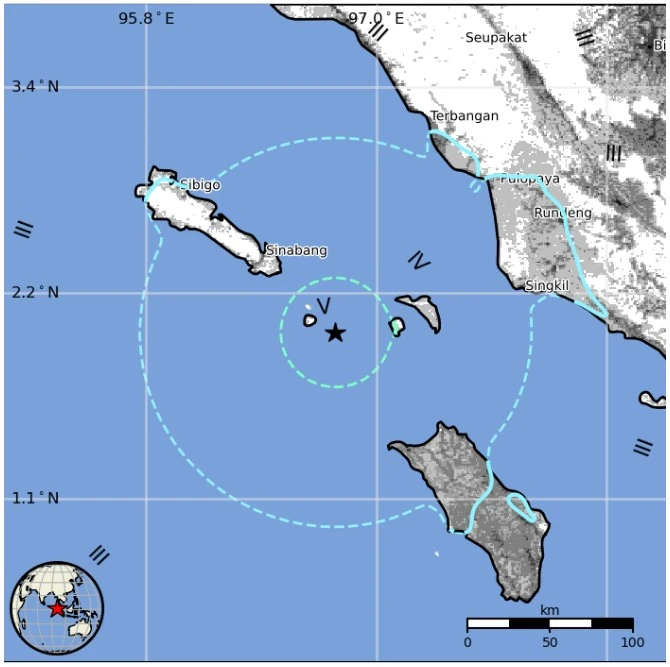
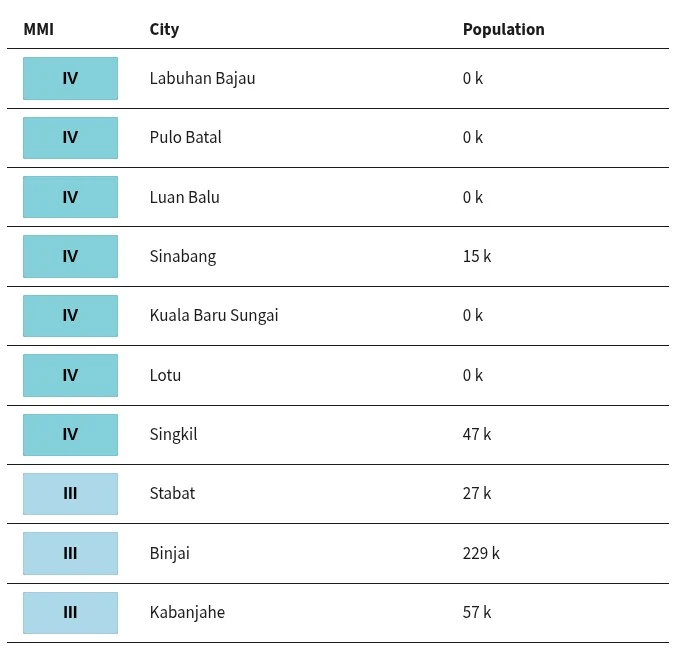
Selected cities exposed
Regional seismicity
References:
1 M6.1 earthquake Simeulue, Indonesia – USGS – March 3, 2026
2 M6.1 earthquake Simeulue, Indonesia – EMSC – March 3, 2026

I'm a dedicated researcher, journalist, and editor at The Watchers. With over 20 years of experience in the media industry, I specialize in hard science news, focusing on extreme weather, seismic and volcanic activity, space weather, and astronomy, including near-Earth objects and planetary defense strategies. You can reach me at teo /at/ watchers.news.

Commenting rules and guidelines
We value the thoughts and opinions of our readers and welcome healthy discussions on our website. In order to maintain a respectful and positive community, we ask that all commenters follow these rules.