
Severe storms in Italy produce damaging tornadoes, flash floods and landslides

Image credit: Pavanator
Severe storms hit much of Italy on Thursday and Friday, September 25, 2020, leaving widespread damage and at least one person dead.
Meteoalarm placed 7 regions on Orange alert for heavy rain and sporadic storms on September 25 – Lombardy, Friuli Venezia Giulia, Tuscany, Lazio, Campania, Basilicata and Sardinia.
On September 26, 4 regions are on Orange alert – Calabria, Basilicata, Campania and Piemonte. Yellow alert is in effect in Lazio, Molise, Abruuzzo, Marche, Emilia e Romagna, Veneto and Friuli Venezia Giulia.
Flash floods in the northern province of Varese claimed the life of one person. According to ANSA, the body of the 61-year-old runner was found in a river in Luvinate, after he went missing on Thursday, September 24.
In the city of Salerno, south of Napoli, locals recorded a giant waterspout coming ashore, uprooting trees and causing damage to vehicles and buildings.
Mayor Vincenzo Napoli said nobody was injured, adding that the worst district affected was Torrione.
It’s not even 9 AM here in Italy and we already had a landfalling waterspout in Genoa, a possible nighttime tornado and just a few minutes ago this waterspout in Salerno with a likely landfall pic.twitter.com/YkPMtdULUp
— Pavanator (@PavanFederico00) September 25, 2020
Local media reported widespread damage to cars and buildings.
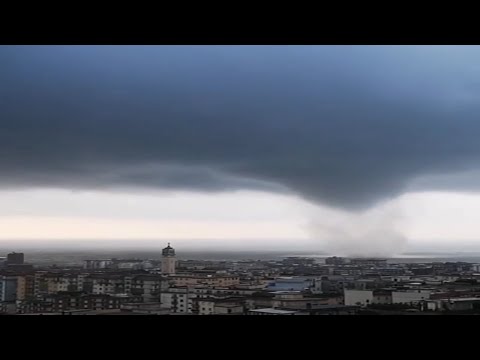
Across the country, at least three landfalling waterspouts were reported — in Genoa, Salerno, and Rosignano.
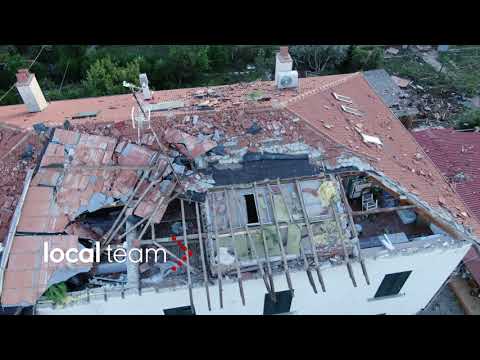
At least 8 people were injured in Rosignano, trees were uprooted, and roofs of homes ripped off:
As the sun rises, the damage from last night’s Rosignano tornado becomes evident: roofs partially ripped off, a tennis field’s tensile structure leveled, trees downed or snapped (actually destroyed IMO) and 8 injuries. Likely high F1/low F2. Images by @localteamtv pic.twitter.com/tTmnUp58oA
— Pavanator (@PavanFederico00) September 26, 2020
Update:
Gestern Abend richtete ein #Tornado in #Rosignano, #Italien schwere Schäden an.Zahlreiche Dächer, Bäume & Autos wurden teils massiv beschädigt. 8 Personen wurden verletzt, 2 davon schwer.
(Bilder in der Übersicht zvg. von "Local Team": https://t.co/rLVohS5PGs) pic.twitter.com/aOwQkBgtDv
— Tornadomap (@tornadomap_org) September 26, 2020
TORNADO A ROSIGNANO (Livorno)
Circa un'ora fa una tromba marina ha fatto landfall.
DECINE DI FERITI, 2 GRAVI.
Case scoperchiate, alberi caduti e tanti altri danni. pic.twitter.com/OdtBBfhj3T— raffaele. ÷ (@liamvoice_) September 25, 2020

Teo Blašković founded The Watchers in 2011 and edited it until 2026, covering seismic and volcanic activity, extreme weather, space weather and near-Earth objects. Articles on this page are his archive.
Published in the last 24 hours
- 10 named storms, one hurricane for the first time since 1925: Why has the Atlantic been so quiet in 2026 Epicenter
- Amazon fire hotspots rise 82.6% in October 2026 as El Niño intensifies Epicenter
- In 2005, a driver near Russia's Chulyshman River picked up a stone to wedge under his car wheel and kept it for 20 years; the Meteoritical Bulletin has now approved it as the Altai Republic's first meteorite. Epicenter
- The Leonid meteor shower peaks on the night of November 17, exactly 60 years after the 1966 storm, when some observers reported meteors falling at up to 40 a second, though this year’s show should be closer to 15 an hour
