
Strong and shallow M5.9 earthquake hits Turkey, leaving 1 person dead and 18 injured
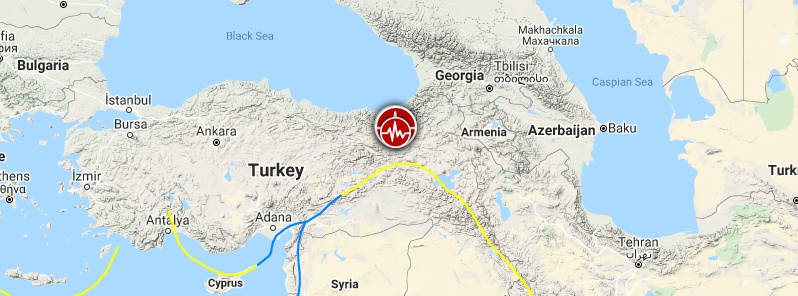
Image credit: TW
A strong and shallow earthquake registered by the USGS as M5.9 hit eastern Turkey's Bingol province at 14:24 UTC (17:24 local time) on June 14, 2020. The agency is reporting a depth of 10 km (6.2 miles). Turkey's Disaster and Emergency Management Authority reported the quake as M5.7 at a depth of 5 km (3.1 miles).
The epicenter was located 15 km (9 miles) E of Yedisu (population 1 771), 50 km (30 miles) SE of Tercan (population 12 235), 55 km (34 miles) S of Aşkale (population 15 462), 59 km (36 miles) NNW of Solhan (population 15 303), and 62 km (38 miles) NNE of Bingöl (population 80 568).
There are 1 370 000 people living within 100 km (62 miles).
Hundreds of aftershocks were registered by 07:14 UTC on June 15, including four significant — M4.5, M4.5, M5.4, and M4.3.
7 000 people are estimated to have felt strong shaking, 53 000 moderate, and 1 538 000 light.
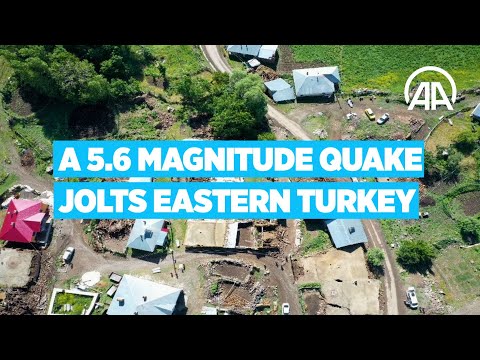

According to Bingol Governor's Office, one person — a village guard — was killed, and two others injured after two observation towers collapsed. Seven others were rescued from the wreckage, the Daily Sabah reports.
In total, 18 people were injured but no one critical.
10 houses were damaged in the Elmalı and Dinarbey villages of the Yedisu district.
The tremor reportedly lasted 8 to 10 seconds.
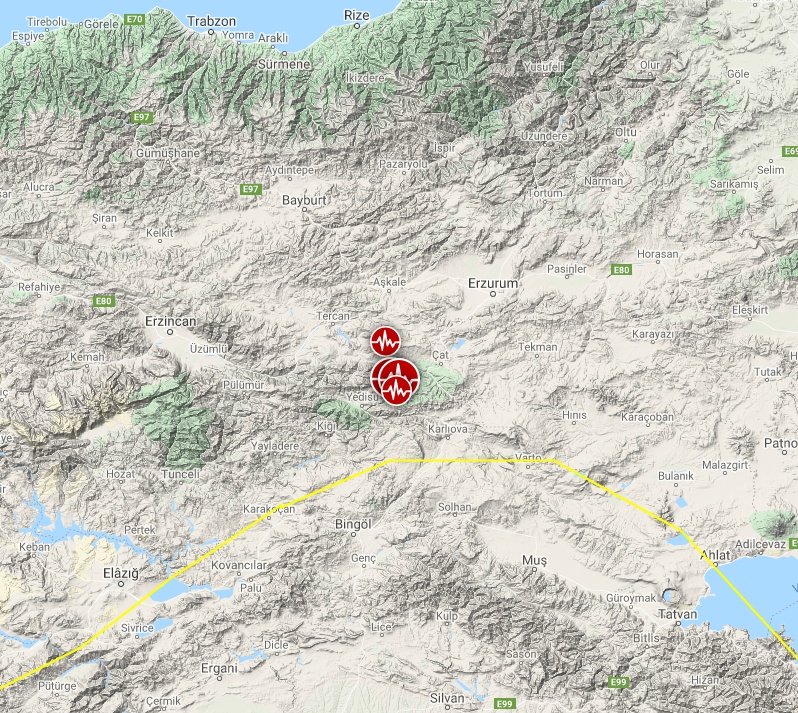

Image credit: TW/SAM, Google
Director of the Dokuz Eylül University Earthquake Research Center, Hasan Sözbilir, said that the two eastern branches of the North Anatolian Fault (NAF) started to trigger earthquakes, adding that the fault has the potential to create earthquakes up to a magnitude of 6.9.
"Faults were triggered. Aftershocks resumed along the Elmalıdere line, which began to break with Sunday’s 5.7 magnitude earthquakes. It is crucial not to enter houses with serious damages. There has been a dangerous degree of seismic activity in the region located between Erzincan and Karlıova," Sözbilir said.
The right-lateral, strike-slip North Anatolia Fault accommodates much of the westwards motion between the Anatolia Block and Eurasia Plate. Between 1939 and 1999, a series of devastating M7.0+ strike-slip earthquakes propagated westwards along the North Anatolia Fault system. The westernmost of these earthquakes was the 17th August 1999, M7.6 Izmit earthquake, near the Sea of Marmara, which killed approximately 17 000 people.
Featured image credit: TW/SAM, Google

Teo Blašković founded The Watchers in 2011 and edited it until 2026, covering seismic and volcanic activity, extreme weather, space weather and near-Earth objects. Articles on this page are his archive.
Published in the last 24 hours
- Male toads abandoned a pond in Italy five days before a deadly 2009 earthquake, while a scientist was counting them Epicenter
- An asteroid was spotted 19 hours before it exploded over Sudan in 2008, and students picked its pieces off the desert Epicenter
- A wave up to 3 m (10 feet) high rose out of Lake Michigan on a sunny June morning in 1954 and swept fishermen off Chicago’s piers, and when a second came 10 days later, warnings had cleared the shore Epicenter
- Just 12 inches of rushing water can carry away most cars, and more than half of US flood drownings happen to people who drive into flood water Epicenter
