
Martian dust storm now officially a global dust event
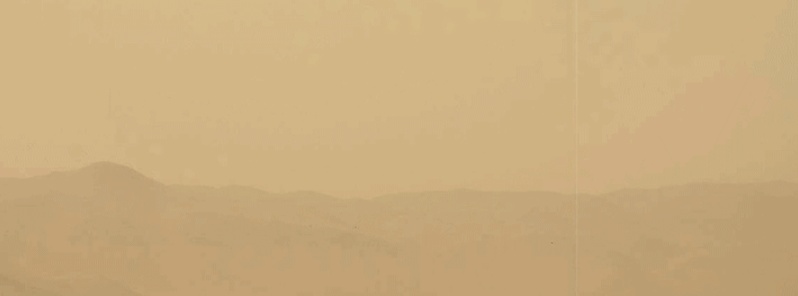
Image credit: NASA/Curiosity Rover
One of the most intense dust storms ever observed on Mars is raging across the planet since May 30, 2018. The storm grew rapidly over the next 20 days and is now officially a 'planet-encircling' (global) dust event.
Although Martian dust storms are common during southern hemisphere spring and summer, when Mars is closest to the Sun, they usually stay contained to a local area. This storm, on the other hand, is one of the most intense if not the most intense dust storm ever observed on the planet.
Within the first few days, it blocked so much light that it effectively turned day into night for NASA's Opportunity rover, which was located near the center of the storm at the time, inside Mars' Perseverance Valley. As a result, Opportunity's power levels have dropped significantly by June 6, requiring it to shift to minimal operations and temporarily cease science operations.
On June 10, the storm covered more than 41 million km2 (15.8 million mi2), or more than a quarter of the surface of Mars, and by Wednesday, June 20, it officially became a global dust event.
The storm is being observed by scientists from Earth using ground-based telescopes, satellites in Mars' orbit and nuclear-powered Curiosity rover, located on the other side of Mars from Opportunity.
Curiosity is expected to remain largely unaffected by the dust, but the dust has steadily increased over it, more than doubling over the past weekend.
The atmospheric haze blocking sunlight, called "tau," is now above 8.0 at Gale Crater, where Curiosity is studying Martian soil. This is the highest tau the mission has ever recorded. Tau was last measured near 11 over Opportunity, thick enough that accurate measurements are no longer possible for Mars' oldest active rover.
Curiosity, plus a fleet of spacecraft in the orbit of Mars, will allow scientists for the first time to collect a wealth of dust information both from the surface and from space.
The last storm of global magnitude that enveloped Mars was in 2007, five years before Curiosity landed there.

I'm a dedicated researcher, journalist, and editor at The Watchers. With over 20 years of experience in the media industry, I specialize in hard science news, focusing on extreme weather, seismic and volcanic activity, space weather, and astronomy, including near-Earth objects and planetary defense strategies. You can reach me at teo /at/ watchers.news.

Could this be caused by the Nibiru system flyby, if so is earth in for?