
Mars’ magnetic history examined in new study
New research published in Nature Communications suggests that Mars’ magnetic field, which may have helped retain the planet’s atmosphere and surface water, existed until approximately 3.9 billion years ago—lasting longer than prior estimates of 4.1 billion years. The updated timeline offers a clearer picture of Mars’ early environment, potentially shedding light on its habitability.
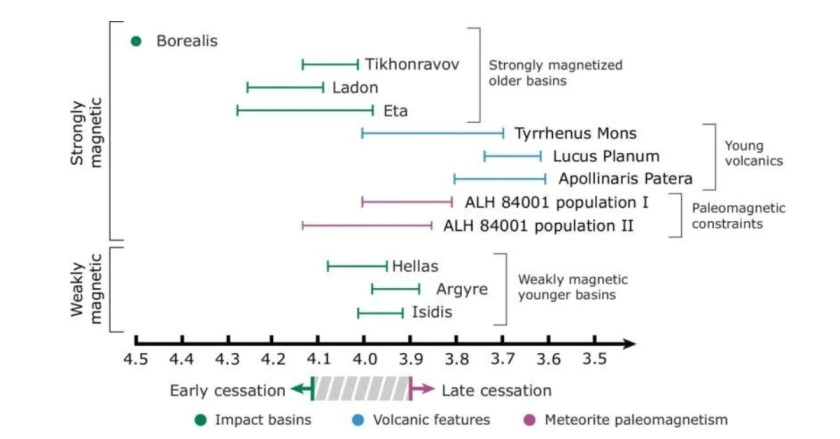
summary of constraints in Mars magnetic history. Image credit: Nature communications/ Sarah Steele
- New data reveals Mars’s magnetic dynamo may have lasted at least 3.7 billion years, longer than the previously predicted shutdown at 4.1 billion years, with possible magnetic reversals.
- Longer-lived magnetic fields may have protected Mars’s atmosphere from the solar wind, retaining water on the surface until roughly 3.5 billion years ago, supporting persistent water flow.
- Analysis of Martian meteorite ALH 84001 and simulations support the notion of a long-lasting, reversing dynamo, shedding light on Mars’s early magnetic environment and habitability.
New research in Nature Communications offers strong evidence that Mars’ life-enabling magnetic field might have existed until around 3.9 billion years ago, compared to earlier predictions of 4.1 billion years.
The study revisits Mars’ magnetic history by analyzing volcanic rocks, Martian meteorites, and magnetic field data from impact basins. Scientists previously believed that Mars’ magnetic field-generating dynamo—an internal mechanism that produces a protective magnetic shield—ceased around 4 billion years ago. This conclusion was based on weak magnetic signatures in ancient Martian impact craters.
Recent findings, however, indicate that Mars’ dynamo persisted longer and may have experienced magnetic reversals, similar to Earth’s. This study explores how these reversals could have led to the demagnetized areas observed around major Martian basins.
The team at Harvard’s Paleomagnetic Lab modeled Mars’ ancient impact sites, testing the hypothesis that polarity reversals may have erased magnetic evidence from the craters. Their results suggest that Mars’ dynamo, likely active from 4.5 to about 3.7 billion years ago, produced a shifting magnetic field that could have shielded Mars’ atmosphere for a significant period.
Some volcanic rocks formed between 3.9 and 3.5 billion years ago contain strong magnetic signatures, suggesting an active dynamo. However, accurately dating these rocks remains a challenge.
Notably, the Martian meteorite ALH 84001, which crystallized 4.1 billion years ago, shows evidence of powerful magnetization due to an impact around 3.9 billion years ago—supporting the extended dynamo theory.
The research, led by graduate student Sarah Steele under Professor Roger Fu, involved advanced simulations and computer modeling to assess the longevity of Mars’ dynamo. These models account for changes in magnetization observed in impact sites and suggest that weak magnetic fields in these basins may be due to polarity reversals rather than a shutdown of the dynamo itself.
The study presents an alternative view to the longstanding belief that Mars’ dynamo ceased early, as previously inferred from low magnetic readings over massive impact basins.
According to Steele, these findings challenge the assumption that a shutdown was necessary to explain Mars’ demagnetized craters. Instead, the craters may have formed amid polarity shifts, with poles switching as they do periodically on Earth.
By investigating Martian meteorite ALH 84001 with a quantum diamond microscope, the team identified varying magnetic signatures that imply a dynamo presence until at least 3.9 billion years ago. Steele acknowledges that questioning established theories is daunting but says planetary scientists remain open to alternative perspectives on Mars’ magnetic and atmospheric history.
The study’s implications extend to Mars’ early water retention. While hydrogen naturally escapes into space, oxygen and heavier ions are less likely to do so without external forces like solar wind. Without a protective magnetic field, solar wind could have stripped Mars of oxygen, leading to water depletion of an estimated 10 – 70 m (33 – 230 feet) equivalent over time.
If Mars’ magnetic dynamo lasted until 3.6 billion years ago, it could have slowed atmospheric loss and preserved surface water during the Noachian period. This revised timeline offers new insight into Mars’ potential for habitability and the role magnetic fields play in atmospheric preservation.
References:
1 Study bolsters theory that protective magnetic field supporting life-enabling atmosphere remained in place longer than estimates – Harvard News – October 29, 2024
2 Weak magnetism of Martian impact basins may reflect cooling in a reversing dynamo – Nature communication – open access – August 9, 2024

The Watchers team and our contributors bring the latest on extreme weather, earthquakes, volcanic eruptions, space weather, and all things science. We're all about making sense of the natural world and keeping you informed on what’s happening. Got a tip or a question? Hit us up using the form at newstips!

Commenting rules and guidelines
We value the thoughts and opinions of our readers and welcome healthy discussions on our website. In order to maintain a respectful and positive community, we ask that all commenters follow these rules.