
Evidence of rain and snow on ancient Mars
Geologists from the University of Colorado Boulder report that extensive valley networks on Mars were likely formed by widespread precipitation, challenging previous theories that attributed their formation to runoff from melting ice caps. Using landscape evolution models and topographic data from NASA missions, the researchers found that valley head elevations across Mars’ southern highlands are more consistent with rain or snowmelt than with localized ice melting.
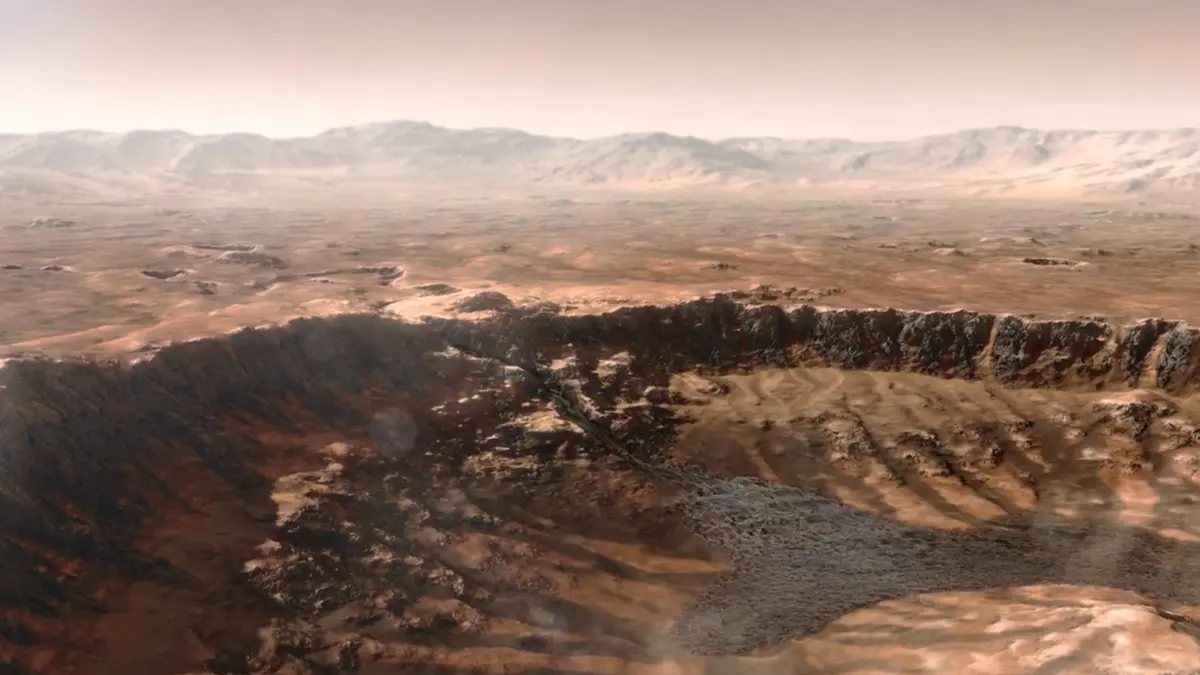
Artist's depiction of water rushing into Mars' Jezero Crater, which billions of years ago was the site of a delta. Image credit: NASA/JPL-Caltech
A study published on April 21 in the Journal of Geophysical Research: Planets, examined a large region of Mars’ cratered southern highlands, focusing on the locations and elevations of valley heads within dendritic valley networks.
The scientists used landscape evolution models to simulate how water shaped these features, comparing two scenarios: one driven by widespread precipitation (rain or snow) and another by runoff from melting ice caps. The precipitation model predicted valley heads forming across a broad elevation range, closely matching the observed distribution on Mars.
In the ice-driven simulation, based on the Late Noachian Icy Highland model, valley heads were expected to form primarily at high elevations near the ice stability line, where melting occurred. But the actual valley heads on Mars span from below the planet’s average surface elevation to over 3.3 km (11 000 feet), inconsistent with the ice-melt model. This discrepancy shows that precipitation was a huge contributor to valley formation during the Noachian epoch.
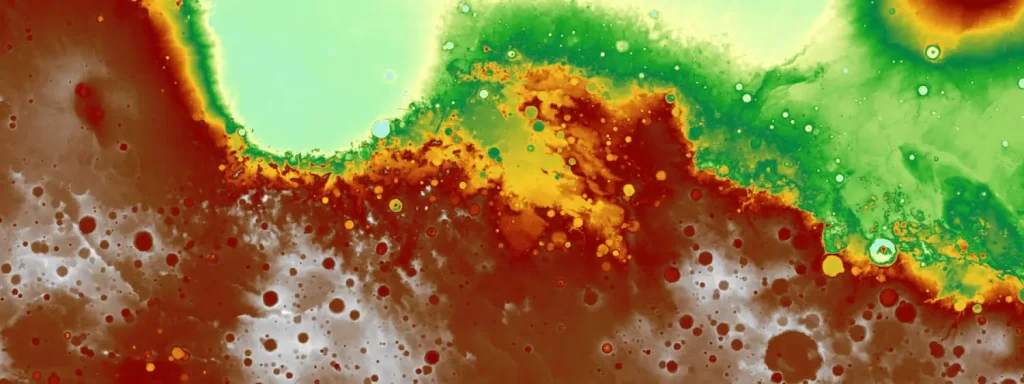
The team adapted a computer model originally developed for Earth studies, creating synthetic Martian terrain resembling the equatorial highlands. In simulations, water from precipitation or ice melt flowed for tens to hundreds of thousands of years, carving valleys and headwaters.
The precipitation-driven simulations produced branching valley networks similar to those seen in NASA satellite images, with headwaters distributed across varied elevations.
Data from NASA’s Mars Global Surveyor and Mars Odyssey spacecraft provided detailed topographic maps for comparison. These maps, generated by instruments like the Mars Orbiter Laser Altimeter, revealed valley networks resembling Earth’s river systems, such as those in Utah.
The precipitation model’s alignment with these observations supports the idea of a climate warm enough to sustain rain or snow across Mars’ surface.
The research also considered geological evidence from NASA’s Perseverance rover, which is exploring Jezero Crater, a former lakebed fed by a river delta. The presence of large boulders and sandstone deposits in the crater shows powerful water flows, consistent with precipitation-driven runoff. The findings indicate that Mars’ ancient climate supported an active hydrological cycle, unlike the cold, dry conditions of today.
The ice-melt model, while plausible for temporary water flows, failed to replicate the widespread and elevation-diverse valley head patterns observed. The simulations showed that ice-cap runoff would create valleys in a narrow elevation band, limiting their distribution.
References:
1 Landscape Evolution Models of Incision on Mars: Implications for the Ancient Climate – Amanda V. Steckel, Gregory E. Tucker et al. – Journal of Geophysical Research: Planets – April 21, 2025 – https://doi.org/10.1029/2024JE008637
2 Did it rain or snow on ancient Mars? New study suggests it did – CU Boulder Today – April 21, 2025

I’m a science journalist and researcher at The Watchers, contributing to the Epicenter edition, where I cover peer-reviewed scientific research and emerging discoveries across Earth and space sciences. With a background in astronomy and a passion for environmental science, I’ve worked in shark and coral conservation in Fiji, conducting reef and shark-behavior research, contributing to mangrove restoration, and earning PADI Open Water and Coral Reef Certifications. I bring a blend of scientific rigor and storytelling to illuminate the discoveries shaping our planet and beyond.

Commenting rules and guidelines
We value the thoughts and opinions of our readers and welcome healthy discussions on our website. In order to maintain a respectful and positive community, we ask that all commenters follow these rules.