
Study identifies hidden transition signal in polar vortex model
Researchers have identified a physically interpretable signal that distinguishes stable polar vortex states from states approaching a regime transition inside an artificial intelligence emulator. The result could provide a method for studying precursors to sudden stratospheric warmings, but the signal has so far been demonstrated only in an idealized atmospheric model and is not a real-world warning system.
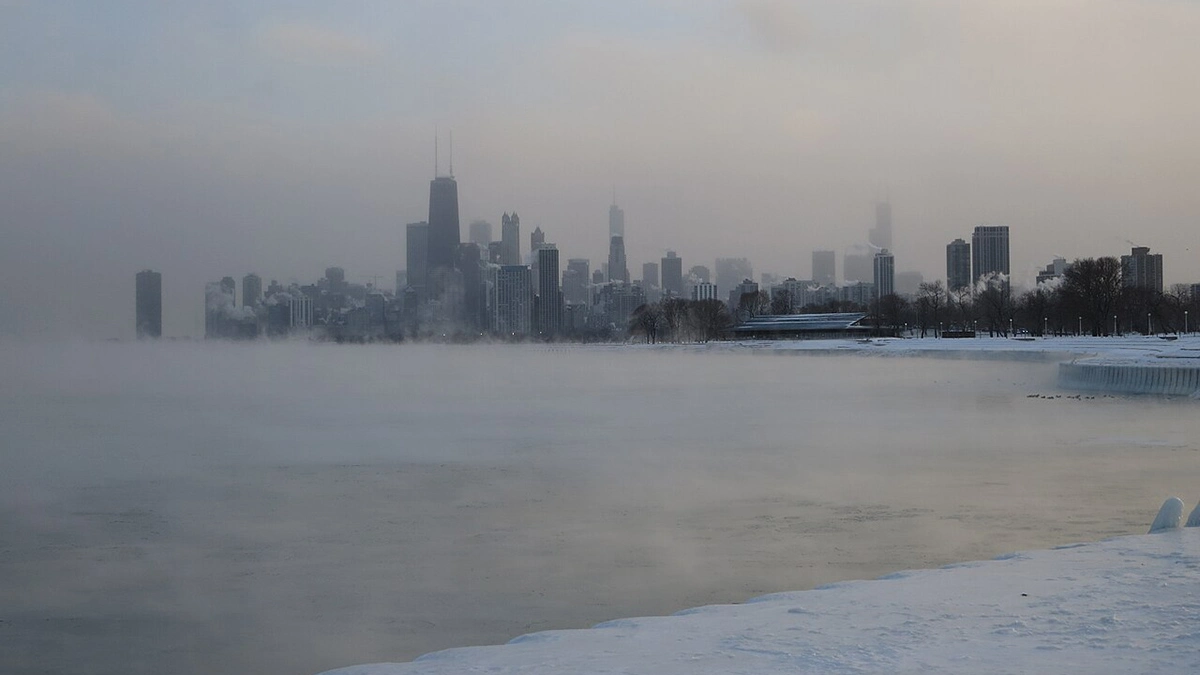
Disruptions to the polar vortex bring frigid temperatures to North America. A new model may show a way to better predict them. Credit: edward stojakovic/Flickr
Boscu et al. (2026) developed the emulator around the stochastic Holton–Mass model, a simplified representation of stratospheric dynamics in which the polar vortex can persist in either a strong or weak state. Transitions from the strong state to the weak state qualitatively represent sudden stratospheric warming (SSW) events. The model provides a controlled environment in which rare regime changes can be studied without presenting them as direct simulations of the full atmosphere.
The result addresses two linked problems in machine-learning weather research. Rare transitions are poorly represented compared with routine atmospheric states, making them difficult for data-driven systems to learn, while the internal representations produced by deep-learning models can be difficult to connect to recognizable physical processes. Boscu and colleagues found that their emulator not only reproduced the Holton–Mass system’s transition behavior but organized its internal representation according to physically meaningful vortex states.
In the Holton–Mass system, strong and weak vortex regimes are maintained by nonlinear interactions between atmospheric waves and the background flow. Adding stochastic forcing, representing unresolved rapidly varying processes, causes the system to spend long periods near one regime before occasionally shifting to the other. This behavior is described as metastability: a state can remain stable for a long time without being permanently locked there.

The researchers used a conditional variational autoencoder, a probabilistic neural-network architecture designed to generate a distribution of plausible future states rather than a single deterministic outcome. It was trained to advance the model by one day. Its encoder and decoder each contain six layers, while the internal latent representation contains 32 dimensions.
Testing extended beyond the one-day training target. The emulator reproduced the model’s steady-state probability distributions, persistence of its vortex regimes, rates of rare transitions, transition pathways and two diagnostics used to describe how close the system is to changing regime: the committor function and expected transition lead time.
The committor function expresses the probability that a system in a given state will reach one regime before returning to another. In physical terms, it helps distinguish a state that merely resembles a weakened vortex from one that is genuinely positioned along a transition pathway. Reproducing this quantity gave the researchers a way to test whether the emulator had learned more than short-range statistical resemblance.

Latent mean vectors are projected onto the first two principal components for the Holton–Mass model (top) and emulator (bottom). The left panels show points colored by their physical regime classes, with crosses marking the regime centroids. The right panels show the same points colored by unsupervised clusters assigned by a Gaussian mixture model fit to the latent coordinates, with dashed curves showing covariance. The unsupervised latent clusters accurately reproduce the physically defined regime classes. Credit: Boscu et al. (2026) AI emulation of stochastic sudden stratospheric warming with interpretable latent structure
The most distinctive result emerged when the researchers examined the emulator’s 32-dimensional latent space. Principal component analysis separated the internal representations into four physically interpretable clusters associated with strong and weak vortex conditions and with stable and transition-prone configurations. When the physical class labels were withheld, Gaussian mixture clustering recovered the same four-group organization.
The separation matters because it makes part of the neural network’s internal behavior physically interpretable. Rather than producing only a forecast, the emulator contained an internal structure linked to whether the idealized vortex was remaining within a regime or approaching a transition. The authors describe this organization as a potential precursor signal for SSW-like regime changes within the Holton–Mass system.
The result does not demonstrate that the same signal exists in the real atmosphere. The Holton–Mass model is deliberately idealized, and its strong-to-weak transitions only qualitatively represent sudden stratospheric warmings. Real SSWs involve a far more complex atmosphere, including interactions across the stratosphere and troposphere and processes operating over timescales from days to years.
That distinction is important because SSWs can reorganize large-scale circulation and, in some cases, precede persistent surface cold outbreaks. Their downstream weather effects are neither uniform nor guaranteed, and the present study did not forecast an actual SSW or a cold-weather event.
The study instead provides a controlled demonstration that a stochastic machine-learning emulator can reproduce rare regime-transition statistics while retaining an interpretable internal representation. Previous machine-learning emulators have more commonly focused on deterministic, although chaotic, atmospheric systems; stochastic systems with noise-driven transitions have received less attention, according to the authors.
The next test is empirical rather than operational. Researchers would need to establish whether comparable latent-state clusters emerge in realistic SSW data, determine what physical processes those clusters represent, and examine whether their relationship with subsequent transitions remains robust enough to provide useful advance information.
Until those tests are completed, the study’s main contribution is an interpretable method for examining rare transitions in stochastic climate dynamics rather than a new operational polar vortex forecast.
References:
1 Boscu, C. D., Hernandez, D., Ventura, F. A., Finkel, J., Chattopadhyay, A., Hassanzadeh, P., & Abbot, D. S. (2026). AI emulation of stochastic sudden stratospheric warming with interpretable latent structure. Journal of Geophysical Research: Machine Learning and Computation, 3(5), e2026JH001387. https://doi.org/10.1029/2026JH001387
2 Scharping, N. (2026). Using machine learning techniques for polar vortex predictions. Eos, 107. https://doi.org/10.1029/2026EO260332

I’m a science journalist and researcher at The Watchers, contributing to the Epicenter edition, where I cover peer-reviewed scientific research and emerging discoveries across Earth and space sciences. With a background in astronomy and a passion for environmental science, I’ve worked in shark and coral conservation in Fiji, conducting reef and shark-behavior research, contributing to mangrove restoration, and earning PADI Open Water and Coral Reef Certifications. I bring a blend of scientific rigor and storytelling to illuminate the discoveries shaping our planet and beyond.

Commenting rules and guidelines
We value the thoughts and opinions of our readers and welcome healthy discussions on our website. In order to maintain a respectful and positive community, we ask that all commenters follow these rules.