
JWST finds a highly reflective atmosphere around lava planet TOI-561 b
James Webb Space Telescope observations of the ultra-hot rocky planet TOI-561 b are best explained by a highly reflective global atmosphere, with an energy-balance analysis finding that the planet reflects roughly three-quarters of the stellar energy reaching it. Atmospheric circulation alone cannot account for its comparatively cool dayside, while climate and condensation models show that reflective silicate clouds can form under the inferred conditions.
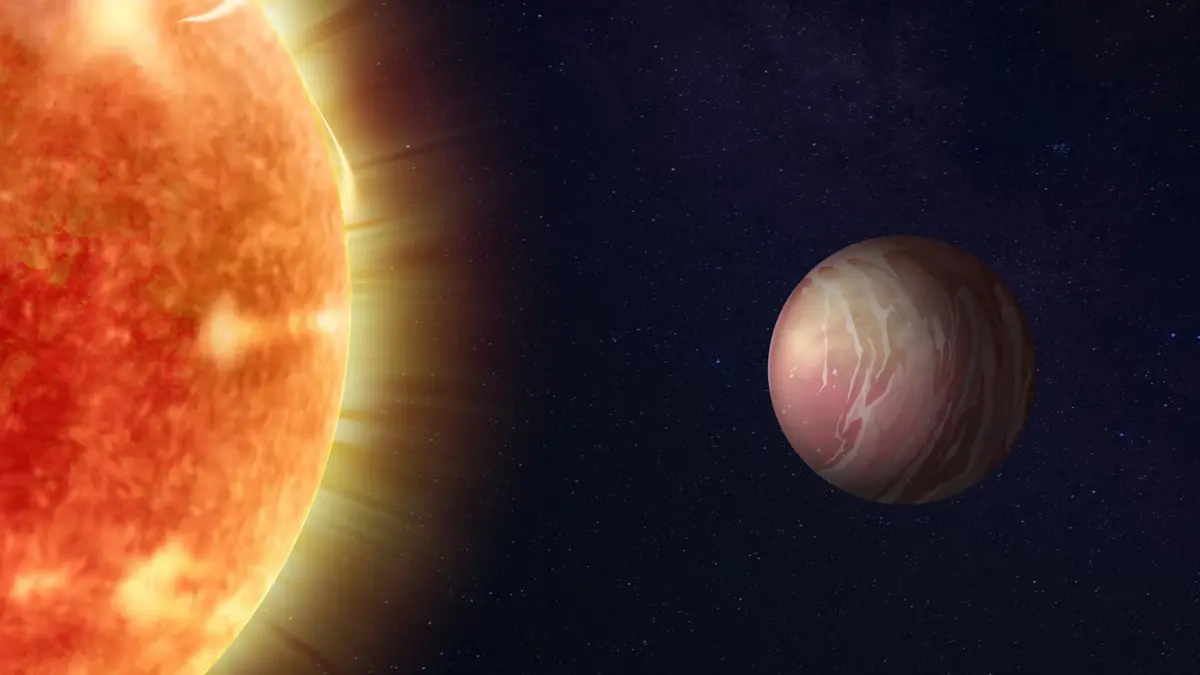
Artist’s concept of the lava world TOI-561 b and its star, whose surface churns with hot, bubbling gas. Webb observations show the planet reflects most of its starlight, and models suggest bright silicate clouds above its magma ocean may be the reason. Credit: CryoDragon Inc
Boucher et al. (2026) reached that conclusion after analyzing approximately 37 hours of continuous observations with JWST’s Near-Infrared Spectrograph (NIRSpec). The telescope measured how TOI-561 b’s 3–5 μm thermal emission changed through multiple orbital phases, giving the researchers information from both the permanent dayside and the hemisphere facing away from the star.
The result addresses the main uncertainty left by earlier observations: whether the planet’s unexpectedly cool dayside was caused mainly by atmospheric heat transport or by stellar energy being reflected before it could heat the planet.
The combined phase-curve analysis yielded a dayside temperature of 2 048 K (+193 / -206 K) and a nightside best estimate of 1 089 K (+175 / -379 K). The same analysis produced a Bond albedo of 0.74 (+0.08 / -0.10) and a heat-redistribution efficiency of 0.18 (+0.14 / -0.15). Bond albedo describes the fraction of incoming stellar energy that a planet reflects back to space. A value near 0.74 means TOI-561 b reflects a large fraction of the energy reaching it, helping explain why its dayside is cooler than expected if the planet absorbed most incoming radiation.
Under the assumptions tested by the researchers, a dark planet with no heat redistribution would reach a maximum dayside temperature of roughly 3 200 K. The phase-curve fit instead places the dayside near 2 050 K. The nightside estimate shows that some heat is redistributed around the planet, but the inferred redistribution efficiency is too low for circulation alone to reproduce the observed dayside.

The new analysis builds on earlier JWST observations reported by Teske et al. (2025). That work measured TOI-561 b during secondary eclipse, when the planet passes behind its star, allowing the planet’s dayside infrared emission to be separated from the combined star-planet signal. The spectrum was inconsistent with a bare-rock surface at high statistical significance and supported a thick volatile atmosphere above a magma-rich surface.
Those eclipse measurements could not fully separate two explanations for the missing dayside heat. An atmosphere could carry absorbed energy toward the nightside, or the planet could reflect a large fraction of the incoming stellar radiation before absorbing it. A phase curve resolves more of that ambiguity because it follows the thermal signal as different parts of the planet rotate through view during its orbit.
Boucher and colleagues simultaneously modeled stellar granulation, the planetary phase variation and the dayside emission. They then compared the resulting thermal behavior with general-circulation models spanning different atmospheric pressures, compositions and imposed reflectivities. This approach links the observed changes in infrared brightness to the amount of heat the atmosphere can transport and the amount of stellar energy that must be reflected.

Models without substantial reflection produced daysides that were too hot compared with the NIRSpec measurements. In the modeled NRS1 wavelength range, a Bond albedo above 0.5 was needed to reproduce the measured dayside emission, while parts of the NRS2 model grid required values around 0.4. The independent energy-balance fit favored an even higher Bond albedo of about 0.74.
A molten rocky surface is not expected to provide enough reflection on its own to account for such an energy budget. The researchers therefore tested whether mineral condensates could form in the atmosphere by combining temperature-pressure structures from their circulation models with equilibrium-condensation calculations for material associated with a magma-ocean environment.
The calculations produced conditions in which silicate condensates including silicon dioxide (SiO₂) and magnesium silicate (MgSiO₃) can form in parts of the dayside atmosphere, including regions near the terminator between the permanent day and night hemispheres. In one conservative SiO₂ calculation based on the hottest zero-albedo circulation model, the modeled cloud region contributed about 0.24 to the globally averaged albedo. Cooling caused by reflective clouds would also allow more material to condense, providing a physical pathway toward still greater reflectivity.
The silicate-cloud composition has not been directly detected by JWST. SiO₂ and MgSiO₃ are model-supported candidates that can reproduce part of the reflectivity required by the thermal observations; they are not a spectroscopic identification of the atmosphere’s mineral content. The atmosphere’s bulk gas composition also remains unresolved.
TOI-561 b belongs to a class of ultra-short-period rocky planets that orbit their stars in less than one Earth day. Such worlds receive intense stellar irradiation and are generally expected to lose substantial gaseous envelopes over time. Evidence for a thick atmosphere around TOI-561 b already placed the planet in tension with that expectation. The new phase curve adds another constraint: the atmosphere-planet system must also reflect a large fraction of the incoming stellar energy.
The persistence of that atmosphere raises a separate question about how gases are retained or replenished under such extreme conditions. Boucher et al. interpret the observations as consistent with volatile exchange between the atmosphere and the planet’s molten interior, but the data do not establish the long-term replenishment mechanism. The University of Waterloo research team has identified carbon dioxide-rich and sulfur dioxide-rich atmospheres among possibilities that future observations could test.
The temperature estimates also retain instrumental and wavelength-coverage limitations. NIRSpec sampled only part of the planet’s thermal emission spectrum, and the researchers report detector-dependent uncertainty affecting the nightside constraint. Observations at longer wavelengths would provide an independent test of the energy-budget interpretation and could help distinguish between competing atmospheric compositions.
References:
1 Boucher, S., Dang, L., McGinty, A., Teske, J. K., Pierrehumbert, R., Piette, A. A. A., Wallack, N. L., Weeks, A., Lewis, N. T., Lichtenberg, T., Plotnykov, M., Postolec, E., Huber, D., Bedding, T. R., Nicholls, H., Peng, B., Hammond, M., & Valencia, D. (2026). A highly reflective atmosphere on the lava world TOI-561b revealed by JWST/NIRSpec phase curves. The Astronomical Journal, 172(4), 239. https://doi.org/10.3847/1538-3881/ae9763
2 Teske, J. K., Wallack, N. L., Piette, A. A. A., Dang, L., Lichtenberg, T., Plotnykov, M., Pierrehumbert, R., Postolec, E., Boucher, S., McGinty, A., Peng, B., Valencia, D., & Hammond, M. (2025). A thick volatile atmosphere on the ultrahot super-Earth TOI-561 b. The Astrophysical Journal Letters, 995(2), L39. https://doi.org/10.3847/2041-8213/ae0a4c
3 Clouds on a lava planet challenge what astronomers expected – University of Waterloo – October 26, 2026

I’m a science journalist and researcher at The Watchers, contributing to the Epicenter edition, where I cover peer-reviewed scientific research and emerging discoveries across Earth and space sciences. With a background in astronomy and a passion for environmental science, I’ve worked in shark and coral conservation in Fiji, conducting reef and shark-behavior research, contributing to mangrove restoration, and earning PADI Open Water and Coral Reef Certifications. I bring a blend of scientific rigor and storytelling to illuminate the discoveries shaping our planet and beyond.

Commenting rules and guidelines
We value the thoughts and opinions of our readers and welcome healthy discussions on our website. In order to maintain a respectful and positive community, we ask that all commenters follow these rules.