
Mount Shirane volcano alert level raised, Japan

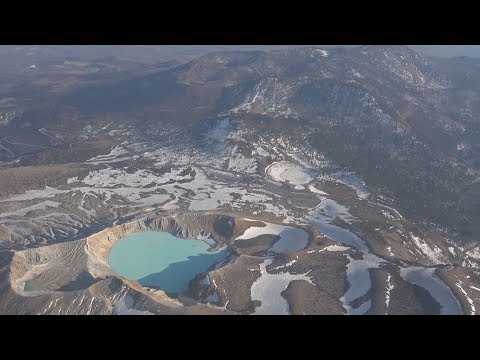
Featured image: Mount Shirane volcano crater on April 22, 2018. Credit: Kyodo
The Japan Meteorological Agency has raised the alert level for Mount Shirane volcano near Gunma and Nagano prefectures from Level 1 to Level 2 on Sunday, April 22, 2018, restricting access to the crater.
JMA said volcanic earthquakes at the Yugama crater have been on the rise since April 21, accompanied by slight crustal movement signaling higher eruption risk.
The number of earthquakes increased from 7 on April 21 to 153 by 16:00 JST, April 22, the agency said and added that large ash deposits might emerge within 1 km (0.62 miles) of the crater as well. There is also a possibility of large rocks being expelled up to 1 km.
The Gunma Prefectural Department closed an 8.5-km long (5.3 miles) stretch of Route 292, the so-called Shiga-Kusatsu road used by many to reach nearby Kusatsu hot springs resort.
On January 23, 2018, Mount Motoshirane, another volcano in the Kusatsu-Shirane chain to the south of Mount Shirane, erupted, killing one person and injuring 11 others.
The Level 2 warning for Mount Motoshirane remains unchanged, JMA said.


Geological summary
The summit of Kusatsu-Shiranesan volcano, located immediately north of Asama volcano, consists of a series of overlapping pyroclastic cones and three crater lakes. The andesitic-to-dacitic volcano was formed in three eruptive stages beginning in the early to mid-Pleistocene.
The Pleistocene Oshi pyroclastic flow produced extensive welded tuffs and non-welded pumice that covers much of the east, south and SW flanks. The latest eruptive stage began about 14 000 years ago.
All historical eruptions have consisted of phreatic explosions from the acidic crater lakes or their margins. Fumaroles and hot springs that dot the flanks have strongly acidified many rivers draining from the volcano. The crater was the site of active sulfur mining for many years during the 19th and 20th centuries. (GVP)

Teo Blašković founded The Watchers in 2011 and edited it until 2026, covering seismic and volcanic activity, extreme weather, space weather and near-Earth objects. Articles on this page are his archive.
Published in the last 24 hours
- In September 1859, a solar storm lit up the night sky so brightly that gold miners in the Rocky Mountains woke up after midnight and started cooking breakfast, convinced the aurora glowing over their camp was the sunrise Epicenter
- A patch of warm Pacific water that could become the strongest El Niño in more than 70 years sits thousands of miles from any American town, yet it is already the main reason NOAA expects a wetter winter across the South and a milder one across the North
- A 19-year-old Nebraska teacher reportedly tied her pupils together with twine and led them to safety through a blizzard in January 1888 Epicenter
- NASA built the Opportunity rover to last 90 days on Mars, and Martian winds helped keep it alive for nearly 15 years by blowing dust off its solar panels, until a planet-wide dust storm in 2018 blocked sunlight and silenced the rover Epicenter
