
April’s solar flares through the eyes of Solar Dynamics Observatory
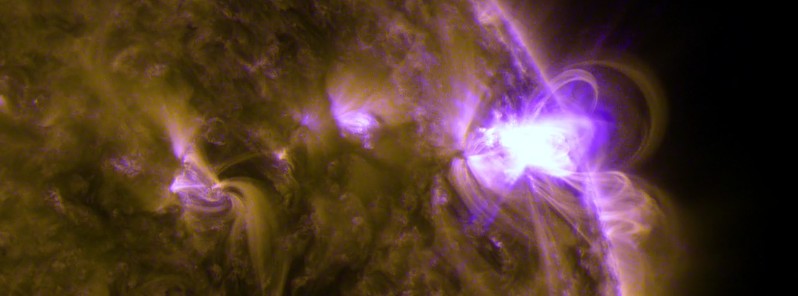
Image credit: NASA/SDO
After 8 months without any significant solar flare, the Sun awakened on April 1, 2017, and unleashed 7 M-class solar flares over the next 2 days. The source of all of them was departing Region 2644.
The series started with M4.4 on April 1 and was followed by M5.3, M2.3, M2.1 and M5.7 on April 2, and M1.2 and M5.8 on April 3. Multiple coronal mass ejections were associated with those events but none of them was Earth-directed.
Three of them were larger than M5 and can be seen in the video below, through the eyes of NASA's Solar Dynamics Observatory:

Video courtesy NASA's Goddard Space Flight Center

Data and imagery for each solar flare in this sequence can be found on the link below:
Seven M-class solar flares erupt from Region 2644

Teo Blašković founded The Watchers in 2011 and edited it until 2026, covering seismic and volcanic activity, extreme weather, space weather and near-Earth objects. Articles on this page are his archive.
Earlier reporting
Nothing on Watchers was published in the last 24 hours. These are older articles.
- On October 22, 2017, a single flash of lightning stretched 515 miles from eastern Texas to near Kansas City, a distance that takes eight hours to drive, and nobody realized how far it had gone until scientists went back through the satellite data years later Epicenter
- CPC posts a slight risk of heavy rain from the Gulf Coast to the Northeast urban corridor November 25-29, and a moderate risk of West Coast wind and Sierra snow on November 25
- Florida's east coast faces a moderate flash flood risk Wednesday through Friday, with 4 to 8 inches of rain forecast and the St. Johns River near Cocoa already in major flood at 17.13 feet
- Cyclone Akvan to make landfall between Nellore and Visakhapatnam around noon on November 20, IMD forecasts 120-130 km/h winds gusting to 145
