
X-Class: A Guide to Solar Flares
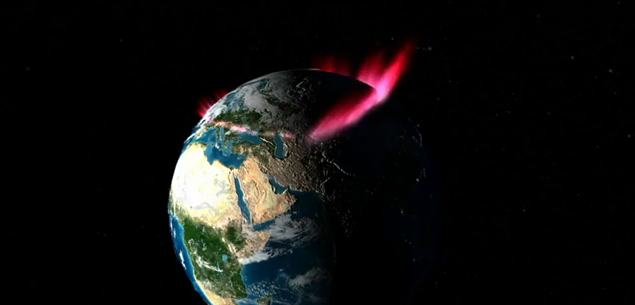
Image credit: TW
Solar flares happen when the powerful magnetic fields in and around the Sun reconnect. They're usually associated with active regions, often seen as sunspots, where the magnetic fields are strongest. Flares are classified according to their strength.
The smallest ones are B-class, followed by C, M and X, the largest. Similar to the Richter scale for earthquakes, each letter represents a ten-fold increase in energy output.
So, an X is 10 times an M and 100 times a C.
Within each letter class, there is a finer scale from 1 to 9. C-class flares are too weak to noticeably affect Earth. M-class flares can cause brief radio blackouts at the poles and minor radiation storms that might endanger astronauts. Although X is the last letter, there are flares more than 10 times the power of an X1, so X-class flares can go higher than 9.
The most powerful flare on record was in 2003, during the last solar maximum. It was so powerful that it overloaded the sensors measuring it. They cut-out at X28.
A powerful X-class flare like that can create long-lasting radiation storms, which can harm satellites and even give airline passengers, flying near the poles, small radiation doses. X flares also have the potential to create global transmission problems and world-wide blackouts.

Featured image and video: Courtesy of NASA Heliophysics

Teo Blašković founded The Watchers in 2011 and edited it until 2026, covering seismic and volcanic activity, extreme weather, space weather and near-Earth objects. Articles on this page are his archive.
Earlier reporting
Nothing on Watchers was published in the last 24 hours. These are older articles.
- On October 22, 2017, a single flash of lightning stretched 515 miles from eastern Texas to near Kansas City, a distance that takes eight hours to drive, and nobody realized how far it had gone until scientists went back through the satellite data years later Epicenter
- CPC posts a slight risk of heavy rain from the Gulf Coast to the Northeast urban corridor November 25-29, and a moderate risk of West Coast wind and Sierra snow on November 25
- Florida's east coast faces a moderate flash flood risk Wednesday through Friday, with 4 to 8 inches of rain forecast and the St. Johns River near Cocoa already in major flood at 17.13 feet
- Cyclone Akvan to make landfall between Nellore and Visakhapatnam around noon on November 20, IMD forecasts 120-130 km/h winds gusting to 145

just after i was reading up on these, i went over to the store and there was a power outage..the real deal would be borderline terror
So if the flares in each class are numbered 1 to 9, how is it possible to have a X28 flare? The scale, from my understanding is logarithmic, such that an X10 should be something else- like a Y1…though there doesn’t appear to be anything higher than X. If there were more classes, such as X Y Z ZZ, then an X28 would have to be a ZZ1, no?
I arrived here looking for a description of how flares over X9 were classified…
Hi. That’s a good question. Solar flare categories are, as you know, grouped in letter (A), B, C, M and X.Each one got linear intensity scale from 1-9, except X-class flares. Values more than 10−4 watts per square meters are indicators of X-class flares. There is no upper level for X-class events. For example, X2 is two time stronger than X1. So, the powerfull X28 from 2003 means that the intensity of that X-flare was 28 time stronger than X1. X-flares are relatively rare events, and explosions meassuring more than X-9 happens very rare so I guess that’s the reason why there is no Y- or Z-class solar flares. If we agree that X10 would be Y1, and X19 Z1, than we can get the idea how strong X28 really was. Enormously powerfull explosion.
[…] The Watchers – X-Class: A Guide to Solar Flares Tags: around-the-sun, christmas, nasa, Power, solar flares, utc, video, western […]
This article was great. Just the other day I posted a comment wondering how solar flares were ranked. Thanks for the answer!