
Jupiter at opposition, closest to Earth in 2017
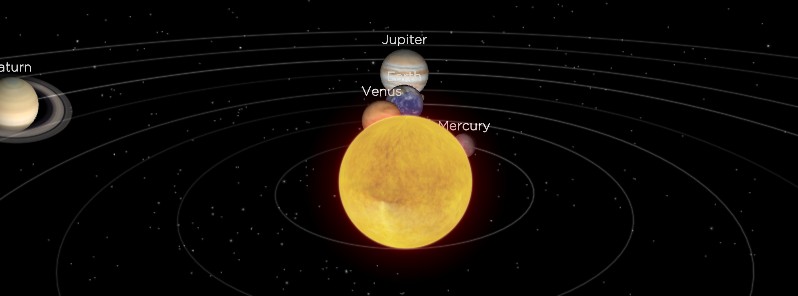
Featured image: Jupiter at opposition on April 7, 2017. Credit: SolarSystemScope
Planet Jupiter is at opposition on April 7, 2017, meaning that the Sun, Earth and Jupiter will form a straight line. At around the same time that Jupiter passes opposition (21:28 UTC), it also makes its closest approach to the Earth in 2017. By midnight (local time), Jupiter will outshine most of its competition in the night sky.
It will be brighter than any other time of the year and will be visible all night long, making tonight the best time to view and photograph the giant planet and its moons. A medium-sized telescope should be able to show you some of the details in Jupiter's cloud bands. A good pair of binoculars should allow you to see Jupiter's four largest moons, appearing as bright dots on either side of the planet.
This optimal positioning occurs when Jupiter is almost directly opposite the Sun in the sky. Since the Sun reaches its greatest distance below the horizon at midnight, the point opposite to it is highest in the sky at the same time.
At around the same time that Jupiter passes opposition, it also makes its closest approach to the Earth – termed its perigee – making it appear at its brightest and largest. This happens because when Jupiter lies opposite the Sun in the sky, the Solar System is lined up so that Jupiter, the Earth and the Sun form a straight line with the Earth in the middle, on the same side of the Sun as Jupiter.

Video courtesy NASA Goddard Space Flight Center

Video courtesy ScienceAtNASA
Over the weeks following its opposition, Jupiter will reach its highest point in the sky four minutes earlier each night, gradually receding from the pre-dawn morning sky while remaining visible in the evening sky for a few months.

Teo Blašković founded The Watchers in 2011 and edited it until 2026, covering seismic and volcanic activity, extreme weather, space weather and near-Earth objects. Articles on this page are his archive.
Published in the last 24 hours
- The storms drenching California this week are fed by a river in the sky, a band of water vapor that can carry up to 15 times the flow of the Mississippi River, and this winter’s near-record El Niño could keep aiming more of them at the West Coast
- Malawi continues Bris AI weather forecasting tests ahead of operational integration Epicenter
- Right about now, Voyager 1 is crossing a line no human-made object has ever reached, a full light-day from Earth, which means a message NASA sends tonight won't arrive until tomorrow night, and the spacecraft's answer won't make it home until the night after that
- G1 geomagnetic storm watch remains in effect as NOAA forecasts Kp 4.67 late on November 17 and early on November 18
