
Juice mission on track, world’s first lunar-Earth flyby successfully redirects spacecraft to Venus

Image credit: ESA
The European Space Agency’s JUICE mission successfully completed the world’s first lunar-Earth flyby on August 20, 2024, a vital maneuver that used the gravitational forces of the Moon and Earth to send the spacecraft toward Venus. This accomplishment is critical for saving fuel and modifying the spacecraft’s trajectory as it travels to Jupiter.
- The flyby was carried out to exploit the gravitational assistance of the Moon and Earth to alter JUICE’s trajectory and conserve fuel, ensuring it stays on track for its final destination, Jupiter. This movement enabled JUICE to test its instruments and plan for future flights.
- This lunar-earth flyby also acted as a practice run for Juice’s sophisticated technology, which will be essential for researching Jupiter’s moons. With this successful system, the mission is well on its way to investigating the ice worlds of the outer Solar System.
The European Space Agency’s Jupiter Icy Moons Explorer (JUICE) accomplished the first lunar-Earth flyby on August 20, marking an important moment in space navigation. This intricate maneuver is especially important given Juice’s voyage to Jupiter, since it uses the gravity of both the Moon and Earth to direct the spacecraft toward Venus.
The mission, led by ESA, is a multinational partnership with support from NASA, the Japan Aerospace Exploration Agency (JAXA), and the Israel Space Agency. Ignacio Tanco, Spacecraft Operations Manager, acknowledged the team’s delight at the success of this complex operation. “The gravity assist flyby was flawless, everything went without a hitch and we were thrilled to see Juice coming back so close to Earth,” he stated.
The occurrence is the first time a spacecraft has employed a combination lunar-Earth gravity assist to change its trajectory. Juice, which launched in April 2023, is on a mission to explore Jupiter and its three frozen moons: Ganymede, Callisto, and Europa.
The recent maneuver was intended to slingshot the spacecraft towards Venus, putting it on a route that would eventually go to the outer solar system. This flyby not only redirected Juice, but also allowed it to test its onboard scientific instruments in the harsh conditions of space.
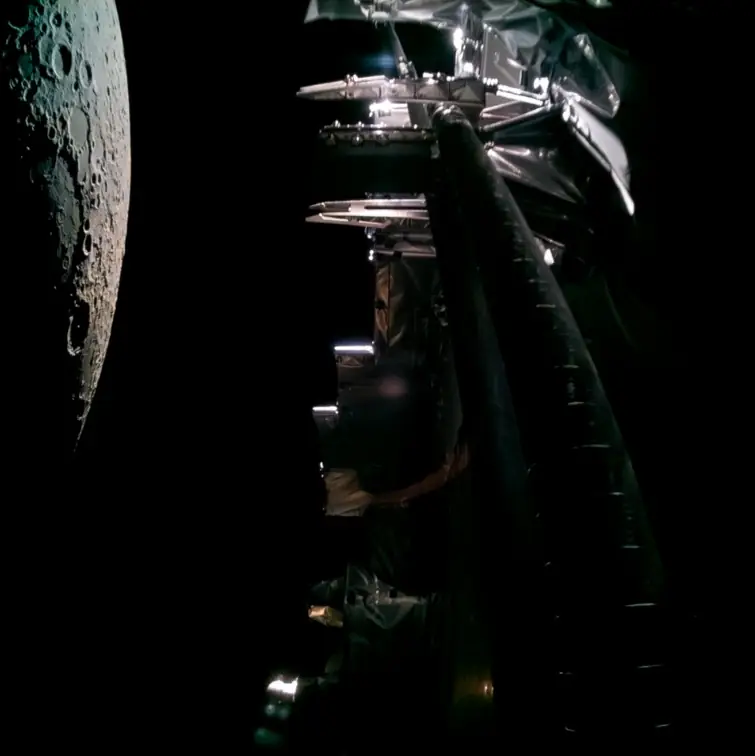


The lunar-Earth flyby occurred in the vicinity of the Moon and the Earth. Juice’s closest approach to the Moon occurred at 21:15 UTC on August 19, 2024, followed by a close pass over Southeast Asia and the Pacific Ocean, bringing it within 6 840 km (4 250 miles) of Earth at 21:56 UTC on August 20. These important flybys were placed within the Earth-Moon system, allowing Juice to make the necessary velocity and trajectory corrections.
The maneuver, which took a little over 24 hours marks Juice’s substantial course correction since its launch last year. The timing was rigorously planned, with mission operators constantly monitoring it to guarantee that the flyby was executed precisely.
The aim of this lunar-earth flyby was to conserve fuel while attaining the necessary velocity to reach Jupiter. Juice was able to adjust its speed and direction without burning much propellant by taking advantage of the gravitational pull of the Moon and Earth. This system is important for long-duration missions like Juice that require many gravity aids to reach their destinations. The completion of this maneuver assures that Juice has enough fuel reserves to carry out more science operations once it reaches Jupiter.
The flyby required detailed navigation and real-time corrections. ESA’s flight dynamics team was able to boost Juice’s speed relative to the Sun by 0.9 km/s (0.6 miles/sec) during the Moon flyby and subsequently drop it by 4.8 km/s (3 miles/sec) during the Earth flyby by precisely timing the approaches. This careful balance of speed allowed Juice to deviate by 100 degrees from its initial flight, putting it on a new trajectory for Venus, where it will flyby again in August 2025.
This lunar-earth flyby also acted as a practice run for Juice’s sophisticated technology, which will be essential for researching Jupiter’s moons. With this successful system, the mission is well on its way to investigating the ice worlds of the outer Solar System.
References:
¹ Juice rerouted to Venus in world’s first lunar-Earth flyby – ESA – August 21, 2024

Harsha Borah is an experienced content writer with a proven track record in the industry. Harsha has worked with LitSpark Solutions and Whateveryourdose, honing skills in creating engaging content across various platforms. A gold medalist in a state-level writing competition organized by Assam Tourism, Harsha’s travelogue on Tezpur was widely appreciated. Harsha’s article, "The Dark Tale of the Only Judge in India to Be Hanged," ranks second on Google and has garnered over 11 000 views and 8 900 reads on Medium. Outside of writing, Harsha enjoys reading books and solving jigsaw puzzles.

Commenting rules and guidelines
We value the thoughts and opinions of our readers and welcome healthy discussions on our website. In order to maintain a respectful and positive community, we ask that all commenters follow these rules.