
Strong M4.7 solar flare erupts from Region 2473

Image credit: NASA SDO/AIA 131
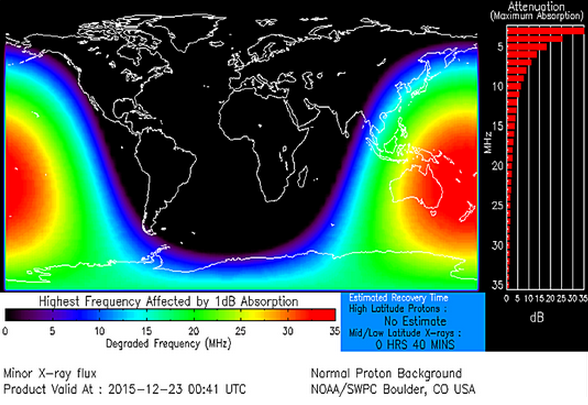
A moderately strong solar flare measuring M4.7 at its peak erupted from Region 2473 at 00:40 UTC on December 23, 2015. The event started at 00:23 and ended at 00:52 UTC.
A Type II radio sweep with estimated velocity of 1318 km/s as well as a Type IV radio sweep were associated with the event. Type IV emissions occur in association with major eruptions on the Sun and are typically associated with strong Coronal Mass Ejections (CMEs) and solar radiation storms.
Additionally, a 10cm Radio Burst lasting 1 minute with peak flux of 140 sfu was associated with the event. A 10cm radio burst indicates that the electromagnetic burst associated with a solar flare at the 10cm wavelength was double or greater than the initial 10cm radio background. This can be indicative of significant radio noise in association with a solar flare. This noise is generally short-lived but can cause interference for sensitive receivers including radar, GPS, and satellite communications.
Coronagraph imagery is still not available to confirm the CME production. However, due to region's location Earth-directed CME is unlikely.
This region has 'beta-gamma' magnetic configuration and is capable of producing more strong eruptions on the Sun. It is now rotating toward the center of the disk making Earth-directed CMEs possible in the days ahead.


SWPC alerts
Space Weather Message Code: ALTTP2
Serial Number: 1035
Issue Time: 2015 Dec 23 0117 UTC
ALERT: Type II Radio Emission
Begin Time: 2015 Dec 23 0036 UTC
Estimated Velocity: 1318 km/s
NOAA Space Weather Scale descriptions can be found at
www.swpc.noaa.gov/noaa-scales-explanation
Description: Type II emissions occur in association with eruptions on the sun and typically indicate a coronal mass ejection is associated with a flare event.
***
Space Weather Message Code: SUM10R
Serial Number: 679
Issue Time: 2015 Dec 23 0108 UTC
SUMMARY: 10cm Radio Burst
Begin Time: 2015 Dec 23 0057 UTC
Maximum Time: 2015 Dec 23 0057 UTC
End Time: 2015 Dec 23 0058 UTC
Duration: 1 minutes
Peak Flux: 140 sfu
Latest Penticton Noon Flux: 130 sfu
NOAA Space Weather Scale descriptions can be found at
www.swpc.noaa.gov/noaa-scales-explanation
Description: A 10cm radio burst indicates that the electromagnetic burst associated with a solar flare at the 10cm wavelength was double or greater than the initial 10cm radio background. This can be indicative of significant radio noise in association with a solar flare. This noise is generally short-lived but can cause interference for sensitive receivers including radar, GPS, and satellite communications.
***
Space Weather Message Code: ALTTP4
Serial Number: 521
Issue Time: 2015 Dec 23 0105 UTC
ALERT: Type IV Radio Emission
Begin Time: 2015 Dec 23 0039 UTC
NOAA Space Weather Scale descriptions can be found at
www.swpc.noaa.gov/noaa-scales-explanation
Description: Type IV emissions occur in association with major eruptions on the sun and are typically associated with strong coronal mass ejections and solar radiation storms.

Teo Blašković founded The Watchers in 2011 and edited it until 2026, covering seismic and volcanic activity, extreme weather, space weather and near-Earth objects. Articles on this page are his archive.
Published in the last 24 hours
- High Risk of excessive rainfall covers Florida’s Space Coast as St. Johns River near Cocoa reaches 5.67 m
- Four small asteroids will pass close to Earth from November 21 to 23
- Cyclone Akvan weakens after landfall near Gopalpur; more than 300 000 evacuated in Odisha, India
- A broad low over southeastern Florida and the northwestern Bahamas has a 30 percent chance of subtropical or tropical development within 48 hours and a 50 percent chance within 7 days, the National Hurricane Center says
