
Geomagnetic storms possible this weekend as CME from M1.0 solar flare heads toward Earth
An M1.0 solar flare erupted from Active Region 4373 at 08:58 UTC on February 13, 2026, launching a coronal mass ejection (CME) expected to glance Earth around February 15–16. SWPC forecasts G1 – Minor to isolated G2 – Moderate geomagnetic storm conditions as the CME interacts with a co-rotating interaction region and a positive-polarity coronal-hole high-speed stream.
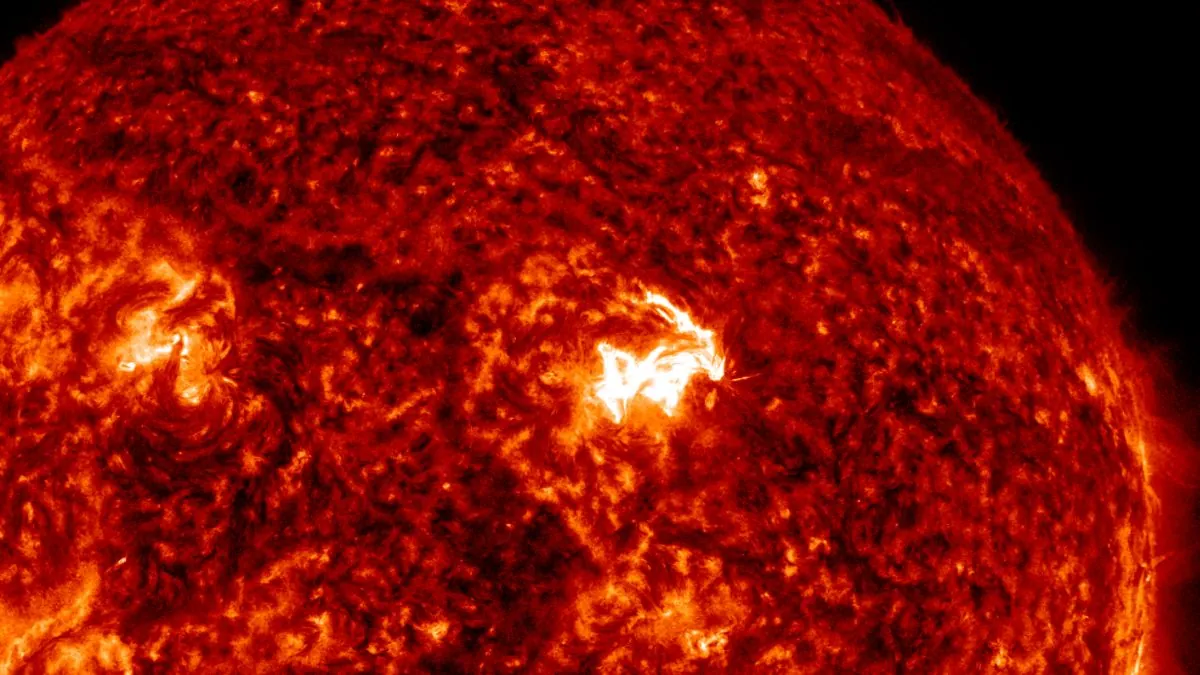
M1.0 solar flare produced by Active Region 4373 at 08:58 UTC on February 13, 2026. Credit: NASA SDO/AIA 304, The Watchers
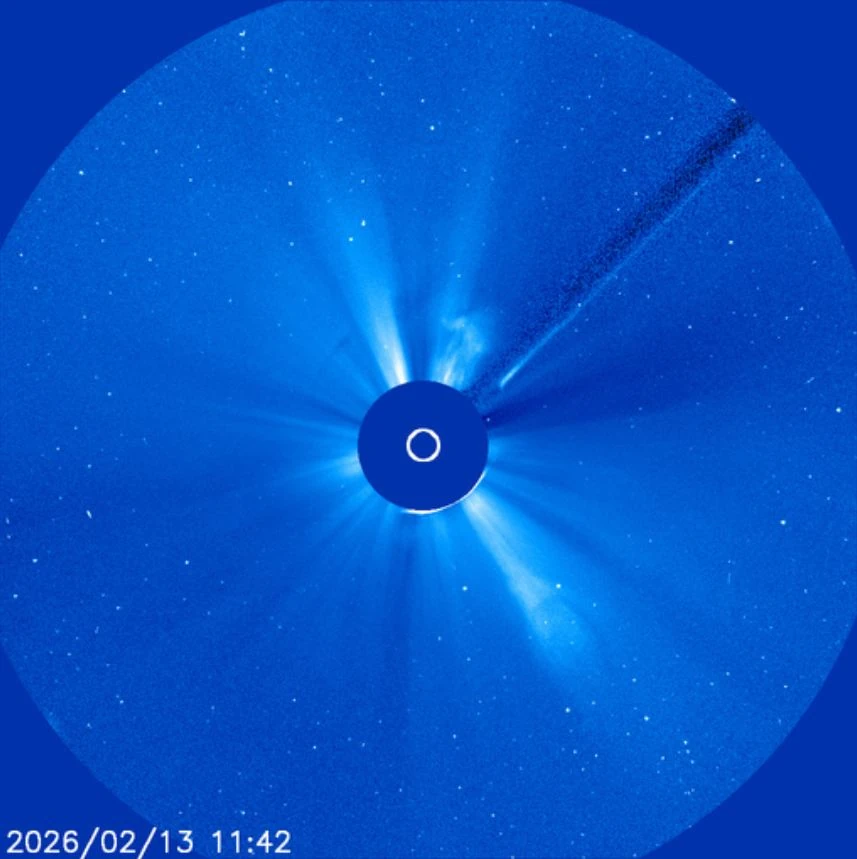
A M1.0 solar flare erupted from Active Region 4373 (beta) at 08:58 UTC on February 13. The eruption was accompanied by a coronal mass ejection (CME) first detected in SOHO LASCO C2 imagery at 09:24 UTC and in STEREO COR2 imagery at 09:38 UTC.
Model simulations from the NOAA Space Weather Prediction Center (SWPC) suggest the CME could arrive at Earth around February 15–16, potentially interacting with a co-rotating interaction region ahead of a positive-polarity coronal hole high speed stream (CH HSS).
As a result, G1 – Minor storming is possible on February 15–16, with isolated G2 – Moderate periods possible on February 15 if the CME interacts strongly with the co-rotating region and high-speed stream.

The solar wind environment was enhanced throughout February 13 under weak negative polarity coronal hole high speed stream influence mixed with transient effects. The total magnetic field (Bt) ranged from 5 to 9 nT and the Bz component was mostly southward with intervals reaching −9 nT.
Solar wind speed rose from about 375 km/s early in the day to near 500 km/s by day’s end. The interplanetary magnetic-field phi angle shifted from negative to positive orientation around 21:00 UTC, signaling the approach of the new stream.
Forecast models suggest the solar wind environment will become increasingly disturbed on February 14 as co-rotating interaction region effects and positive polarity high speed stream influences arrive. Weak CME contributions are possible through February 16 as the ejections from February 11 and 13 move past Earth.
Geomagnetic conditions reached active levels on February 13 under waning negative polarity stream effects and mild transients. NOAA forecasts quiet to active conditions for February 14, followed by G1 – Minor storming on February 15–16, with isolated G2 – Moderate periods possible on February 15 if the CME interacts strongly with the co-rotating region and high speed stream.
G1 geomagnetic storms can produce weak power grid fluctuations and minor impacts on satellite operations. Auroras can extend to near 60° geomagnetic latitude, often visible across parts of Canada, Alaska, northern Europe, and southern New Zealand.
During G2 conditions, power systems may experience voltage alarms at high latitudes, and spacecraft can encounter increased drag and surface charging. Aurora can become visible farther south, reaching northern United States states such as Montana, North Dakota, and Minnesota, as well as northern parts of the British Isles and central Scandinavia.

Energetic particle measurements showed greater than 2 MeV electron flux peaking at 1 120 pfu at 17:45 UTC on February 13 (high levels). Moderate to high electron flux is expected to continue through February 16, while greater than 10 MeV proton flux remains at background levels.
SWPC forecasts low solar activity levels through February 16 with a slight chance of M-class flares. Region 4374 developed a small trailer spot, while other active regions remained stable.
References:
1 Forecast Discussion – NOAA/SWPC – Issued at 00:30 UTC on February 14, 2026

I'm a dedicated researcher, journalist, and editor at The Watchers. With over 20 years of experience in the media industry, I specialize in hard science news, focusing on extreme weather, seismic and volcanic activity, space weather, and astronomy, including near-Earth objects and planetary defense strategies. You can reach me at teo /at/ watchers.news.

Commenting rules and guidelines
We value the thoughts and opinions of our readers and welcome healthy discussions on our website. In order to maintain a respectful and positive community, we ask that all commenters follow these rules.