
Active Region 1652 produced M1.0 solar flare
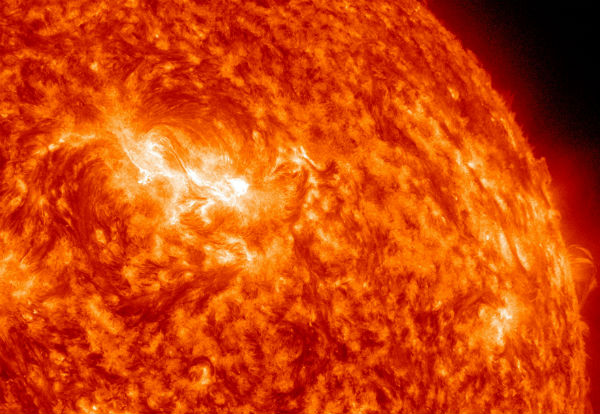
Image credit: TW
Beta-gamma-delta Active Region 1652 generated M1.0 solar flare at 00:50 UTC on January 13, 2013. Considering the position of Sunspot 1652, which is facing Earth, geoeffective CME is possible.
 Active Region 1652 (Credit: SDO/The Watchers)
There are currently 9 numbered sunspots. Active Regions 1652 and 1654 reached beta-gamma magnetic complexity and are capable of producing M-class and X-class solar flares in coming days. NOAA/SWPC forecasters estimate 65% chances of M-class and 10% chances of X-class solar flares.
 Visible sunspots on January 12/13, 2013 (Credit: SDO/The Watchers)
 Solar regions summary (Credit: NOAA/SWPC)

Published in the last 24 hours
- High Risk of excessive rainfall covers Florida’s Space Coast as St. Johns River near Cocoa reaches 5.67 m
- Asteroid 2026 WJ to pass Earth at 1.7 lunar distances at 04:20 UTC on November 22, with 2026 WD following at 4.4 lunar distances on November 23
- Cyclone Akvan crossed the north Andhra Pradesh and south Odisha coasts close to Gopalpur on November 20 with 70-80 km/h winds gusting to 90, and has weakened into a deep depression
- A broad low over southeastern Florida and the northwestern Bahamas has a 30 percent chance of subtropical or tropical development within 48 hours and a 50 percent chance within 7 days, the National Hurricane Center says
