
Large explosive eruption seen at Manam volcano northeast of New Guinea
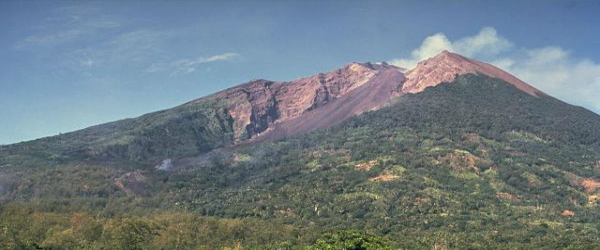
Image credit: Wally Johnson /Australia Bureau of Mineral Resources
A large eruption occurred on January 12, 2013 at Manam volcano northeast of New Guinea. VAAC Darwin reported an ash plume rising up to 14 km (approx. 45,000 ft) altitude. A hot spot is visible on MODIS satellite data.
 Manam’s volcanic ash advisory graphics (Credit: VAAC Darwin)
 Recent OMI satellite data shows a modest SO2 anomaly over the volcano (Credit: NOAA/OMI)
During December 8-14, 2012 diffuse and dense ash plumes rose 400 m above Manam’s Southern Crater and drifted NW after strombolian explosions. Small lava flows on upper flank from two vents. Most of the island population had been relocated after the last major activity in 2004. 5 people were killed, mostly due to inhaling ash, and 9600 people were evacuated. The ash damaged crops, water supplies, and houses.
 Manam volcano (Credit: Wally Johnson /Australia Bureau of Mineral Resources)
Papua New Guinea’s Manam Volcano sits in the southwest segment of the Pacific Ring of Fire where the Pacific Plate sinks beneath the Indo-Australian Plate. One of the region’s most active volcanoes, Manam forms a tiny 10-kilometer wide island that rises from the Bismarck Sea 13 kilometers off the shore of Papua New Guinea. The volcano has erupted frequently since its first recorded eruption in 1616.

Published in the last 24 hours
- High Risk of excessive rainfall covers Florida’s Space Coast as St. Johns River near Cocoa reaches 5.67 m
- Asteroid 2026 WJ to pass Earth at 1.7 lunar distances at 04:20 UTC on November 22, with 2026 WD following at 4.4 lunar distances on November 23
- Cyclone Akvan crossed the north Andhra Pradesh and south Odisha coasts close to Gopalpur on November 20 with 70-80 km/h winds gusting to 90, and has weakened into a deep depression
- A broad low over southeastern Florida and the northwestern Bahamas has a 30 percent chance of subtropical or tropical development within 48 hours and a 50 percent chance within 7 days, the National Hurricane Center says
