
High-level eruption at Bezymianny volcano, Russia

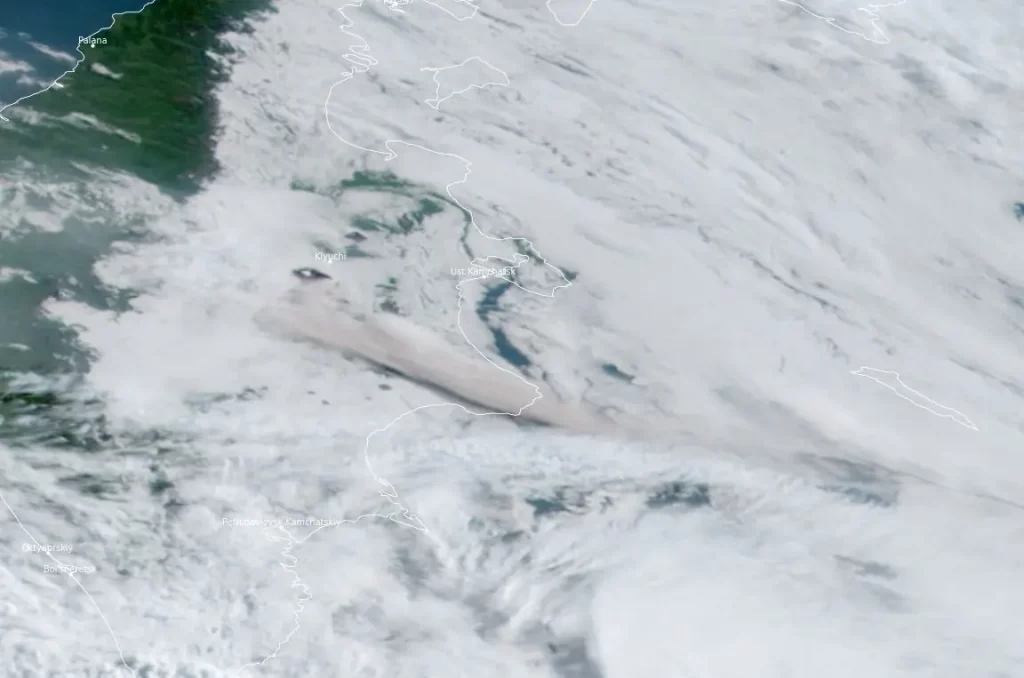
Featured image: Satellite image of ash rising from Bezymianny volcano at 19:00 UTC on July 24, 2024. Credit: JMA/Himawari-9, RAMMB/CIRA, The Watchers
A strong explosive eruption began at Bezymianny volcano, Kamchatka, Russia, at 15:10 UTC on July 24, 2024, ejecting ash up to 12 km (40 000 feet) above sea level.
- Bezymianny has experienced three periods of intensified activity over the past 3 000 years (VEI 3 – 5).
- The most recent period began with a significant eruption in 1955-56, which followed 1 000 years of dormancy.
Today’s first explosions sent ash up to 9.6 km (31 500 feet) above sea level and later up to 12 km (40 000 feet) a.s.l.
The large ash plume produced by the eruption continues to move to the east-southeast of the volcano, and at 19:30 UTC, it was 300 km (186 miles) away.
The Aviation Color Code was raised to Red at 20:02 UTC today for the first time since October 18, 2023, when a large explosion produced ash plumes that rose 10 – 11 km (32 800 – 36 100 feet) a.s.l.
While ashfalls do not currently threaten populated areas of the Kamchatka Krai, the explosive eruption of the volcano continues. Ongoing activity could affect international and low-flying aircraft.
An extrusive eruption of the volcano increased significantly on July 21, with pyroclastic flows on the eastern slopes of the lava dome, sending ash up to 2 – 3 km (6 600 – 9 800 feet) a.s.l.
Satellite data acquired by KVERT on July 22 showed a significant increase in the size and temperature of the thermal anomaly over the volcano. On the same day, KVERT reported that ash explosions up to 10 – 15 km (32 800 – 49 200 feet) a.s.l. could occur over the next three days.
Bezymianny volcano, located on the Kamchatka Peninsula, is a relatively small volcano formed approximately 4 700 years ago over an older lava-dome complex and an edifice built 11 000 – 7 000 years ago.
It has experienced three periods of intensified activity over the past 3 000 years (VEI 3 – 5).
The most recent period began with a significant eruption in 1955-56, which followed 1 000 years of dormancy.
This eruption, similar to the 1980 Mount St. Helens eruption, created a large open crater through the collapse of the summit and a lateral blast. Since then, the crater has been largely filled by ongoing lava-dome growth, accompanied by intermittent explosive activity and pyroclastic flows.
References:
1 VONA/KVERT Information Release for Bezymianny – KVERT/FEB RAS – July 24, 2024
2 Bezymianny – Geological summary – GVP – Accessed July 24, 2024

Teo Blašković founded The Watchers in 2011 and edited it until 2026, covering seismic and volcanic activity, extreme weather, space weather and near-Earth objects. Articles on this page are his archive.
Published in the last 24 hours
- Flying glass cut a teacher in Russia but none of her 44 pupils, because when a meteor flashed across the sky in 2013, she told them to get under their desks Epicenter
- A South Dakota man put the widest and heaviest hailstone on US record in his freezer, and a power cut melted part of it before NOAA measured it at 8 inches across and nearly 2 pounds in 2010 Epicenter
- Black kites and brown falcons in northern Australia have been seen snatching smoldering sticks from wildfires, flying them into unburned grass and dropping them, starting new fires that send lizards, rodents and insects running straight toward the waiting birds Epicenter
- A levee protecting a highway north of San Francisco is pocked with animal burrows and only 3 feet wide in places, and a report warns this winter's El Niño could push water over the top Epicenter
