
Major X14 solar flare erupts on the Sun’s far side, the strongest flare of Solar Cycle 25
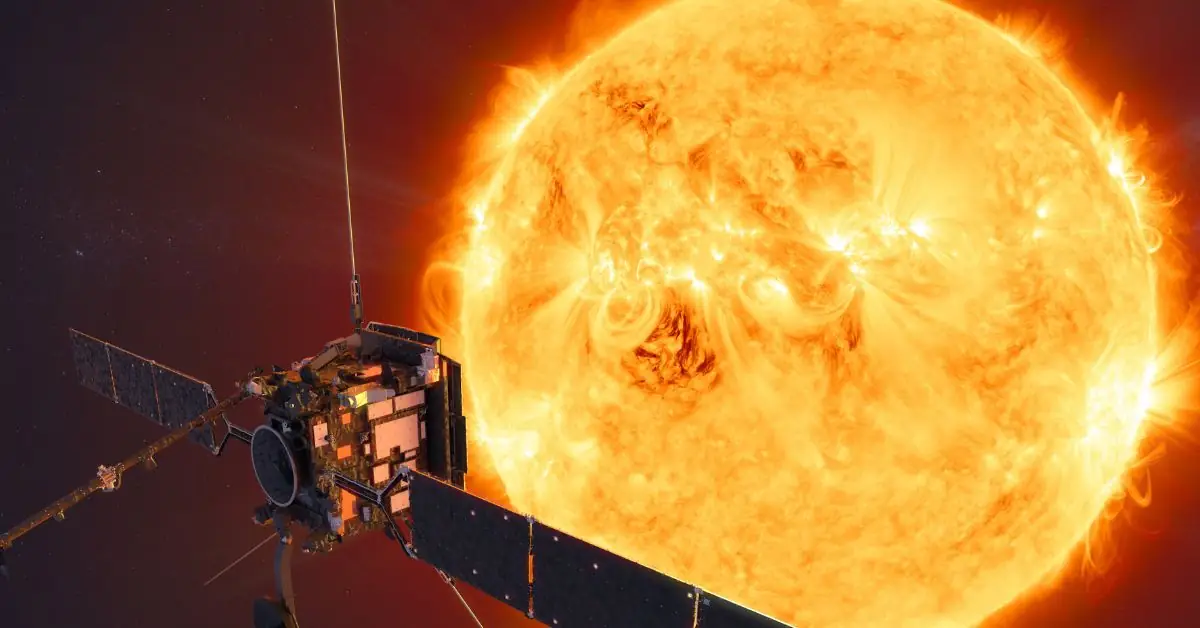
Image credit: ESA/Solar Orbiter
A major, long-duration solar flare measuring X14 erupted on the Sun’s far side around 00:00 UTC on July 23, 2024, producing a full halo coronal mass ejection (CME). The event sent energetic particles throughout the solar system, including Earth, where it caused an S1 – Minor solar radiation storm.
- The X14 farside solar flare on July 23, 2024, was detected by ESA’s Solar Orbiter.
- This is the strongest solar flare of Solar Cycle 25.
- The source region is expected to turn into Earth-view next week.
On Earth, we experienced an S1 – Minor solar radiation storm starting at 02:50 UTC on July 23 and lasting for the remainder of the UTC day.
While only minor effects were observed on Earth due to the location of the source region, this flare was estimated as X14 by the STIX X-ray telescope aboard ESA’s Solar Orbiter, making it the strongest solar flare of the current solar cycle, Solar Cycle 25.
George Ho, a space physicist at Johns Hopkins Applied Physics Laboratory (APL) and the principal investigator of the Suprathermal Ion Spectrograph (SIS) — one of four sensors in an instrument suite that measures the composition of energetic electrons, protons, and heavy ions from the Sun — said ‘this was a big, 360-degree event’ that also had a high impact on planet Mars.
The region that produced the July 23 X14 solar flare will rotate into Earth’s view next week.


Solar Orbiter also detected an X12 solar flare on May 20, 2024, which was previously the strongest flare of Solar Cycle 25 and among the top 10 flares since 1996, and an X10 on July 17, 2023 — both from the far side of the Sun.
The largest solar flare detected on the Earth-facing side of the Sun was X8.9 on May 14, 2024, just three days after a series of CMEs hit Earth, causing a G5 – Extreme geomagnetic storm — the strongest since 2003.
This geomagnetic storm forced thousands of satellites in Low Earth Orbit (LEO) to begin mass maneuvers in response to the sudden increase in atmospheric density after the CMEs impacted Earth.
On Earth, such powerful solar flares can cause widespread disruptions to power grids, satellite communications, and navigation systems, as seen in events like the Great Quebec Blackout in March 1989.

I'm a dedicated researcher, journalist, and editor at The Watchers. With over 20 years of experience in the media industry, I specialize in hard science news, focusing on extreme weather, seismic and volcanic activity, space weather, and astronomy, including near-Earth objects and planetary defense strategies. You can reach me at teo /at/ watchers.news.

Commenting rules and guidelines
We value the thoughts and opinions of our readers and welcome healthy discussions on our website. In order to maintain a respectful and positive community, we ask that all commenters follow these rules.