
Hydrothermal explosion in Yellowstone’s Biscuit Basin thermal area damages nearby boardwalk
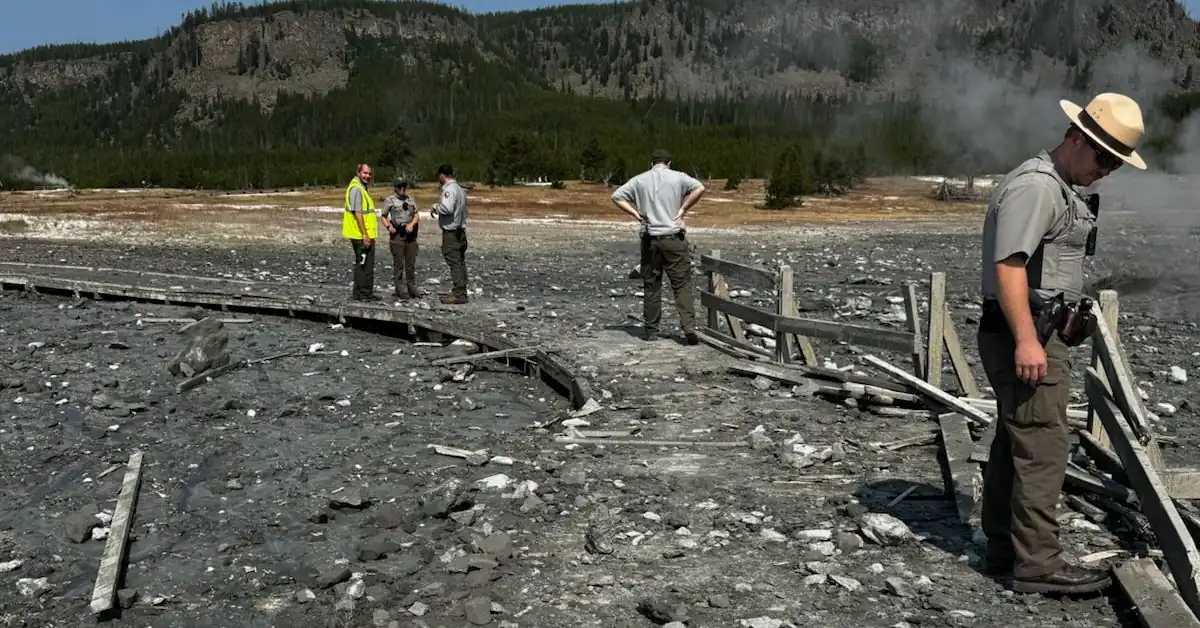
Image credit: National Park Service
A small hydrothermal explosion occurred in Yellowstone National Park in the Biscuit Basin thermal area at around 16:19 UTC (10:19 MST) on July 23, 2024.
According to the USGS Yellowstone Volcano Observatory (YVO), the explosion appears to have originated near Black Diamond Pool, about 3.5 km (2.1 miles) northwest of Old Faithful.
The eruption damaged a nearby boardwalk, but despite visitors being near the eruption site, nobody was injured.
Biscuit Basin, including the parking lot and boardwalks, is temporarily closed for visitor safety, but the Grand Loop road remains open.
#Yellowstone Park staff are on scene assessing conditions after a small hydrothermal explosion occurred today (July 23) in #BiscuitBasin. There are no reports of injuries. The boardwalk, on the other hand, will need a few repairs. The area remains temporarily closed. NPS photos. pic.twitter.com/XrHuUhw7fk
— USGS Volcanoes (@USGSVolcanoes) July 23, 2024
(Heads Up!) Biscuit Basin in Yellowstone National Park temporarily closed due to hydrothermal explosion. More info: https://t.co/tcDR8oRNSx pic.twitter.com/YP7CkwNrQR
— Yellowstone National Park (@YellowstoneNPS) July 23, 2024
“Monitoring data show no changes in the Yellowstone region and the explosion does not reflect activity within the volcanic system, which remains at normal background levels of activity,” YVO volcanologists said.
“Hydrothermal explosions like that of today are not a sign of impending volcanic eruptions, and they are not caused by magma rising towards the surface.”
Numerous videos of the event were recorded by visitors:


Hydrothermal explosions occur when water suddenly flashes to steam underground, and they are relatively common in Yellowstone.
For example, Porkchop Geyser, in Norris Geyser Basin, experienced an explosion in 1989, and a small event in Norris Geyser Basin was recorded by monitoring equipment on April 15, 2024. An explosion similar to that of today also occurred in Biscuit Basin on May 17, 2009.
The Volcano Alert Level remains at NORMAL and the Aviation Color Code at GREEN.
References:
1 YELLOWSTONE VOLCANO OBSERVATORY INFORMATION STATEMENT – USGS/YVO – Issued at 19:24 UTC on July 23, 2024

Teo Blašković founded The Watchers in 2011 and edited it until 2026, covering seismic and volcanic activity, extreme weather, space weather and near-Earth objects. Articles on this page are his archive.
Published in the last 24 hours
- In September 1859, a solar storm lit up the night sky so brightly that gold miners in the Rocky Mountains woke up after midnight and started cooking breakfast, convinced the aurora glowing over their camp was the sunrise Epicenter
- A patch of warm Pacific water that could become the strongest El Niño in more than 70 years sits thousands of miles from any American town, yet it is already the main reason NOAA expects a wetter winter across the South and a milder one across the North
- A 19-year-old Nebraska teacher reportedly tied her pupils together with twine and led them to safety through a blizzard in January 1888 Epicenter
