
Moderate solar flare reaching M1.7 erupted from AR 1652
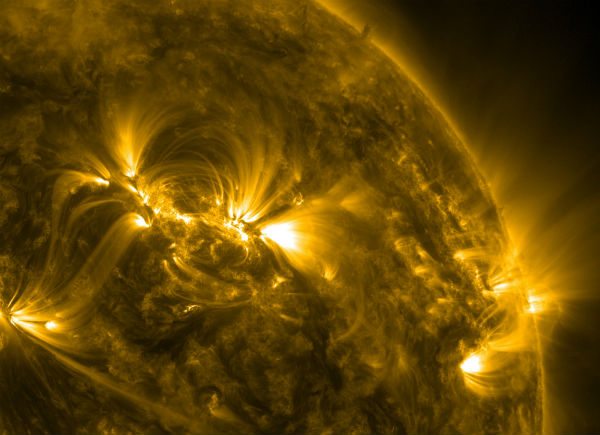
Image credit: TW
A second moderate solar flare erupted on January 13, 2013 from AR 1652. M1.7 solar flare peaked at 08:38 UTC. The event started at 08:35, peaked at 08:38 and ended at 08:40 UTC. Type II and IV radio emissions were associated with the event. Type II emissions occur in association with eruptions on the sun and typically indicate a coronal mass ejection is associated with a flare event. Type IV emissions occur in association with major eruptions on the sun and are typically associated with strong coronal mass ejections and solar radiation storms.
 X-ray flux – January 13, 2013 – M1.7
 M1.7 flare seen in combined AIA imagery (Credit: SDO)
Earlier today the same Active Region 1652 classified with beta-gamma-delta magnetic configuration generated an M1.0 solar flare at 00:50 UTC. AR 1652 generated 2 M-class and 20 C-class solar flares in the past 24 hours. Considering the position of Sunspot 1652, which is facing Earth, geoeffective CME is possible.
 Recent sunspot regions (Credit: SDO/The watchers)
There are currently 9 numbered sunspots with AR 1652 and AR 1654 capable of generating more M-class and X-class solar flares. NOAA/SWPC forecasters estimate there is 65% chance for an M-class solar flare and 10% chance for an X-class solar flare.
Space Weather Message Code: ALTTP2
Serial Number: 834
Issue Time: 2013 Jan 13 0918 UTCALERT: Type II Radio Emission
Begin Time: 2013 Jan 13 0839 UTC
Estimated Velocity: 907 km/s
Description: Type II emissions occur in association with eruptions on the sun and typically indicate a coronal mass ejection is associated with a flare event.***
Space Weather Message Code: ALTTP4
Serial Number: 400
Issue Time: 2013 Jan 13 0918 UTCALERT: Type IV Radio Emission
Begin Time: 2013 Jan 13 0845 UTC
Description: Type IV emissions occur in association with major eruptions on the sun and are typically associated with strong coronal mass ejections and solar radiation storms.
 Sunspots and magnetic configuration on January 13, 2013

Teo Blašković founded The Watchers in 2011 and edited it until 2026, covering seismic and volcanic activity, extreme weather, space weather and near-Earth objects. Articles on this page are his archive.
Published in the last 24 hours
- High Risk of excessive rainfall covers Florida’s Space Coast as St. Johns River near Cocoa reaches 5.67 m
- Asteroid 2026 WJ to pass Earth at 1.7 lunar distances at 04:20 UTC on November 22, with 2026 WD following at 4.4 lunar distances on November 23
- Cyclone Akvan weakens after landfall near Gopalpur; more than 300 000 evacuated in Odisha, India
- A broad low over southeastern Florida and the northwestern Bahamas has a 30 percent chance of subtropical or tropical development within 48 hours and a 50 percent chance within 7 days, the National Hurricane Center says
