
GOES-15 replaces GOES-11 as the operational GOES-West satellite
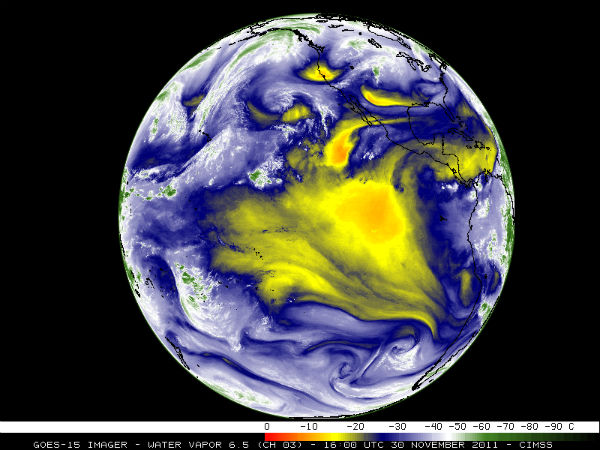
Image credit: TW
For all our readers that use satellite images CIMSS Satellite blog announced today that at 15:46 UTC on 06 December 2011, GOES-15 replaced GOES-11 as the operational GOES-West satellite. GOES-11 (launched in 2000, and operational since 2006) was one of the older GOES-I/J/L/K/M series of satellites, while GOES-15 (launched in 2010) is one of the newer GOES-N/O/P series of satellites — so there are some important differences that operational users of the imagery should be aware of:
- Improved water vapor channel (Imager channel 3)
- Slightly different visible channel (Imager chanel 1)
- 13.3 µm IR (Imager channel 6) replaces the 12.0 µm IR (Imager channel 5)
- Improved Image Navigation and Registration (INR)
- Shorter image outages during Spring and Fall season “eclipse periods”
- Less noise on many of the Sounder channels

The improvement made to the GOES-15 Imager instrument water vapor channel is likely the most important change to operational users. In the sequence of AWIPS images above, the first 3 images are using the 8-km resolution GOES-11 6.7 µm channel as the source for GOES-West water vapor imagery, while the final 3 images use the 4-km resolution GOES-15 6.5 µm channel. Note the change to slightly warmer/drier water vapor brightness temperatures (brighter yellow color enhancement) after the changeover to GOES-15. In addition, notice that the north-south “seam” joining the GOES-West and GOES-East water vapor channel images disappears, since the characteristics of the water vapor channels are identical on those two satellites.
In the sequence of AWIPS images below, the first 2 images are using the GOES-11 Sounder instrument 6.5 µm channel as the source for GOES-West water vapor imagery, while the final 2 images use the GOES-15 Sounder 6.5 µm channel. Note the improvement in noise seen in the Sounder instrument water vapor images after the changeover to GOES-15. Since the 3 GOES Sounder water vapor channels are a component of the GOES Sounder Total Precipitable Water derived product imagery, the quality of that product should also improve.

In terms ofthe visible imagery, a similar comparison using GOES-11 (the first 3 images) vs GOES-15 (the final set of 3 images) Imager visible channel data is seen below (during a test on 29 November). Immediately obvious is the fact that the GOES-15 visible channel imagery appears “brighter” than the GOES-11 visible channel imagery — this is due to the fact that the performance of the GOES visible detectors degrades over time (GOES-11 was launched in 2000, and became the operational GOES-West satellite in 2006). The 0.63 µm visible channel on GOES-15 is also slightly different than the 0.65 µm visible channel on GOES-11, as is discussed in the “GOES-13 is now the operational GOES-East satellite” CIMSS blog post. GOES-15 is similar to GOES-13, since it is part of the GOES-N/O/P series of spacecraft.


Published in the last 24 hours
- Male toads abandoned a pond in Italy five days before a deadly 2009 earthquake, while a scientist was counting them Epicenter
- An asteroid was spotted 19 hours before it exploded over Sudan in 2008, and students picked its pieces off the desert Epicenter
- A wave up to 3 m (10 feet) high rose out of Lake Michigan on a sunny June morning in 1954 and swept fishermen off Chicago’s piers, and when a second came 10 days later, warnings had cleared the shore Epicenter
- Just 12 inches of rushing water can carry away most cars, and more than half of US flood drownings happen to people who drive into flood water Epicenter
