
Sunspot 1363 subsiding, solar activity remains low
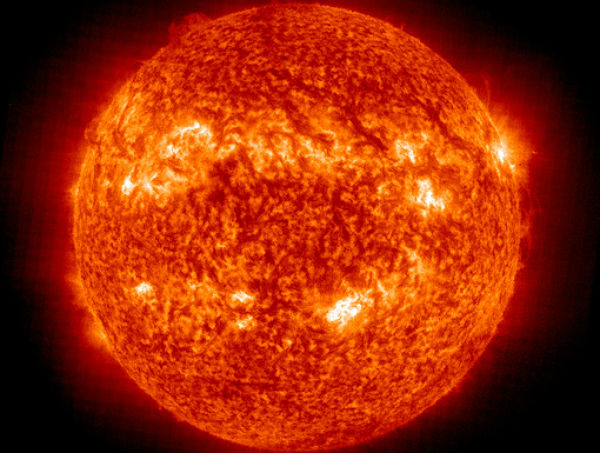
Image credit: TW
After three days of meteoric growth, sunspot AR1363 has reversed course and is beginning to decay. As its magnetic field relaxes, the active region poses a subsiding threat for strong flares. It’s not dead yet, though, as this snapshot shows:
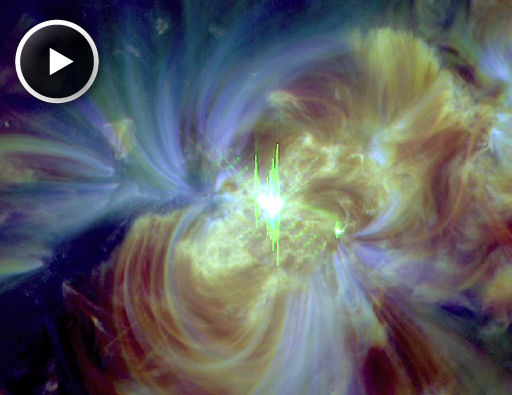
There is still a slim chance that AR1363 will buck the trend and unleash a major M- or X-class eruption. If such an flare happens today, it will be geoeffective because the sunspot is facing Earth. Quiet, however, is more likely. (SpaceWeather)
Solar wind
speed: 296.8 km/sec
density: 2.6 protons/cm3
The Radio Sun
10.7 cm flux: 158 sfu
Planetary K-index
Now: Kp= 0 quiet
24-hr max: Kp= 1 quiet
Interplanetary Mag. Field
Btotal: 2.1 nT
Bz: 0.4 nT south
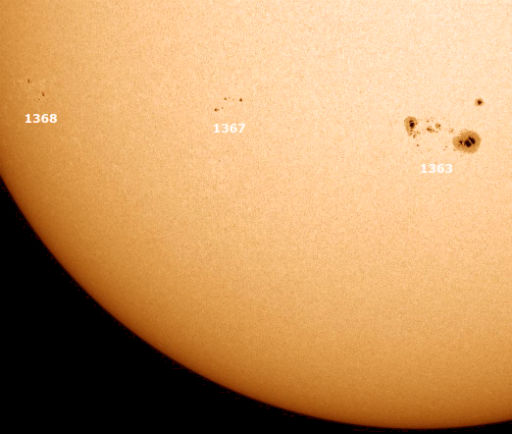
Despite the numerous visible sunspot regions, including Sunspot 1363 which has a Beta-Gamma magnetic classification, solar activity has been fairly low over the past 48 hours. The largest flare thus far was a C6.9 which occurred Monday evening. There will remain the risk of an M-Class event on Tuesday. (SolarHam)
Joint USAF/NOAA Report of Solar and Geophysical Activity (06 Dec 2011)
Solar activity was low. Region 1363 (S22W20) produced the sole C-class event, a C6 x-ray flare at 05/2325Z.
Solar activity is expected to be low for the next 3 days (7-9 December).
The geomagnetic field was quiet and is expected to be mostly quiet for the next 3 days (7-9 December). (NOAA/SWPC)


Commenting rules and guidelines
We value the thoughts and opinions of our readers and welcome healthy discussions on our website. In order to maintain a respectful and positive community, we ask that all commenters follow these rules.