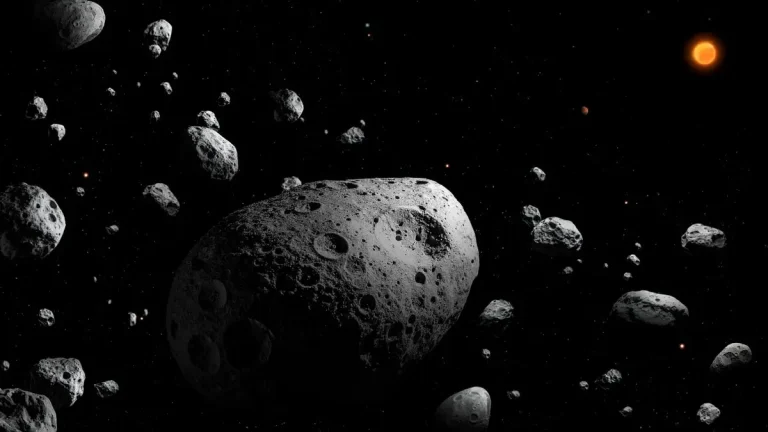
• This 700-m asteroid is spinning so fast it shouldn’t exist

    Astronomers analyzing early commissioning data from the NSF–DOE Vera C. Rubin Observatory have identified the fastest-spinning asteroid ever confirmed at sizes larger than 500 m (0.3 miles). The object, designated 2025 MN45, was observed in April–May 2025 and reported in a peer-reviewed study published on January 7, 2026.

  • A star shredded by a black hole unleashes a jet seen across 8 billion light years

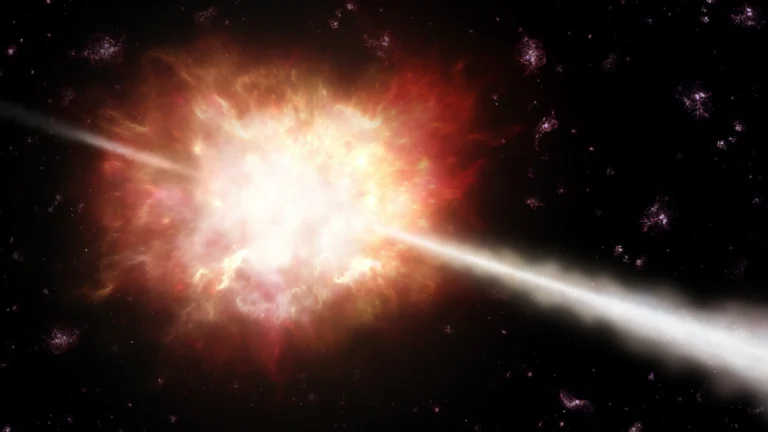
    A rare and extremely luminous tidal disruption event, designated AT2022cmc, was detected in 2022 at cosmological distance after a Sun-like star was torn apart by a supermassive black hole, producing a relativistic jet observed from Earth across optical, X-ray, radio, and submillimetre wavelengths.

  • ALMA peers inside a colossal edge on disk where giant planets may already be forming

    Astronomers using the Atacama Large Millimeter/submillimeter Array found an unusually revealing target in “Gomez’s Hamburger,” a protoplanetary disk seen almost edge-on, where neatly layered gas and dust expose how giant planets may begin assembling deep within young planetary systems.

  • Two massive space rock collisions detected around Fomalhaut

    Hubble Space Telescope observations have identified two transient debris clouds produced by separate planetesimal collisions in the Fomalhaut planetary system, located about 25 light-years from Earth, with the second event detected in 2023. The findings indicate that objects previously interpreted as candidate exoplanets are instead the dusty aftermath of rare, high-energy impacts within the system’s debris belt.