Scientists may have finally “seen” dark matter for the first time
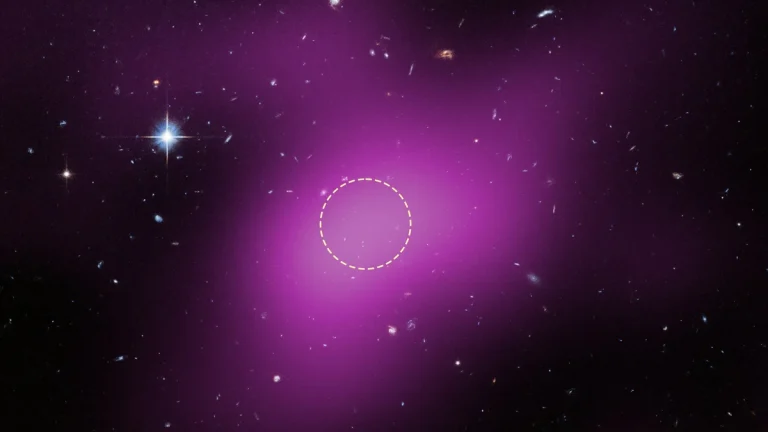
A new study reports possible detection of dark matter through a 20 GeV gamma-ray halo around the Milky Way, based on 15 years of NASA’s Fermi Gamma-ray Space Telescope data.
The exploration of celestial bodies and cosmic phenomena beyond Earth. This field seeks to uncover the mysteries of the universe, including the nature of stars, planets, galaxies, and the laws governing space and time.

A new study reports possible detection of dark matter through a 20 GeV gamma-ray halo around the Milky Way, based on 15 years of NASA’s Fermi Gamma-ray Space Telescope data.

Electric discharges caused by dust devils and dust storms on Mars have been detected for the first time, according to data from NASA’s Perseverance rover, published in Nature on November 26, 2025.

A recent analysis reports the detection of a previously unrecognized concentration of Kuiper belt objects near 43 astronomical units, located just inward of the well known 44 astronomical unit kernel and identified through clustering of barycentric free orbital elements.

A recent study published in Science shows that Theia, the planetary body that collided with early Earth around 4.5 billion years ago and formed the Moon, originated in the inner Solar System, likely closer to the Sun than Earth.

Astronomers have identified the 40 000th near-Earth asteroid (NEA), marking a major milestone in planetary defense monitoring. The catalog expanded from 30 000 objects in 2022 to 40 000 in 2025, driven by advanced survey telescopes, automated orbit analysis, and coordinated international data sharing.

NASA spacecraft positioned from Mars orbit to near-Sun vantage points have collected coordinated observations of interstellar comet 3I/ATLAS, forming a solar system–wide dataset as the object travels inward ahead of its December 19, 2025 closest approach to Earth.

ESA scientists analysing a decade of Swarm satellite data have found that equatorial GPS signal disruptions follow a universal mathematical law describing many natural systems, suggesting the ionosphere behaves as a self-organising complex system.

Astronomers confirmed the first coronal mass ejection ever observed from another star at about 130 light-years away, using LOFAR and XMM-Newton, according to research published this week in Nature.

A meteoroid impact near Apollinaris Mons triggered more than one hundred new slope streaks that were imaged by ESA’s ExoMars Trace Gas Orbiter on December 24, 2023. Additional analysis shows the impact and streak formation occurred between 2013 and 2017, offering a rare example of modern surface change on Mars that scientists can link directly to a specific event.

A study published on October 30, 2025, reveals how the May 2024 super geomagnetic storm dramatically reshaped the ionosphere across the Asia-Pacific, producing intense hemispheric asymmetries that challenge existing space weather models.