• Universe’s expansion may already be slowing, new study suggests

    A new analysis of more than 300 Type Ia supernovae by astronomers at Yonsei University, published on November 6, 2025 in Monthly Notices of the Royal Astronomical Society, finds evidence that the Universe’s expansion has already begun to slow — challenging the long-standing idea of an accelerating cosmos driven by dark energy.

  • Magnetic flows surge at the Sun’s south pole, defying solar physics models

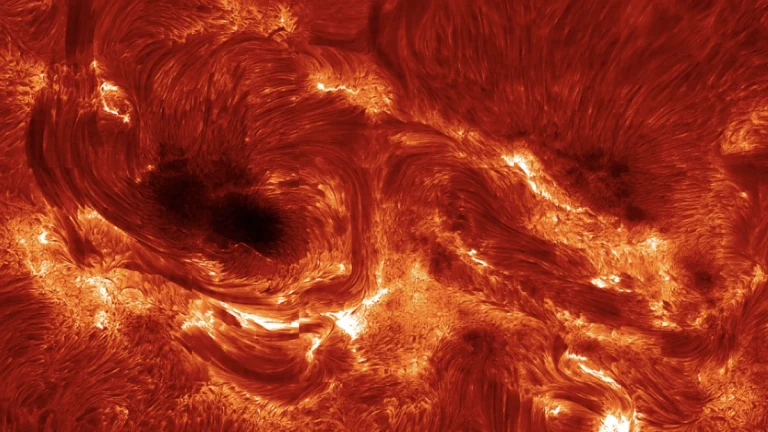
    Data from ESA’s Solar Orbiter, published on November 5, 2025 in The Astrophysical Journal Letters, show magnetic fields at the Sun’s south pole flowing toward the pole at 10–20 m/s (33–66 ft/s). The discovery overturns decades of theory about how the Sun’s magnetic field circulates.

  • X45 superflare of 2003 rivaled Carrington Event and carried potential to trigger a planetary-scale power-grid collapse

    A solar flare of extraordinary intensity erupted from Active Region 10486 at 19:29 UTC on November 4, 2003, overwhelming every X-ray detector in orbit and leaving scientists temporarily blind to its true scale. Only later would they learn it reached about X45 — the most powerful ever measured in the Space Age. Its radiative power rivaled that of the 1859 Carrington Event, yet most of its debris was ejected harmlessly sideways into space. Had Active Region 10486 faced Earth, researchers estimate the geomagnetic index Dst could have dropped below –850 nanoteslas — enough to trigger a planetary-scale power-grid collapse.

  • Astronomers uncover Earth-sized planets in a compact binary system

    Astronomers have confirmed two Earth-sized planets and a third candidate orbiting both stars of the binary system TOI-2267 in the constellation Canis Minor, according to observations analyzed from NASA’s Transiting Exoplanet Survey Satellite (TESS) and ground telescopes between 2019 and 2025. The finding, published in Astronomy & Astrophysics, reveals that rocky worlds can form and persist in gravitational environments once thought too unstable for complex planetary systems.

  • Astronomers detect rare ammonia signal from comet 12P/Pons-Brooks

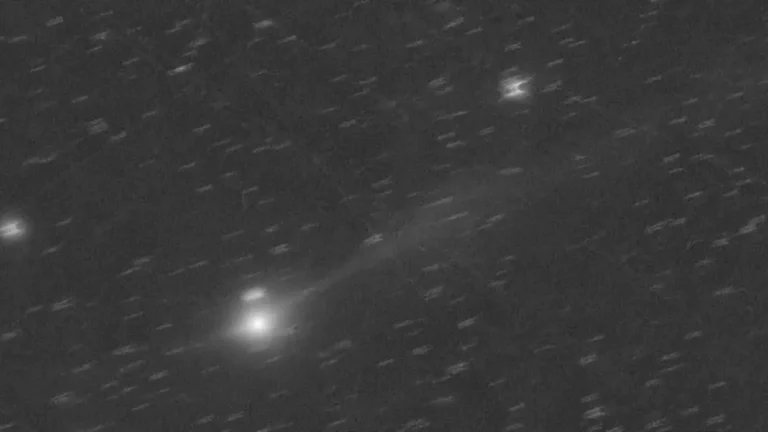
    Scientists at the Shanghai Astronomical Observatory used the Tianma 65 m Radio Telescope in China to detect hydroxyl and ammonia radio emissions from comet 12P/Pons-Brooks between December 2023 and March 2024, marking the most distant ammonia detection ever recorded in a Halley-type comet and revealing how volatile gases drive its powerful outbursts.

  • How ancient heavy water in a distant star’s disk explains Earth’s oceans

    Astronomers using the Atacama Large Millimeter/submillimeter Array (ALMA) detected heavy water in the planet-forming disk around V883 Ori, a young star 400 parsecs (1 300 light years) away in Orion. This first-ever discovery of doubly deuterated water (D₂O) shows that some planetary water predates the stars themselves.

  • Meteorite relics in Chang’e-6 samples rewrite story of how water reached the Moon

    Scientists in China have identified rare meteorite fragments inside lunar samples returned by the Chang’e-6 mission, the first from the Moon’s far side, according to a study published on October 20, 2025, in Proceedings of the National Academy of Sciences.