
Astronomers identify 40 000th near-Earth asteroid, marking major milestone in planetary defense
Astronomers have identified the 40 000th near-Earth asteroid (NEA), marking a major milestone in planetary defense monitoring. The catalog expanded from 30 000 objects in 2022 to 40 000 in 2025, driven by advanced survey telescopes, automated orbit analysis, and coordinated international data sharing.
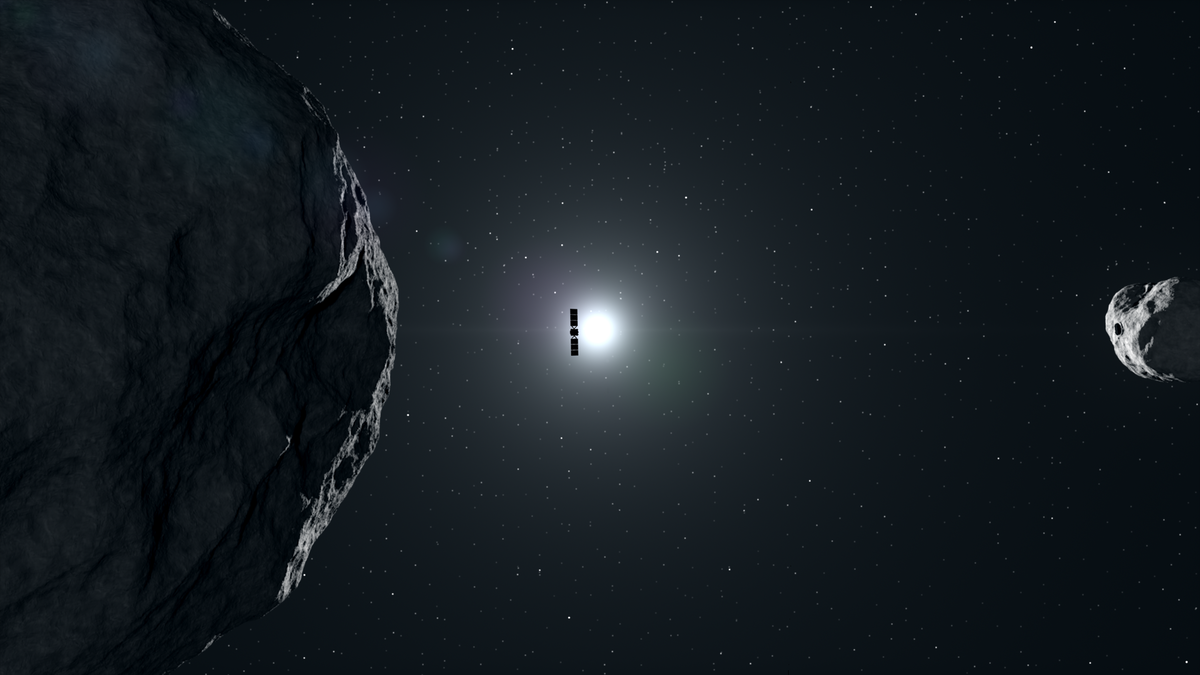
Hera glides past Didymos to Dimorphos. Credit: ESA
The identification of the 40 000th near-Earth asteroid (NEA) is not only a statistical benchmark but also a direct measure of how well Earth is being monitored for potential impact hazards. NEAs are objects whose orbits approach within roughly 45 million km (28 million miles) of Earth’s orbital path, and each newly discovered one provides additional clarity on long-term risks.
This milestone is significant because the majority of NEAs discovered recently are small or mid-sized bodies that were previously overlooked. These include objects large enough to cause regional devastation if they were to strike Earth. The recent surge in discoveries means scientists now have far more complete models of the population of hazardous objects.
The growth from 30 000 known NEAs in 2022 to 40 000 in 2025 reflects improvements in sky survey methods, automated data pipelines, and global coverage. The last three years alone brought 10 000 new NEAs into the catalog, a trend planetary defense experts did not expect to accelerate so sharply until later in the decade.
One of the most important outcomes of this increase is improved impact forecasting. With more objects catalogued, fewer potential threats remain hidden, and long-term orbital uncertainties shrink as new observations are added. This reduces the number of objects that appear on international risk lists and refines models used for early warning assessments.
The 40 000 object milestone also highlights how global the effort has become. Astronomers, agencies, and dedicated observatories share data, confirm orbits, and continuously update models so that planetary defense assessments remain accurate far into the future.
The accelerating rise of NEA discoveries
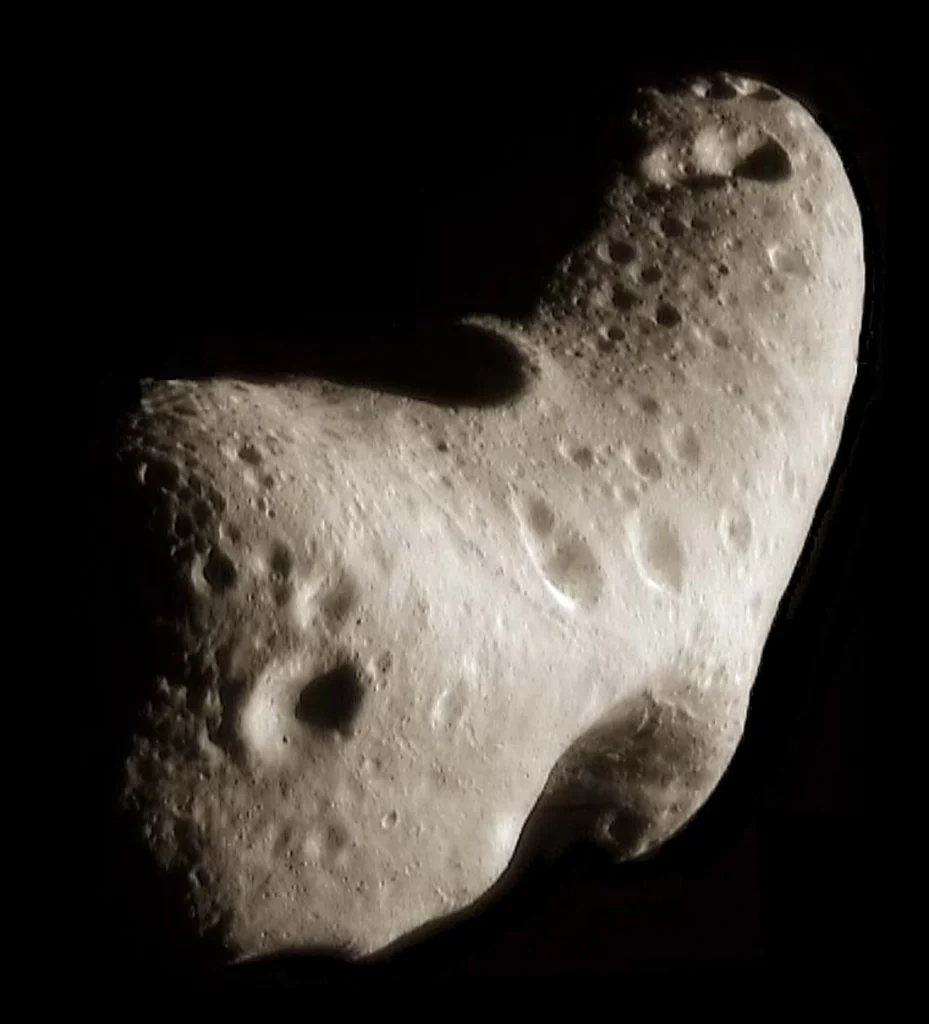
The history of near-Earth asteroid discovery began with the detection of 433 Eros in 1898, a time when telescopes could only detect very bright objects that moved slowly across the sky. For nearly a century, only a few NEAs were found each decade because astronomical instruments had narrow fields of view and long exposure times.
This changed dramatically in the 1990s as survey programs using new CCD detectors began scanning the sky automatically. The surveys captured multiple images of the same region each night, allowing computers to detect moving objects with much greater efficiency. The result was a surge in discoveries that continued through the 2000s as the technology matured.
By 2016, astronomers had identified 15 000 NEAs. That number doubled to 30 000 by 2022 as surveys expanded their sky coverage. Improvements in detection algorithms also helped researchers find fainter objects that move quickly relative to background stars. As survey systems improved, more small bodies entered the catalog, revealing previously unknown populations.
Since 2022, the rate of discovery has increased again, driven by higher resolution sensors, faster cadence observations, and more sophisticated algorithms. In only three years an additional 10 000 NEAs were added to the global database. This rapid increase confirms that many small objects were still awaiting detection, particularly those that approach Earth from difficult geometries.
This discovery curve continues to rise as next-generation observatories come online. The growth is not linear but closer to exponential, meaning upcoming surveys could expand the catalog far beyond 40 000 NEAs within a few years.
What we now know about the NEA population
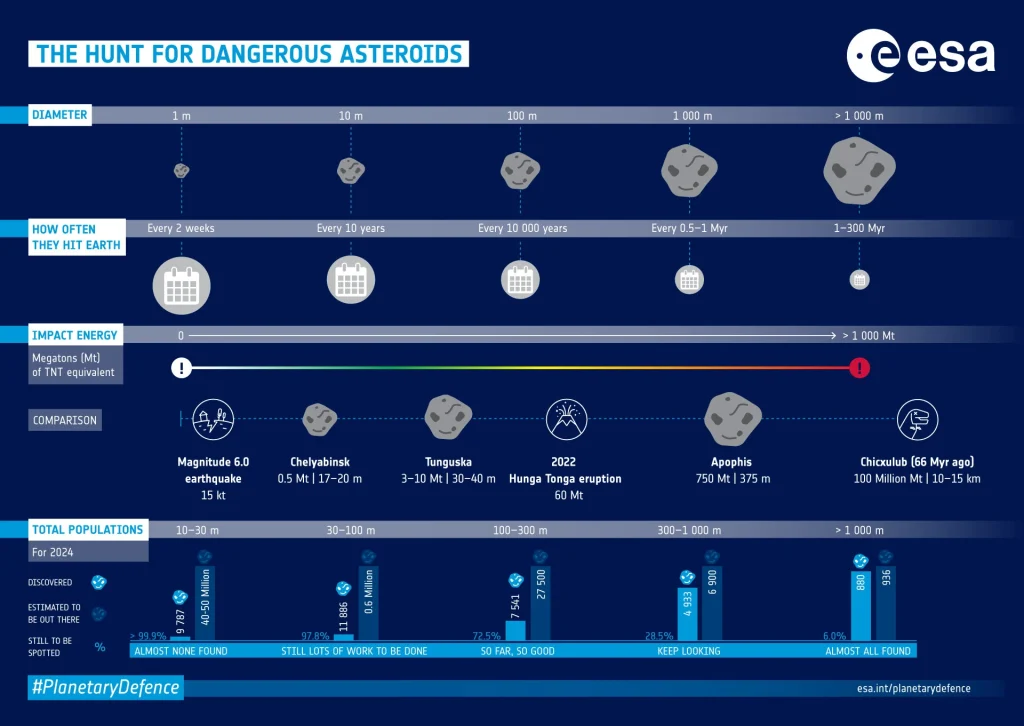
Of the 40 000 NEAs currently known, nearly 2 000 have a non-zero probability of impacting Earth within the next century. The probabilities are extremely small, usually far below one percent, and almost all such objects are small enough to pose limited danger. These impact calculations are regularly updated as new observations refine each orbit.
Scientists have the highest level of confidence in the catalog of large NEAs, particularly those larger than 1 km (0.6 miles). Objects of this size can trigger global consequences, but most were identified early because they are relatively bright. The scientific community is confident that the vast majority of these large asteroids have already been found, and currently, none remain a threat.
The greatest remaining uncertainty lies in the population of mid-sized asteroids between about 100–300 m (328–984 feet). These bodies are capable of causing severe regional destruction but are faint and difficult to detect until they approach relatively close to Earth. Current models indicate that only about 30 percent of these mid sized NEAs have been discovered.
Understanding the distribution of these objects is important because they represent the greatest realistic risk in planetary defense scenarios. While global-scale impacts are exceedingly rare, regional-scale impacts from objects in this size range are statistically more common and require complete detection to model effectively.
As new surveys continue to fill in gaps in the NEA population, estimates of the remaining undiscovered fraction will narrow. Each additional detection reduces uncertainty and helps refine long-term hazard forecasts.
How modern telescopes are transforming asteroid discovery
The Vera C. Rubin Observatory in Chile began full operations in 2025 and is now one of the most powerful tools for detecting NEAs. Its wide field camera captures large regions of the sky repeatedly, enabling rapid identification of moving objects. Although it is not an asteroid-dedicated telescope, its observing cadence makes it capable of discovering tens of thousands of new asteroids during its survey lifetime.
Rubin’s ability to observe the entire accessible sky every few nights allows researchers to track faint objects that earlier telescopes would miss. Its data pipeline can process enormous volumes of information, automatically detecting motion and issuing alerts for follow-up observations. This capability is one of the reasons discovery rates have surged.
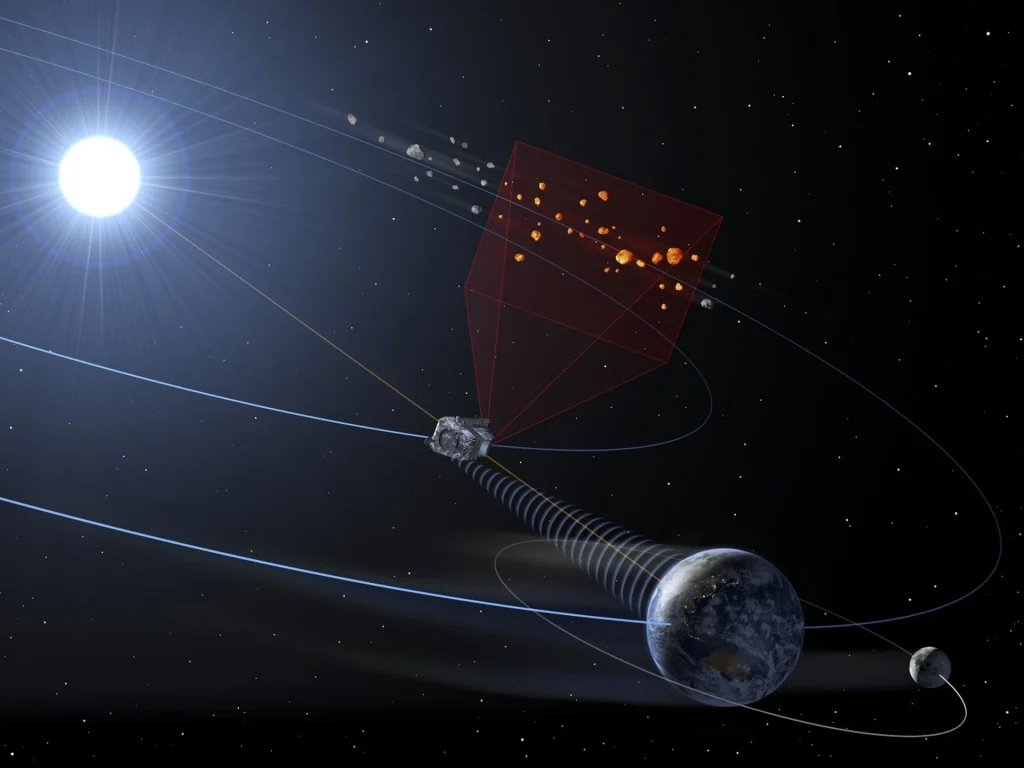
ESA’s Flyeye telescopes are also being deployed to enhance planetary defense. Each Flyeye unit uses a segmented optical system that mimics the compound eye of an insect, giving it an exceptionally wide field of view. This design allows the telescope to detect fast-moving objects approaching from directions that traditional telescopes rarely monitor.
As both Rubin and Flyeye expand their coverage, discovery gaps are expected to shrink significantly. These telescopes will detect objects that move quickly across the sky or that spend much of their time at low solar elongation, two factors that made them difficult to observe previously.
The combined effect of these observatories is a dramatic improvement in the completeness of the NEA catalog. With more coverage in both hemispheres and better sensitivity to faint targets, astronomers can detect asteroids earlier and with improved precision.
From detection to action: what planetary defense will look like next
Identifying NEAs is only part of the challenge. Understanding how to deflect a hazardous object if needed is essential for future planetary defense strategies. This is why missions such as ESA’s Hera are critical to the next phase of impact preparedness.
Hera is currently traveling to the asteroid Dimorphos, the target of NASA’s DART impact experiment in 2022. The mission will collect detailed measurements of the crater, the internal structure of the asteroid, and the degree to which its orbit changed after the impact. These measurements will help scientists determine how effective kinetic impactors are on different types of asteroid surfaces.
ESA is also preparing the Ramses mission, which will accompany the 375 m (1 230 feet) asteroid Apophis during its exceptionally close flyby in 2029. Apophis will pass closer to Earth than many satellites, making it an ideal natural experiment for studying how tidal forces shape NEA surfaces and motion.
Another major future component is NEOMIR, an infrared observatory planned for launch in the mid-2030s. NEOMIR will monitor the region between Earth and the Sun, an area where ground-based telescopes cannot detect objects due to bright sunlight. Infrared capability will allow NEOMIR to detect objects similar in size to the 20 m (66 feet) Chelyabinsk asteroid before they reach Earth.
Together these missions will transition planetary defense from a detection-focused effort into an action-ready discipline with tested deflection strategies and improved early warning systems.
References:
1 40 000 near-Earth asteroids discovered! – ESA – November 20, 2025

I’m a science journalist and researcher at The Watchers, contributing to the Epicenter edition, where I cover peer-reviewed scientific research and emerging discoveries across Earth and space sciences. With a background in astronomy and a passion for environmental science, I’ve worked in shark and coral conservation in Fiji, conducting reef and shark-behavior research, contributing to mangrove restoration, and earning PADI Open Water and Coral Reef Certifications. I bring a blend of scientific rigor and storytelling to illuminate the discoveries shaping our planet and beyond.

Commenting rules and guidelines
We value the thoughts and opinions of our readers and welcome healthy discussions on our website. In order to maintain a respectful and positive community, we ask that all commenters follow these rules.