
ESA proposes Ramses mission to rendezvous with asteroid Apophis ahead of 2029 Earth flyby
Asteroid 99942 Apophis will sweep within about 32 000 km (19 900 miles) of Earth’s surface on April 13, 2029, passing inside the orbit of many geostationary satellites. ESA’s proposed Ramses spacecraft aims to fly alongside it and observe this near miss up close.

ESA's Ramses mission to asteroid Apophis, Credit: ESA-Science Office
Apophis’s 2029 passage will be one of the closest flybys of a large asteroid in recorded history. The object will pass at less than 32 000 km (19 900 miles) from Earth, according to current JPL orbit solutions. For comparison, the International Space Station orbits at about 420 km (260 miles).
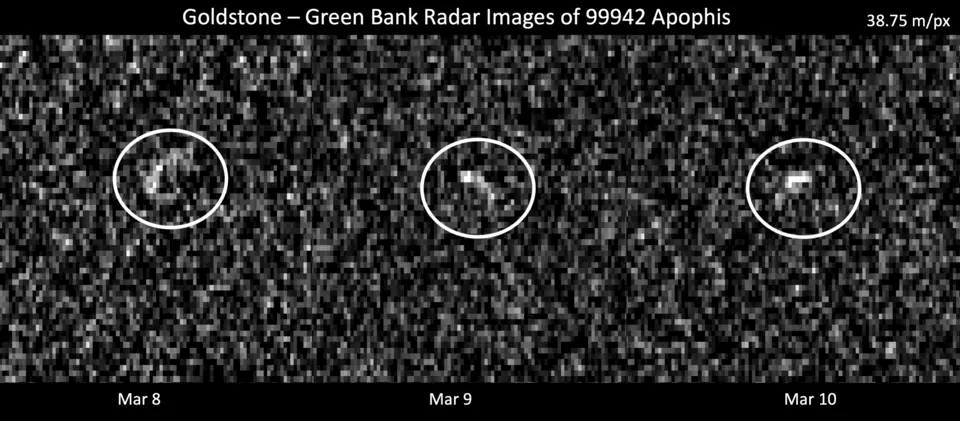
Apophis has an irregular, elongated shape. Thermal-infrared and radar analyses give mean diameter estimates ranging from 340 m (1 115 feet) to 375 m (1 230 feet), with radar fits suggesting dimensions near 450 x 170 m (1475 x 560 feet).
During the flyby, it could reach visual magnitude 3, easily visible in dark skies. Such an approach by an asteroid of this size happens only once in several thousand years, offering an unparalleled chance to study tidal effects in real time.
Although Apophis poses no impact threat in 2029, the encounter provides a living laboratory for orbital mechanics, material strength, and gravitational stress on small bodies — key parameters in planetary defense modeling.
Europe’s rapid response: what Ramses will do
The European Space Agency (ESA) conceived Ramses under its Space Safety Programme to study Apophis before, during, and after its close pass, measuring how the asteroid’s rotation, shape, and internal structure change under Earth’s gravitational pull.
If approved at the ESA Ministerial Council in late 2025, Ramses will launch between April and May 2028 and rendezvous with Apophis in February 2029, two months before the encounter. This schedule allows a full baseline characterization before the flyby and follow-up afterward.
The main spacecraft will carry optical imagers, laser altimetry, and spectrometers to map surface composition and shape and to measure subtle spin-state changes caused by Earth’s gravity.
By capturing these minute shifts, Ramses will reveal how loosely or tightly the asteroid’s material is bound, clarifying whether Apophis behaves as a single block or as a gravitationally held rubble pile.
The twin CubeSats: small explorers, big science
Upon arrival, Ramses will deploy two CubeSats to study Apophis at close range, marking Europe’s first multi-spacecraft mission to a single asteroid.
The first CubeSat, built by Tyvak International, carries a compact radar and a dust analyzer adapted from ESA’s Hera mission technology. Its radar will probe several metres beneath the surface to identify layers or voids, while its sensor monitors dust activity that may increase as tidal forces disturb surface material.
The second CubeSat, developed by Emxys in Spain, is designed for a more daring role. It may attempt to hover just metres from or briefly touch the surface to record vibrations or minor landslides. In Apophis’s gravity, less than one millionth that of Earth, it must use precise cold-gas thrusters and reaction wheels to remain stable.
Both CubeSats will transmit data to the mothercraft via radio links, supporting a Radio Science Experiment that uses inter-satellite tracking to determine the asteroid’s gravity field and internal density. These results will improve estimates of how Apophis might react to any future deflection attempt.
Testing Europe’s planetary-defence readiness
Ramses is intended not only as a science mission but also as a rapid-response technology test. ESA’s Space Safety Programme designed it to prove that Europe can design, launch, and operate a complex asteroid mission on a compressed timescale.
In October 2024, ESA awarded OHB Italia a €63 million preparatory contract for early design and systems work. Full-scale funding will depend on member-state approval in 2025.
Ramses reuses key components from ESA’s Hera mission, avionics, navigation software, and small-probe architecture, to reduce cost and risk. If realized, the spacecraft would reach flight readiness in less than four years, a pace closer to what a true deflection emergency would require.
Through Ramses, ESA aims to show that Europe can mount a scientifically valuable, quick-turnaround planetary-defence operation without long development cycles.
Engineering challenges of flying near a changing world
Operating near Apophis during its Earth flyby presents unique challenges. As the asteroid accelerates through Earth’s gravity well, its spin rate and orbital parameters will shift. Ramses must autonomously adjust its own orbit to stay safely in formation.
In microgravity, even a small thruster impulse can push a spacecraft kilometres away. The rapidly changing gravitational environment during closest approach adds additional perturbations that must be modelled precisely.
The CubeSats face higher risks. Their limited propellant and small mass make them vulnerable to instability or collision if guidance drifts. Their surface operations are complicated by Apophis’s irregular shape and rotating frame of reference.
Navigation will rely on optical tracking and image-based control. Real-time decisions from ground controllers will be impossible because of light-time delays and the fast dynamics of the flyby. Ramses’s autonomous guidance software will therefore be a major technological demonstration for future deep-space missions.
Despite these challenges, ESA expects valuable lessons from this environment: improved algorithms for autonomous formation flight, proximity operations, and rapid-trajectory re-planning near small bodies.
Full-scale experiment in gravitational stress
The Apophis encounter offers a natural, full-scale experiment in gravitational stress. Ramses will allow scientists to watch an asteroid’s internal and surface response evolve minute by minute, providing data that no simulation can reproduce.
The observations will refine models of how small bodies deform, fracture, or shed dust under stress—critical information for designing safe deflection missions. Understanding these mechanics can help ensure that an asteroid nudge does not fragment a target into multiple hazardous pieces.
The mission also strengthens Europe’s planetary-defence network. Alongside NASA’s planned OSIRIS-APEX mission, which will arrive at Apophis after the flyby, Ramses would deliver the complementary “before-and-during” record. Together, they could offer the first complete observation of an asteroid’s transformation through a major tidal encounter.
If launched, Ramses will mark a milestone: Europe’s first spacecraft to orbit and study a near-Earth object as it interacts with our planet’s gravity. When Apophis crosses the night sky on April 13, 2029, Ramses may be flying beside it, turning a celestial spectacle into a real-time experiment in planetary safety.
References:
1 Ramses: ESA’s mission to asteroid Apophis – ESA -Accessed on October 17, 2025

I’m a science journalist and researcher at The Watchers, contributing to the Epicenter edition, where I cover peer-reviewed scientific research and emerging discoveries across Earth and space sciences. With a background in astronomy and a passion for environmental science, I’ve worked in shark and coral conservation in Fiji, conducting reef and shark-behavior research, contributing to mangrove restoration, and earning PADI Open Water and Coral Reef Certifications. I bring a blend of scientific rigor and storytelling to illuminate the discoveries shaping our planet and beyond.

Commenting rules and guidelines
We value the thoughts and opinions of our readers and welcome healthy discussions on our website. In order to maintain a respectful and positive community, we ask that all commenters follow these rules.