
High solar activity caused Earth’s faint radio signal to disappear
A team from the Higher School of Economics (HSE) and the Space Research Institute of the Russian Academy of Sciences (IKI RAS) analyzed seven years of satellite data and confirmed that Earth produces a natural radio emission called the hectometer continuum — a faint signal that vanished in mid-2022 as the Sun’s activity increased.
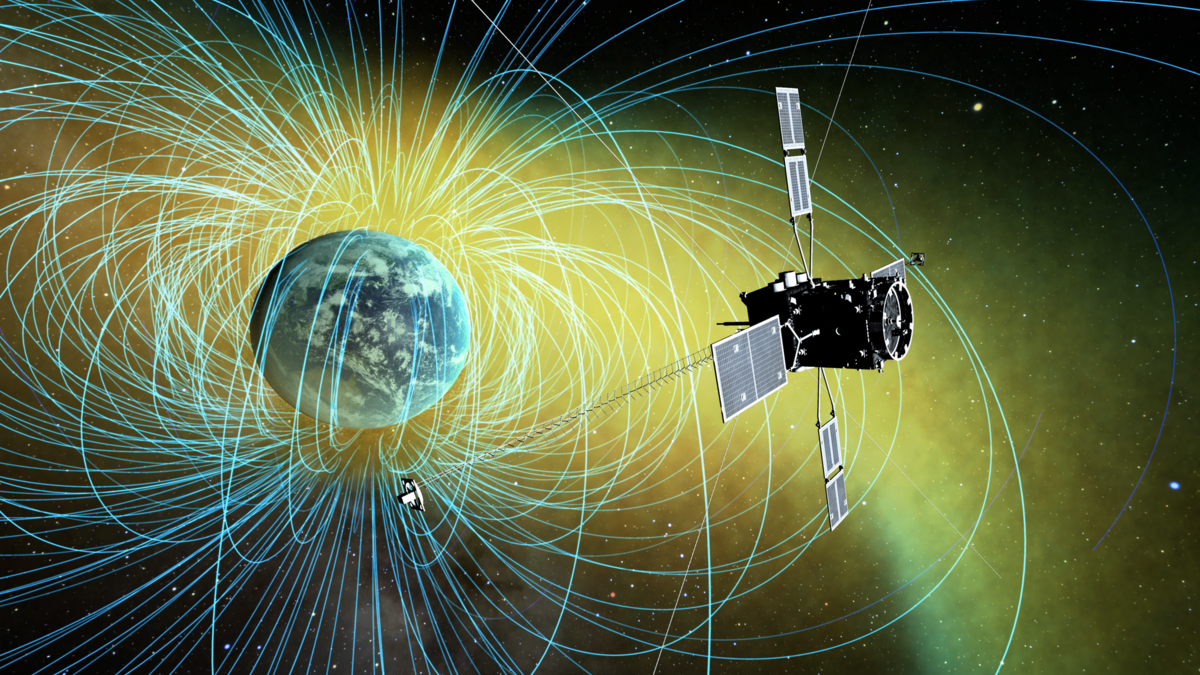
Artists rendering of the ERG satellite on orbit. Credit: ISAS/JAXA
For seven years, scientists listened to a faint voice coming from near-Earth space, a whisper in the radio band that appeared only after dark. Then, without warning, it vanished.
Researchers from the Higher School of Economics (HSE) and the Space Research Institute of the Russian Academy of Sciences (IKI RAS) discovered that this natural radio emission, known as the hectometer continuum, disappeared completely by mid-2022 as solar activity intensified.
Their work, published in Journal of Geophysical Research: Space Physics, describes how this unusual signal once filled the space around Earth every night. It rose a few hours after sunset and faded one to three hours after sunrise. But when the Sun became louder, sending more ultraviolet radiation and stronger magnetic flux toward Earth, the planet’s own faint emission fell silent.
The finding came from an analysis of data collected by Japan’s ERG (Arase) satellite between 2017 and 2023. Over that period, researchers recorded more than 1 000 individual events of the hectometer continuum and traced how its behavior changed with season, solar conditions, and time of day. The data revealed a consistent rhythm: nightly activity, summer peaks, and complete disappearance in periods of high solar energy input.
This sudden silence wasn’t caused by the failure of instruments or interference. It reflected a real physical change in near-Earth plasma, where delicate electromagnetic conditions can either amplify or suppress natural radio emissions depending on what the Sun is doing.
A hidden radio world just above Earth
Earth constantly radiates radio waves from its magnetosphere, the region dominated by its magnetic field. These emissions form part of the planet’s electromagnetic environment, shaped by the constant stream of charged particles flowing from the Sun. By studying them, scientists can observe how solar energy interacts with the magnetosphere and alters the balance of space weather.
The hectometer continuum occupies frequencies between 600 and 1 700 kHz, well below ordinary AM broadcasting bands. It is one of the weakest but most intriguing natural emissions known to exist around Earth. The source lies roughly one to two Earth radii above the surface, between 6 400–12 800 km (4 000–8 000 miles), where the magnetic field still guides the motion of charged particles.
Unlike other forms of natural radio waves, these frequencies never reach the ground. The ionosphere, a dense shell of ionized gas surrounding the planet, absorbs them completely. Only satellites positioned high above the ionosphere can detect the signal. This is why the Japanese Arase satellite was key to its discovery in 2017, nearly a century after scientists first began studying Earth’s radio environment.
For years, the emission appeared sporadically in spacecraft recordings. It wasn’t until the long-term HSE and IKI RAS analysis that its behavior patterns, nightly onset, seasonal strength, and solar dependency became clear.
The physics behind the disappearing signal
At the heart of the phenomenon lies a process called double plasma resonance. It occurs when two natural frequencies of plasma coincide: the plasma frequency, which depends on particle density, and the electron cyclotron frequency, which depends on magnetic field strength. When these two match, plasma becomes unstable and starts to radiate electromagnetic waves.
The hectometer continuum forms when this resonance develops in specific regions of the magnetosphere, where hot electrons spiral along magnetic field lines. As they gyrate, their motion reinforces oscillations in the surrounding plasma, releasing narrowband radio waves that propagate outward.
The Arase data also revealed that these waves have a distinct left-hand polarization, meaning their electric field rotates counterclockwise as they move. This distinguishes them from auroral kilometric radiation, the intense emission linked to auroras in polar regions, which shows right-hand polarization and lower frequencies of 300–700 kHz. Such polarization differences make it possible to separate these two emissions even when they overlap in frequency space.
Because the resonance requires specific plasma densities, the signal’s existence is extremely sensitive to changes in the ionosphere. When the Sun rises, ultraviolet light increases ionization and raises plasma density, breaking the delicate resonance condition. The result is that the signal fades quickly after dawn and only reappears at night, once the ionosphere cools and density drops back to a favorable range.
The role of the Sun. How light destroys a whisper
The nightly rhythm of the hectometer continuum reveals how sunlight governs even distant layers of Earth’s magnetosphere. The signal appears only after several hours of darkness, showing that the ionosphere must first relax before resonance can form. Its disappearance after sunrise reflects the opposite process, renewed solar heating and a rapid rise in electron density that suppresses emission.
By mid-2022, this balance was lost altogether. The Sun had entered a more active phase of its 11-year cycle. Sunspot counts increased, ultraviolet output rose, and the 10.7-centimeter radio flux, a standard measure of solar activity, climbed sharply. These changes propagated outward through the solar wind, altering the plasma environment near Earth and eliminating the conditions needed for double plasma resonance.
Associate Professor Alexander Chernyshov from IKI RAS explained that this reaction to solar activity is the opposite of what happens with most magnetospheric emissions. “Unlike auroral radio waves that intensify during solar storms, the hectometer continuum weakens and disappears,” he said. “We expect it may return once the Sun’s activity declines again.”
This anti-correlation with solar intensity highlights how small changes in the balance between magnetic field strength and particle density can silence a natural emission that has existed for years. It also provides a sensitive diagnostic tool for measuring how deeply solar variability penetrates Earth’s near-space environment.
What Earth’s lost radio voice tells us about other worlds
The discovery and disappearance of the hectometer continuum do more than describe a terrestrial curiosity. They provide a model for understanding radio emissions from planets beyond the Solar System. Detecting such emissions from exoplanets could be one of the few ways to infer the presence of a magnetic field, a vital feature that shields atmospheres from stellar wind and may allow life to persist.
If an exoplanet emits radio waves in a similar hectometric range, it could indicate that plasma instabilities are forming near its magnetic poles. Such signals, if ever detected by future space telescopes or low-frequency radio arrays, would confirm that these worlds have internal dynamos generating magnetic protection like Earth’s.
The study, therefore, links a local atmospheric process to universal questions of habitability. By tracing how and when Earth’s own magnetosphere can produce or lose its radio voice, scientists gain clues about where to listen for similar signals in other planetary systems.
As solar activity decreases in the next few years, researchers expect the hectometer continuum to return. When it does, continuous satellite monitoring will allow them to test whether the signal’s properties, frequency range, polarization, and timing remain constant or evolve with the solar cycle.
The value of continuous monitoring
The ERG (Arase) mission, operated by the Japan Aerospace Exploration Agency, has been orbiting Earth since 2016 to study the Van Allen radiation belts. Its instruments measure electric and magnetic fields, particle densities, and wave interactions in the magnetosphere. The long operational lifespan of Arase provided the statistical power needed to identify the hectometer continuum’s behavior over time.
Because the satellite’s orbit precesses slowly, its position relative to Earth changes from month to month. Over seven years, this allowed the researchers to observe the emission from many local times and latitudes, eliminating biases caused by orbital geometry. Only such long-term data could reveal the true daily and seasonal cycles of the phenomenon.
The team’s analysis mapped the missing signal’s timeline and offered a diagnostic tool for future missions. The appearance or disappearance of such weak emissions can now serve as an early indicator of major transitions in solar activity or magnetospheric density.
Continuous monitoring will be essential as Solar Cycle 25 approaches its peak in 2025–2026. The return of the hectometer continuum after the solar maximum would confirm that the phenomenon is directly governed by solar output and could serve as a sensitive barometer of the Earth–Sun relationship.
The quiet link between Sun and planet
The vanishing of Earth’s natural radio voice is a reminder that the Sun controls far more than the light we see. Even faint electromagnetic murmurs, produced thousands of kilometers above the surface, respond to the rhythms of solar energy.
This study, combining long-term observation and plasma theory, transforms a mysterious disappearance into a tool for understanding how our planet and its star remain connected through invisible magnetic threads. Listening for the return of this lost radio whisper may soon tell us not just about Earth, but about how all magnetic worlds speak to their suns.
References:
1 Исчезнувший сигнал: как солнечная активность заглушила радиоголос Земли – HSE – October 28, 2025
2 Hectometric Continuum Radiation Observations on Different Temporal Scales in Near‐Earth Space – D. A. Dorofeev et al. – Journal of Geophysical Research: Space Physics –

I’m a science journalist and researcher at The Watchers, contributing to the Epicenter edition, where I cover peer-reviewed scientific research and emerging discoveries across Earth and space sciences. With a background in astronomy and a passion for environmental science, I’ve worked in shark and coral conservation in Fiji, conducting reef and shark-behavior research, contributing to mangrove restoration, and earning PADI Open Water and Coral Reef Certifications. I bring a blend of scientific rigor and storytelling to illuminate the discoveries shaping our planet and beyond.

Commenting rules and guidelines
We value the thoughts and opinions of our readers and welcome healthy discussions on our website. In order to maintain a respectful and positive community, we ask that all commenters follow these rules.