
Scientists may have finally “seen” dark matter for the first time
A new study reports possible detection of dark matter through a 20 GeV gamma-ray halo around the Milky Way, based on 15 years of NASA’s Fermi Gamma-ray Space Telescope data.
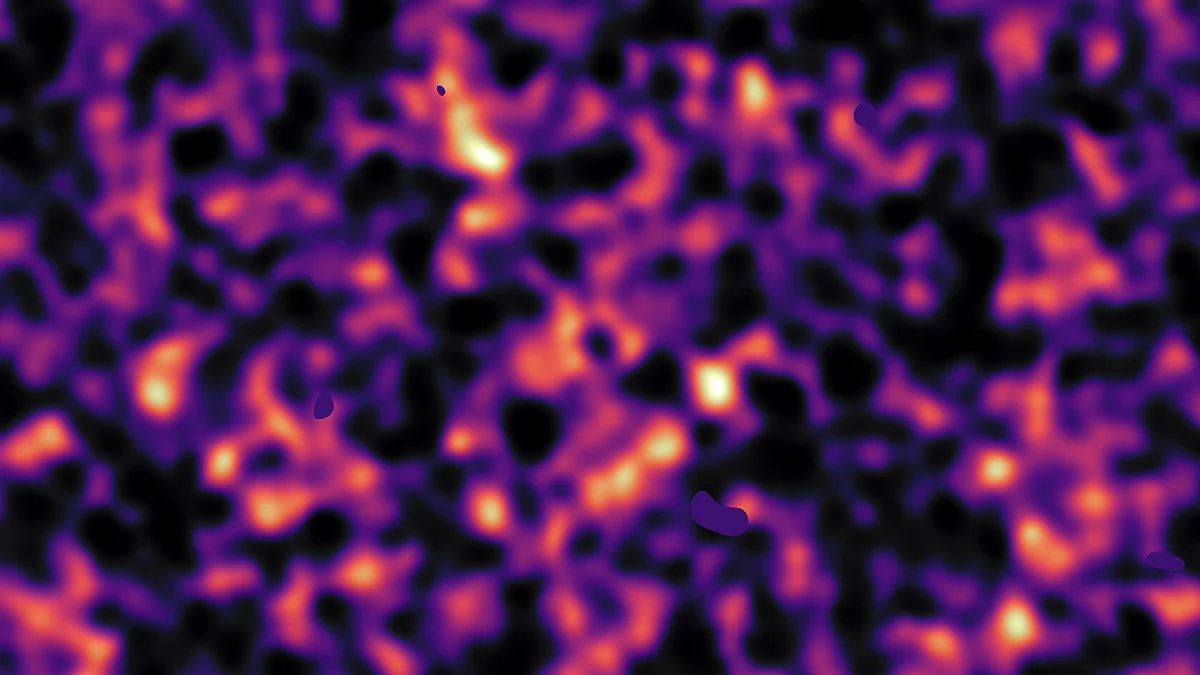
Dark matter map for a patch of sky based on gravitational lensing analysis of a Kilo-Degree Survey. Credit: ESO
A new study published on November 25 in the Journal of Cosmology and Astroparticle Physics reports what could be the first direct evidence of dark matter. The discovery comes from a 15-year analysis of data collected by NASA’s Fermi Gamma-ray Space Telescope, revealing a faint yet distinct halo of gamma rays surrounding the Milky Way.
For nearly a century, scientists have known that something invisible exerts a gravitational pull strong enough to hold galaxies together. Yet the true nature of this substance, known as dark matter, has eluded every form of direct observation. If the findings hold up, this would be the first time dark matter has been “seen,” not through its gravitational influence but through radiation produced by its own particle interactions.
Professor Tomonori Totani from the University of Tokyo’s Department of Astronomy analyzed the telescope’s all-sky data, focusing on high-latitude regions away from the bright Galactic plane. Within these quieter areas, he detected a halo-shaped glow extending about 100° around the Galactic Center. The energy of the gamma rays peaked sharply at 20 gigaelectronvolts (20 GeV), equivalent to 20 billion electronvolts or roughly the energy released by a proton accelerated to 20 billion times its rest mass.
This energy signature aligns with what scientists have long predicted from the annihilation of hypothetical dark matter particles. The observed halo matches both the shape and intensity expected from the Milky Way’s predicted dark matter distribution. Totani described the finding as a long-awaited hint of the invisible matter that makes up most of the universe.
A century of searching for the unseen universe
The story of dark matter begins in the 1930s, when Swiss astronomer Fritz Zwicky studied galaxies in the Coma Cluster and found they were moving too fast to be held together by visible mass. He proposed that some hidden form of matter must provide additional gravity. Decades later, in the 1970s, astronomer Vera Rubin’s precise measurements of spiral galaxies confirmed that an unseen component dominates galactic rotation.
Dark matter is estimated to make up about 85 percent of all matter in the universe. It neither emits nor reflects light and does not interact with electromagnetic radiation. Scientists detect it only through its gravitational influence on stars and galaxies. Despite decades of experimental searches, no direct detection of its particles has been confirmed.
One of the strongest candidates for dark matter is the weakly interacting massive particle, or WIMP. These particles are thought to be hundreds of times heavier than protons but interact so weakly that they pass through ordinary matter almost undetected. When two WIMPs collide, theory predicts they annihilate each other and release secondary particles, including energetic gamma-ray photons. Detecting these gamma rays from dark matter–rich regions of space has been one of the main strategies in the search.
Totani’s findings are significant because the detected gamma-ray energy of 20 GeV falls exactly within the range predicted for WIMP annihilation. The observed halo structure also resembles the theoretical shape of dark matter in the Milky Way, which becomes denser toward the Galactic Center and gradually thins out in a smooth, spherical pattern.
If the halo truly originates from dark matter, this would be the first time its presence has been recorded through emitted radiation rather than inferred from gravity alone. It would mark one of the most important discoveries in modern astrophysics, offering direct insight into a substance that governs cosmic structure on the largest scales.
The physics behind the 20 GeV glow
The detailed analysis of the Fermi telescope’s data revealed a gamma-ray spectrum that peaks around 20 GeV and drops off sharply below 2 GeV and above 200 GeV. This shape fits well with models of WIMP annihilation producing pairs of standard particles such as bottom quarks or W bosons. These decay quickly, generating a burst of high-energy gamma rays that the telescope can detect.
The results suggest that the dark matter particle responsible would have a mass between 0.5 and 0.8 teraelectronvolts (TeV), about 500 to 850 times the mass of a proton. However, Totani explains that this discrepancy could be due to uncertainties in the Milky Way’s dark matter density profile or background gamma-ray modeling.
The faint halo was detected even when using conservative background models that accounted for cosmic-ray interactions, known point sources, and other diffuse structures such as the Fermi Bubbles. This consistency strengthens the argument that the halo is not an artifact of the analysis but a real astrophysical component.
The radial profile of the emission closely follows the Navarro-Frenk-White (NFW) distribution, a well-established model describing how dark matter density increases toward a galaxy’s center. The fit suggests the signal originates from a smooth, nearly spherical halo enveloping the Milky Way.
If this interpretation is correct, the results not only identify dark matter’s location but also provide the first measurement of how its particles behave when they annihilate. That makes this discovery a crucial step toward linking cosmological observations with fundamental particle physics.
Why this discovery could change everything
Dark matter has remained one of the greatest missing pieces in physics. The Standard Model successfully explains known particles and forces, but it does not include any viable dark matter candidate. Detecting radiation directly produced by dark matter would extend the boundaries of this model and open the door to a new class of particles.
Totani noted that if the finding holds up, it would mark humanity’s first glimpse of this invisible component of the cosmos. It could provide experimental evidence for physics beyond the Standard Model, unifying astronomical observations with theories long developed at particle accelerators.
Such a discovery would also help cosmologists better understand how galaxies form and evolve. Dark matter’s gravity dictates the large-scale structure of the universe, pulling together gas and dust that eventually form stars and planets. Knowing its particle nature would reveal not only what the universe is made of, but also how it came to look the way it does.
However, as with any extraordinary claim, extraordinary evidence is required. Similar gamma-ray excesses in the past have later been attributed to more conventional astrophysical sources, such as unresolved populations of pulsars near the Galactic Center. Totani’s analysis is unique because it focuses on the extended halo far beyond the crowded galactic plane, where contamination from known sources is much weaker.
The path toward independent verification
While Totani’s analysis is robust, independent teams must verify the findings using alternative models and methods. One of the most promising approaches is to search for the same 20 GeV gamma-ray signal in nearby dwarf spheroidal galaxies. These small galaxies orbiting the Milky Way contain large amounts of dark matter but emit very little other radiation, providing a cleaner testing ground.
If the same spectral signature is detected in those galaxies, it would strongly support the dark matter interpretation. On the other hand, if the signal is absent, it could indicate that the Milky Way’s halo contains some unknown astrophysical process unrelated to dark matter.
Future observatories such as AMEGO-X and the Cherenkov Telescope Array (CTA) are expected to provide more sensitive gamma-ray data in the coming years. These instruments will test Totani’s hypothesis at higher resolution and across a wider range of energies. Cross-checks with neutrino observatories and cosmic-ray detectors could also offer additional confirmation, since dark matter annihilation would produce not only gamma rays but other secondary particles as well.
Regardless of the outcome, Totani’s work provides one of the most detailed and statistically significant analyses yet conducted on the Milky Way’s high-energy halo. It narrows the search window for dark matter and demonstrates how long-term archival data can yield groundbreaking insights.
The cosmic significance of seeing the unseen
From Zwicky’s early suspicions to Rubin’s rotational curves, the idea of dark matter has guided much of modern cosmology. Yet until now, it remained purely theoretical. The faint 20 GeV halo observed by the Fermi telescope could represent the long-awaited bridge between theory and observation.
The implications extend far beyond astrophysics. If dark matter particles truly exist at energies near 0.5 to 0.8 TeV, they could potentially be produced in high-energy particle accelerators on Earth, such as the Large Hadron Collider or its successors. Detecting similar signals in laboratory conditions would provide a direct link between cosmic and terrestrial experiments.
For now, the universe’s invisible framework has revealed only a faint trace of its existence, a whisper of high-energy light across the sky. Whether this signal proves to be the long-sought evidence of dark matter or another unknown cosmic phenomenon, it marks a turning point in humanity’s quest to understand what the universe is truly made of.
References:
1 20 GeV halo-like excess of the Galactic diffuse emission and implications for dark matter annihilation – Tomonori Totani – Journal of Cosmology and Astroparticle Physics – November 25, 2025 – https://iopscience.iop.org/article/10.1088/1475-7516/2025/11/080 – OPEN ACCESS
2 After nearly 100 years, scientists may have detected dark matter – University of Tokyo – November 26, 2025

I’m a science journalist and researcher at The Watchers, contributing to the Epicenter edition, where I cover peer-reviewed scientific research and emerging discoveries across Earth and space sciences. With a background in astronomy and a passion for environmental science, I’ve worked in shark and coral conservation in Fiji, conducting reef and shark-behavior research, contributing to mangrove restoration, and earning PADI Open Water and Coral Reef Certifications. I bring a blend of scientific rigor and storytelling to illuminate the discoveries shaping our planet and beyond.

Commenting rules and guidelines
We value the thoughts and opinions of our readers and welcome healthy discussions on our website. In order to maintain a respectful and positive community, we ask that all commenters follow these rules.