
Sugars from asteroid Bennu complete the extraterrestrial inventory for life’s building blocks
Scientists have confirmed that asteroid Bennu contains ribose, glucose, and other foundational sugars of life — the final missing pieces of prebiotic chemistry beyond Earth. The discovery shows that the building blocks of RNA and metabolic energy were present in the early solar system, strengthening the view that life’s chemistry began as a cosmic process rather than a strictly terrestrial one.
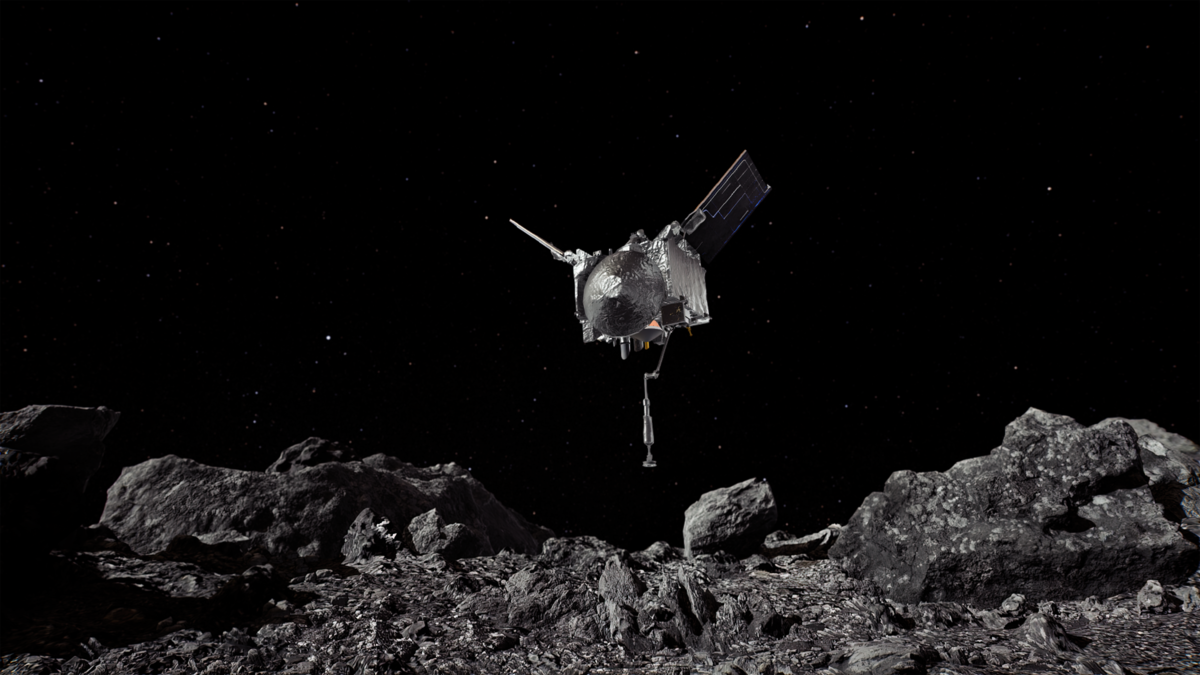
An artistic visualization of the OSIRIS-REx spacecraft descending towards asteroid Bennu to collect a sample. Credit: NASA/Goddard/University of Arizona
Sugars that form the backbone of RNA and power metabolism on Earth have been found in samples returned from asteroid Bennu, confirming that the essential chemistry for life extends far beyond our planet. The discovery comes from the analysis of pristine regolith delivered by NASA’s OSIRIS-REx spacecraft, marking one of the most significant steps yet in tracing the molecular origins of biology.
The samples revealed ribose, a five-carbon sugar used in RNA, and glucose, a six-carbon sugar that serves as the primary energy molecule for life on Earth. These findings, published in Nature Geoscience on December 2, 2025, show that all the fundamental molecular components of life, including amino acids, nucleobases, phosphates, and now sugars, exist in extraterrestrial material.
The asteroid material, collected under ultra-clean nitrogen conditions at NASA’s Johnson Space Center, was analyzed using gas chromatography–mass spectrometry. Researchers identified several key sugars, including ribose, xylose, arabinose, lyxose, glucose, and galactose. The concentration of glucose was 0.35 nmol per gram of sample, while ribose was found at 0.097 nmol per gram, confirming their extraterrestrial presence beyond doubt.
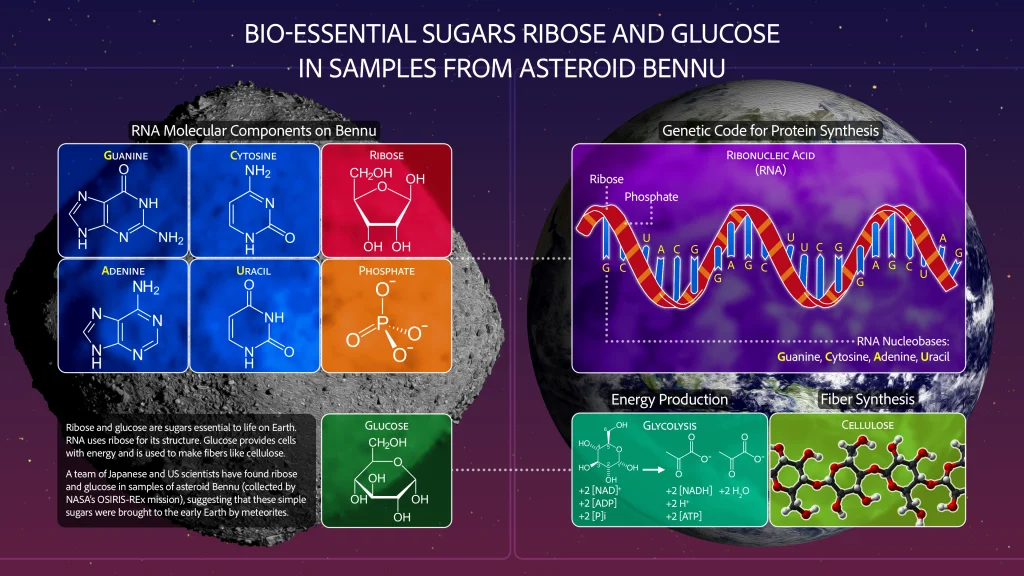
Ribose and similar sugars had been reported in carbonaceous meteorites such as Murchison and NWA 801, but those samples were collected after exposure to Earth’s biosphere. Bennu’s unexposed samples eliminate the contamination concern that has long complicated earlier studies. A diagram released by NASA’s Scientific Visualization Studio illustrates how ribose and glucose could have reached Earth, linking them to RNA structure and cellular energy metabolism.
“All five nucleobases used to construct both DNA and RNA, along with phosphates, have already been found in the Bennu samples,” said Yoshihiro Furukawa of Tohoku University, who led the study.
“The new discovery of ribose means that all of the components to form RNA are present in Bennu.”
The absence of deoxyribose, the DNA sugar, suggests that ribose may have been far more abundant in the early solar system, supporting the RNA world hypothesis, where RNA acted both as a genetic carrier and a catalytic molecule before DNA and proteins evolved.
How Bennu’s chemistry forged life’s essential sugars
The chemical environment inside Bennu’s parent asteroid appears to have been ideal for spontaneous sugar formation. Laboratory analysis shows that the pH of Bennu’s aqueous extracts is about 8.23, a mildly alkaline condition conducive to formose-type reactions. In this process, formaldehyde reacts in the presence of calcium and magnesium ions to form increasingly complex sugars, starting from simple aldehydes and progressing to pentoses and hexoses.
The mineral composition of Bennu supports this scenario. Samples contain evaporite carbonates and phyllosilicates, both formed by water-rock interactions. These minerals indicate the presence of ancient liquid water and chemical catalysts that could drive abiotic organic synthesis. The asteroid’s mineralogy points to an early environment rich in sodium, magnesium, and calcium carbonate brines that may have persisted for millions of years.
Such aqueous alteration would have allowed smaller molecules like formaldehyde and glycolaldehyde to condense into larger, more complex structures, including ribose and glucose. The ratios of sugars in Bennu closely match laboratory products of formose reactions, suggesting a common chemical mechanism between space chemistry and terrestrial prebiotic experiments.
Interestingly, Bennu’s total sugar content, about 0.668 nmol per gram, is roughly one-hundredth that of amino acids previously detected in its samples, but the diversity of organic compounds is unmatched. The balance between amino acids, nucleobases, and sugars demonstrates that complex organic synthesis occurred within Bennu’s parent body rather than being inherited directly from interstellar ices.
These results show that sugar formation in space is not only plausible but chemically predictable when water, heat, and simple aldehydes coexist in the presence of catalytic minerals. The same process could have taken place in many other small bodies throughout the solar system, dispersing the seeds of life across the inner planets.

The discovery of an ancient ‘space gum’
Another study published in Nature Astronomy revealed an entirely different form of organic matter in Bennu, a nitrogen- and oxygen-rich polymeric substance that researchers nicknamed “space gum.” Once flexible and soft, but now hardened over billions of years, this material may represent one of the earliest stages of organic polymerization in the solar system.
The research, led by Scott Sandford of NASA’s Ames Research Center and Zack Gainsforth of the University of California, Berkeley, showed that the gum-like compound likely formed as ammonia and carbon dioxide reacted to produce carbamate, which later polymerized into complex chains as Bennu’s parent asteroid warmed. This reaction occurred before the asteroid became water-rich, suggesting that polymer formation preceded the onset of liquid-phase chemistry.
“To study it, we had to do blacksmithing at the molecular level,” said Sandford. Using facilities at the Molecular Foundry at Lawrence Berkeley National Laboratory, the team applied thin layers of platinum to reinforce a microscopic fragment, welded a tungsten microneedle to lift it, and then milled the grain to a thickness of about 30 micrometers (0.001 inch). They then analyzed it using electron microscopy and X-ray spectroscopy at Berkeley Lab’s Advanced Light Source.
The resulting images revealed an organic matrix with a random, heterogeneous structure. The polymer’s molecular groups resemble those in polyurethane, earning it the nickname “space plastic.” Unlike synthetic polymers on Earth, Bennu’s version is irregular and variable from one grain to another. It is translucent, and prolonged radiation exposure in space made it brittle, much like plastic left in sunlight for too long.
The discovery of this “space gum” provides evidence that complex macromolecules capable of storing or stabilizing other organic compounds could form naturally in small bodies before the emergence of biological systems. Such materials may have acted as primitive molecular scaffolds, protecting reactive organic species from degradation and creating localized chemical stability in the young solar system.
Stardust from ancient supernovae preserved in Bennu
A third paper, also published in Nature Astronomy, reported the presence of presolar grains in Bennu’s regolith, tiny particles that formed in supernova explosions long before the solar system existed. The study, led by Ann Nguyen of NASA’s Johnson Space Center, found that Bennu contains six times more supernova-derived dust than any other known extraterrestrial sample.
These presolar grains, rich in exotic isotopes, reveal that Bennu’s parent body formed in a region of the solar nebula heavily enriched with debris from dying stars. The survival of such fragile material indicates that parts of Bennu remained unaltered despite extensive fluid processing elsewhere in the asteroid.
“These fragments retain a higher abundance of organic matter and presolar silicate grains, which are known to be easily destroyed by aqueous alteration in asteroids,” said Nguyen. “Their preservation in the Bennu samples was a surprise and illustrates that some material escaped alteration in the parent body. Our study reveals the diversity of presolar materials that the parent accreted as it was forming.”
The discovery demonstrates that Bennu is a mosaic of ancient and altered material. Some regions were shaped by water and chemistry that produced sugars and polymers, while others preserved unaltered stardust from supernovae. This dual nature makes Bennu a time capsule spanning from interstellar origins to the birth of the solar system.
The presence of both chemically evolved and primordial material confirms that asteroids like Bennu were major contributors to the chemical enrichment of early Earth. During the late heavy bombardment period, fragments of similar carbonaceous asteroids could have delivered sugars, amino acids, and other organic precursors across the inner planets.
How NASA’s OSIRIS-REx mission brought Bennu to Earth
The OSIRIS-REx mission was managed by NASA’s Goddard Space Flight Center with spacecraft design and operations by Lockheed Martin Space. The University of Arizona led the mission’s science team and observation planning, while KinetX Aerospace provided spacecraft navigation. The Canadian Space Agency supplied the OSIRIS-REx Laser Altimeter, and the Japan Aerospace Exploration Agency contributed through its Hayabusa2 partnership. The mission is part of NASA’s New Frontiers Program overseen by the Marshall Space Flight Center in Alabama.
After traveling more than 6.2 billion km (3.9 billion miles), the spacecraft successfully collected about 121.6 grams of material from Bennu’s surface and returned it to Earth in September 2023. The samples were immediately transferred to a nitrogen-filled glovebox at the Johnson Space Center to prevent contact with terrestrial air or moisture.
OSIRIS-REx provided the most pristine extraterrestrial samples ever obtained, preserving molecular structures that predate the solar system itself. The precision and cleanliness of this collection allow scientists to study chemistry unaltered since the dawn of planet formation.
This combination of high-purity collection and interdisciplinary analysis has given researchers a direct glimpse into the chemical inventory available to early Earth. The samples show that sugars, polymers, and stardust coexist naturally in small bodies, linking planetary chemistry to stellar evolution.
The success of OSIRIS-REx demonstrates that asteroids like Bennu are more than ancient rocks; they are chemical archives holding the recipes for life.
Why Bennu changes our understanding of life’s origins
Bennu’s samples complete the molecular triad that defines living systems, amino acids for proteins, nucleobases for genetic material, and sugars for energy and structure. Together, these compounds represent the raw chemical potential that could evolve into metabolism and heredity under the right planetary conditions.
This discovery supports a broader view of life’s origins as a planetary process seeded by cosmic chemistry. The formation of ribose, glucose, and polymer-like organics in Bennu shows that complex organic synthesis is not unique to Earth but rather a natural outcome of geochemical evolution in small water-bearing bodies.
The combination of sugars, nitrogen-rich polymers, and presolar dust from supernovae demonstrates that asteroids acted as both chemical factories and delivery systems. These findings imply that Earth, Mars, and even Venus may all have been seeded with similar organic material during their formative periods.
As Furukawa summarized, early life may have started simpler than today’s DNA-protein world. “RNA remains the leading candidate for the first functional biopolymer because it can both store information and catalyze reactions,” he said. The discovery of ribose in Bennu makes that scenario not only possible but probable.
Bennu’s dust and organics tell a unified story that the chemistry leading toward biology is a cosmic inheritance, written into the same material that built our planet. The line between planet formation and prebiotic chemistry is now thinner than ever.
References:
1 Sugars, ‘Gum,’ Stardust Found in NASA’s Asteroid Bennu Samples – NASA – December 2, 2025
2 Bio-essential sugars in samples from asteroid Bennu – Yoshihiro Furukawa et al. – Nature Geoscience – December 2, 2025 – https://doi.org/10.1038/s41561-025-01838-6 – OPEN ACCESS

I’m a science journalist and researcher at The Watchers, contributing to the Epicenter edition, where I cover peer-reviewed scientific research and emerging discoveries across Earth and space sciences. With a background in astronomy and a passion for environmental science, I’ve worked in shark and coral conservation in Fiji, conducting reef and shark-behavior research, contributing to mangrove restoration, and earning PADI Open Water and Coral Reef Certifications. I bring a blend of scientific rigor and storytelling to illuminate the discoveries shaping our planet and beyond.

Sperm of the universe.
This is fascinating stuff. How did scientists decide to sample material from Bennu as opposed to any other asteroid?