
Astronomers detect a massive spinning filament that links hundreds of galaxies
An international team led by the University of Oxford has identified a 15-megaparsec-long rotating filament of galaxies about 140 million light-years away, one of the largest spinning structures ever observed.
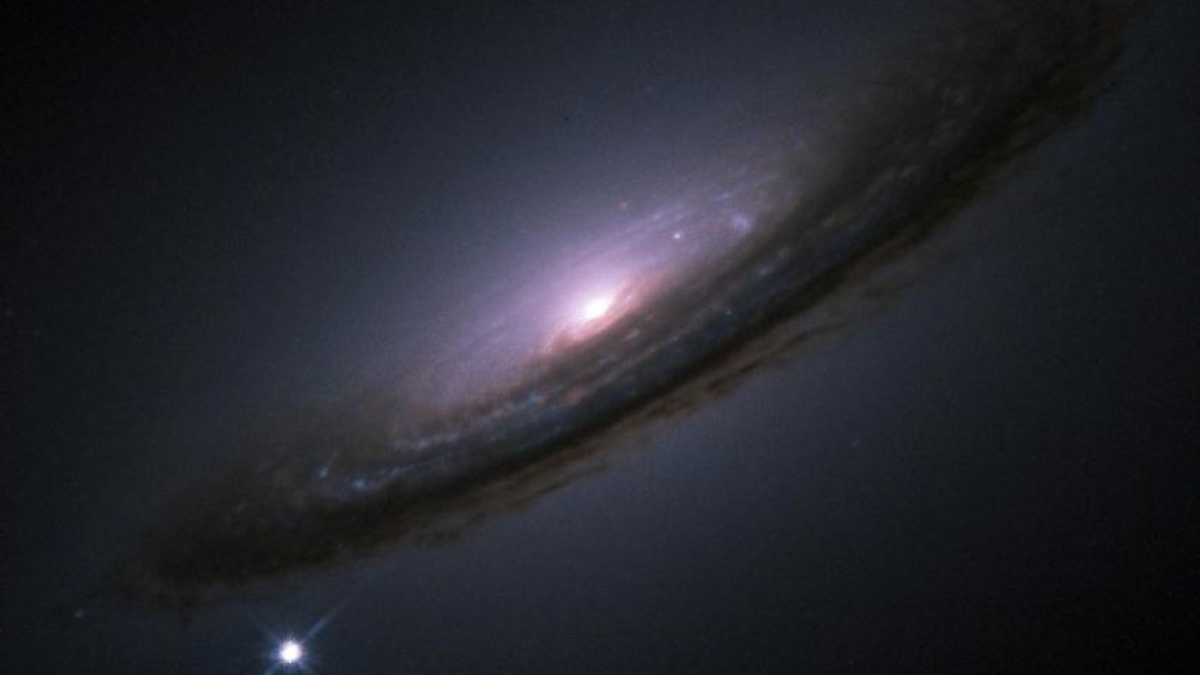
Credit: NASA/ESA
An international team led by the University of Oxford has identified a filament that rotates as a single structure across roughly 15 megaparsecs. This scale places it among the largest spinning formations ever detected in the Universe. Such coherent motion indicates that angular momentum can develop on scales far larger than galaxies or clusters.
The filament contains more than 280 galaxies, and within its spine lies a thin string of 14 hydrogen-rich systems. These galaxies form an exceptionally narrow line measuring about 1.7 megaparsecs and only 36 kiloparsecs wide. Their orderly arrangement provides astronomers with a natural probe of how gas and momentum flow through the cosmic web.
The most striking result is the rotational pattern. Galaxies on one side of the filament are receding while those on the opposite side are approaching, an arrangement that strongly indicates large-scale rotation rather than random motion. This rotation persists across millions of light-years, a scale at which many models predict far weaker coherence.
Researchers used dynamical models to infer a rotation speed of about 110 km/s (68 mi/s). They also estimate that the dense central region of the filament spans roughly 50 kiloparsecs, suggesting a structured core that organizes the rotation around it.
Co-lead author Dr Lyla Jung compared this behavior to a familiar theme park ride. “Each galaxy is like a spinning teacup, but the whole platform, the cosmic filament, is rotating too,” she said. The analogy captures the unusual dual motion at play as individual galaxies spin while the entire cosmic structure turns beneath them.
Why this discovery reshapes our understanding of galaxy evolution
Cosmic filaments form the backbone of the large-scale structure of the Universe. They consist of dark matter, galaxies, and diffuse gas, and act as channels delivering material into clusters and groups. The discovery that a filament of this size rotates challenges the assumption that such flows are linear and non-rotational.
Angular momentum is a fundamental property of galaxies, yet its origin remains one of the most persistent questions in astrophysics. Many theories suggest that galaxies inherit their spin through tidal torques in the early Universe. This new filament provides direct evidence that angular momentum may also be transferred along filaments long after galaxies form.
The alignment of galaxy spins strengthens this interpretation. Many of the hydrogen-rich galaxies appear to rotate in the same direction as the filament itself. The degree of alignment is far higher than expected from random orientation and exceeds predictions from modern cosmological simulations. This suggests that earlier models may underestimate how strongly filaments influence their galaxies.
Hydrogen gas, especially atomic hydrogen detectable at radio wavelengths, is extremely sensitive to motion. The fact that these galaxies remain gas-rich and dynamically cold indicates that they preserve the imprint of the larger-scale flow. Their kinematics record the history of how material streams into the filament and then into galaxies.
Co-lead author Dr Madalina Tudorache described the structure as a fossil record of cosmic flows. Its coherence suggests that the imprint of matter movement has been conserved for hundreds of millions of years, giving astronomers a rare window into how galaxies grew their discs and spins.
How astronomers identified the filament and its motion
The filament was detected using the MIGHTEE survey from South Africa’s MeerKAT radio telescope, an array of 64 dishes designed for deep hydrogen observations. MeerKAT revealed the compact string of 14 hydrogen-rich galaxies, each with clear velocity structure and well-measured rotation.
Because the hydrogen line traces cold gas, the measurements provide precise Doppler velocities that allow astronomers to reconstruct motion within the filament. The galaxies lie within a narrow velocity range between 9 230–9 700 km/s (5 735–6 027 mi/s). Their small internal scatter points to a dynamically cold configuration.
Optical spectroscopic data from the Dark Energy Spectroscopic Instrument and the Sloan Digital Sky Survey expanded the view, showing that the 14 hydrogen-rich galaxies sit inside a larger filament that stretches roughly 15 megaparsecs. More than 280 galaxies in the region share the same large-scale structure.
The team found that the galaxies positioned east of the filament’s spine have predominantly negative velocities, while those to the west show positive velocities. This mirrors the pattern expected from rotation around a central axis and does not match the behavior of non-rotating cosmic walls or sheets.
A young and dynamically cold filament that preserves cosmic history
The filament’s low internal velocity dispersion suggests that it has experienced little disruption from mergers or interactions. This means it likely represents an early stage of filament evolution, before gravitational dynamics heat the system and scatter the coherent motions.
Galaxies in the filament contain large reservoirs of hydrogen, indicating that they are actively gathering or retaining fuel for star formation. Because hydrogen gas is easily disturbed, its orderly motion further supports the interpretation that the filament remains undisturbed and dynamically cold.
Such cold filaments are valuable for tracing the flow of angular momentum through the cosmic web. They show how gas streams along filaments and how that gas can deliver spin to galaxies. This process likely played a major role in shaping early galaxy discs.
The detection also provides observational support for the idea that protofilaments in the early Universe acquired angular momentum through tidal torques. Over cosmic time, these torques can produce rotation on very large scales, consistent with the behavior seen in this structure.
The structure’s remarkable coherence therefore reveals not only the present-day motion of galaxies, but also the ancient forces that shaped them. It captures a stage where angular momentum has not yet been erased by interactions, making it an unusually clean laboratory for studying cosmic flows.
Implications for cosmology and future surveys
The strong alignment between galaxy spins and the filament raises questions for cosmological surveys that rely on weak gravitational lensing. Intrinsic alignment of galaxies with surrounding structures can bias lensing measurements if not properly accounted for.
Upcoming missions such as the European Space Agency’s Euclid and the Vera C. Rubin Observatory’s Legacy Survey of Space and Time aim to measure the growth of cosmic structure with unprecedented precision. Filaments with strong spin alignment could introduce systematic correlations that complicate these analyses.
The discovery also suggests that simulations may need to revisit how they model angular momentum transfer in the cosmic web. Current numerical models predict weaker alignment and less coherent rotation than observed here. Improving filament physics may be necessary to reconcile theory with observation.
Because only a few hydrogen-traced filaments have been discovered so far, this one may represent only the beginning of a new era of filament studies. MeerKAT and its successor, the Square Kilometre Array, will map hydrogen across vast cosmic volumes and are expected to reveal many more such structures.
If rotating filaments prove common, they will reshape how we understand the assembly of galaxies and the evolution of the cosmic web. They may reveal that rotation is not a rare outcome but a fundamental feature of cosmic structure.
References:
1 Astronomers spot one of the largest spinning structures ever found in the Universe – University of Oxford – December 4, 2025
2 A 15 Mpc rotating galaxy filament at redshift z = 0.032 – Madalina N Tudorache et al. – Monthly Notices of the Royal Astronomical Society – December 4, 2025 – https://doi.org/10.1093/mnras/staf2005 – OPEN ACCESS

I’m a science journalist and researcher at The Watchers, contributing to the Epicenter edition, where I cover peer-reviewed scientific research and emerging discoveries across Earth and space sciences. With a background in astronomy and a passion for environmental science, I’ve worked in shark and coral conservation in Fiji, conducting reef and shark-behavior research, contributing to mangrove restoration, and earning PADI Open Water and Coral Reef Certifications. I bring a blend of scientific rigor and storytelling to illuminate the discoveries shaping our planet and beyond.

Commenting rules and guidelines
We value the thoughts and opinions of our readers and welcome healthy discussions on our website. In order to maintain a respectful and positive community, we ask that all commenters follow these rules.