
Hidden magma oceans shielding rocky exoplanets from harmful radiation
A study published in Nature Astronomy on January 15, 2026, reports that deep layers of molten rock inside rocky exoplanets known as super-earths could generate powerful magnetic fields, potentially shielding these worlds from harmful cosmic radiation and high-energy particles.
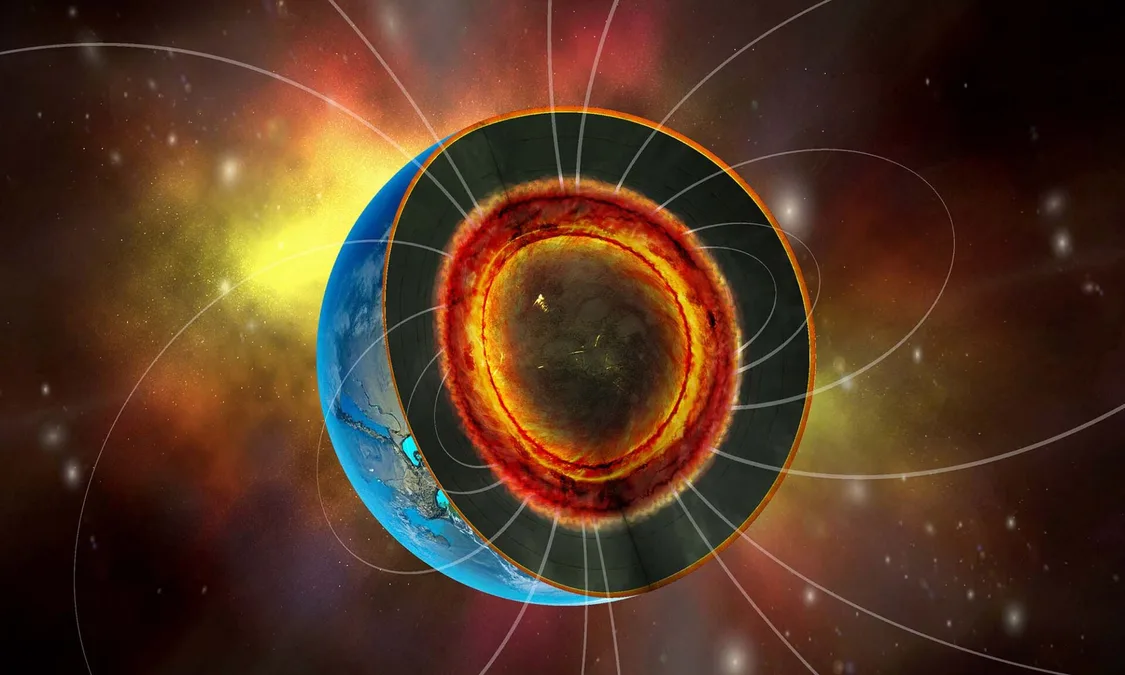
Deep layers of molten rock inside some super-earths could generate powerful magnetic fields, potentially stronger than Earth’s, and help shield these exoplanets from harmful radiation. Credit: University of Rochester Laboratory for Laser Energetics illustration/Michael Franchot
Magnetic fields are one of the strongest defenses a planet can have against atmospheric loss and surface radiation. New research indicates that many super-earths may generate such protection not from their cores, but from hidden magma oceans buried deep inside their interiors.
Deep inside some rocky exoplanets, vast reservoirs of molten rock may be quietly shaping whether those worlds can hold onto their atmospheres and remain hospitable over billions of years. According to new research, these deep magma layers can power global magnetic fields strong enough to deflect high-energy particles from space.
Planetary magnetic fields act as shields, redirecting charged particles emitted by stars and from interstellar space. Without this protection, stellar winds can gradually erode atmospheres, while radiation levels at the surface increase. On Earth, this magnetic shielding has played a major role in preserving an atmosphere capable of supporting liquid water and life.
Many rocky planets, however, do not share this protection. Mars lost its global magnetic field early in its history, and Venus lacks one entirely. In both cases, the absence of sustained magnetic shielding is thought to have contributed to extreme atmospheric evolution. For decades, scientists assumed that the ability to generate a magnetic field depended almost entirely on the behavior of a planet’s metallic core.
That assumption poses a problem for super-earths. These planets are larger than Earth but smaller than ice giants such as Neptune, and they are believed to be predominantly rocky. Their greater mass leads to much higher internal pressures, which may leave their cores either fully solid or fully molten. In both cases, the traditional core dynamo that powers Earth’s magnetic field may not operate efficiently.
The new study proposes a different solution. Instead of relying on the core, some super-earths may generate magnetic fields from a deep layer of molten rock known as a basal magma ocean. This layer forms at the boundary between a planet’s mantle and core during early stages of planetary evolution, when intense heating from accretion and giant impacts melts much of the interior.
As a magma ocean cools, iron can become concentrated in its deepest regions. This denser, iron-rich melt sinks toward the core-mantle boundary and can remain molten for extended periods. Scientists believe Earth itself likely possessed such a basal magma ocean shortly after its formation, although it eventually crystallized as the planet cooled.
In larger rocky planets, internal pressures are far greater. These pressures slow crystallization and allow basal magma oceans to persist far longer than they did on Earth. In some super-earths, models suggest that these molten layers could remain active for several billion years.
To test whether a basal magma ocean could generate a magnetic field, researchers from the University of Rochester conducted a series of laser-driven shock experiments at the university’s Laboratory for Laser Energetics. These experiments recreated pressures between 467 GPa and 1 400 GPa, conditions expected deep inside the mantles of massive super-earths. For comparison, pressures at Earth’s core mantle boundary are about 136 GPa.
The experiments focused on ferropericlase, a mineral composed of magnesium, iron, and oxygen, where iron fractions ranged from 0.95 to 1. This material is considered a close analogue for iron-rich molten rock expected in basal magma oceans.
Under these extreme pressures, the researchers found that molten silicate rock becomes highly electrically conductive. Measurements showed that the direct current electrical conductivities of magnesium oxide and iron-bearing (Mg,Fe)O are effectively indistinguishable across the tested pressure range. This result contradicts earlier predictions that conductivity would depend strongly on iron content.
Electrical conductivity is essential for generating a magnetic field. A dynamo requires moving, electrically conductive material to sustain circulating currents. The new findings demonstrate that molten mantle material under super-earth conditions can meet this requirement even without extreme iron enrichment.
To connect laboratory results with planetary behavior, the team combined their experiments with quantum mechanical simulations and long-term planetary evolution models. These models indicate that super-earths larger than about three to six times Earth’s mass can sustain magma-driven dynamos for several billion years.
The predicted magnetic fields generated by basal magma oceans are nearly one order of magnitude stronger than Earth’s present-day magnetic field. Unlike core dynamos, which depend on complex interactions between cooling, crystallization, and composition in metallic cores, magma ocean dynamos are powered by slow cooling and chemical gradients within the molten mantle layer.
This mechanism greatly expands the range of planets that could possess magnetic shielding. Even super-earths with cores unable to generate traditional dynamos could remain magnetically active if a conductive basal magma ocean is present.
The implications for habitability are significant as many super-earths orbit close to their host stars, where radiation levels are intense. A strong magnetic field could slow atmospheric erosion and reduce surface radiation, improving the chances that liquid water and stable climates persist over geological timescales.
Basal magma oceans cannot be observed directly. Their existence must be inferred from planetary mass, radius, thermal evolution, and magnetic signatures. Importantly, the hypothesis is testable. Magnetic fields around exoplanets may be detected indirectly through star-planet interactions, radio emissions, or auroral signatures.
As observational capabilities improve, detecting strong magnetic fields around super-earths would provide indirect evidence for long-lived magma oceans and confirm that planetary magnetism can arise from deep within rocky mantles, not just metallic cores.
Together, the findings reshape how scientists think about the hidden interiors of rocky worlds and where protective magnetic shields might exist across the galaxy.
References:
1 Electrical conductivities of (Mg,Fe)O at extreme pressures and implications for planetary magma oceans – Nakajima, M., Harter, S.K., Jasko, A.V. et al – Nature Astronomy – January 15, 2026 – https://doi.org/10.1038/s41550-025-02729-x
2 Hidden magma oceans could shield rocky exoplanets from harmful radiation – University of Rochester – January 15, 2026

I’m a science journalist and researcher at The Watchers, contributing to the Epicenter edition, where I cover peer-reviewed scientific research and emerging discoveries across Earth and space sciences. With a background in astronomy and a passion for environmental science, I’ve worked in shark and coral conservation in Fiji, conducting reef and shark-behavior research, contributing to mangrove restoration, and earning PADI Open Water and Coral Reef Certifications. I bring a blend of scientific rigor and storytelling to illuminate the discoveries shaping our planet and beyond.

Commenting rules and guidelines
We value the thoughts and opinions of our readers and welcome healthy discussions on our website. In order to maintain a respectful and positive community, we ask that all commenters follow these rules.