
Solar Orbiter observations reveal avalanche-like reconnection powering a solar flare
Solar Orbiter has provided direct observational evidence that avalanche-like magnetic reconnection can power a solar flare. The mechanism was observed during a close approach to the Sun on September 30, 2024, as an M7.7-class flare evolved over roughly 40 minutes before reaching peak intensity. The results, published today in Astronomy & Astrophysics, confirm long-standing avalanche models previously supported mainly by statistical flare studies.
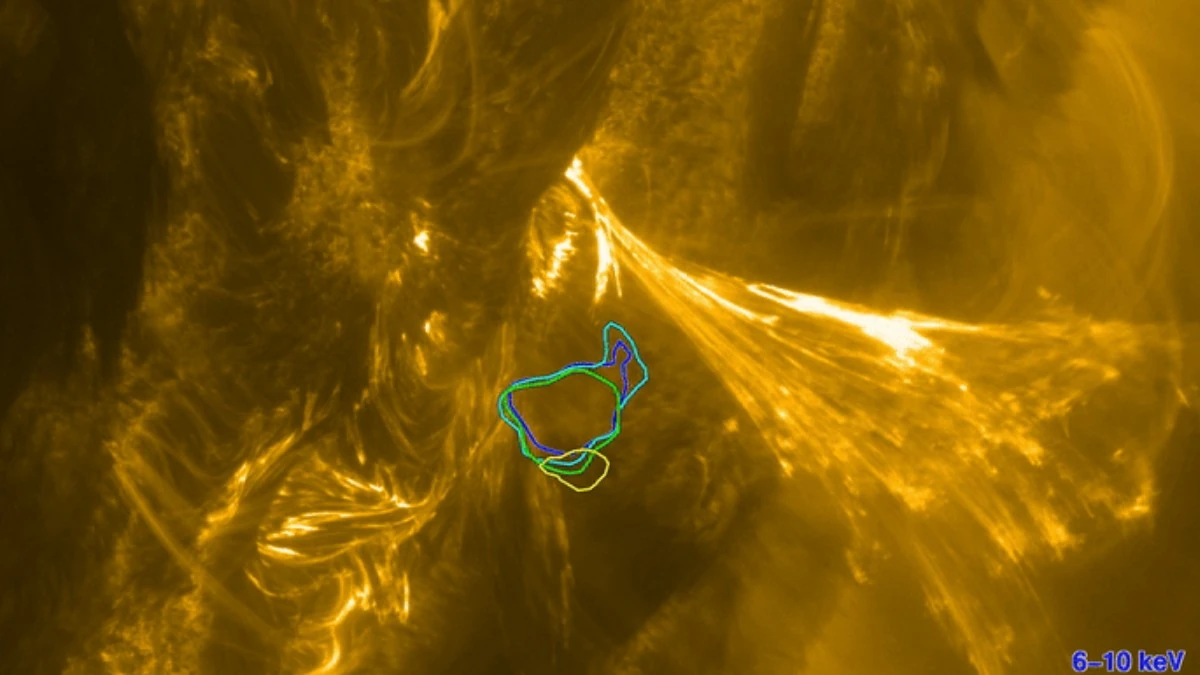
Solar Orbiter observations reveal avalanche-like reconnection powering a solar flare. Image credit: ESA & NASA/Solar Orbiter/EUI & STIX Teams
The discovery shows that solar flares grow through a process comparable to an avalanche. Initially weak magnetic reconnection events rapidly multiply, spread through the magnetic structure, and intensify until they release vast amounts of energy. This mechanism explains how the Sun can unleash powerful flares within minutes and why these events can pose serious space weather risks to Earth.
The observations were made during Solar Orbiter’s close approach to the Sun on September 30, 2024, when the spacecraft was operating in a rare high-cadence observing mode. Such modes are limited by onboard memory and mission constraints, meaning that full observations of flare precursor phases are seldom captured. In this case, the spacecraft was pointed at an active region at exactly the right moment, allowing scientists to follow the flare’s evolution from its earliest stages.
At the heart of the event was an M7.7-class solar flare that peaked at around 23:47 UTC. Solar Orbiter monitored the region for roughly 40 minutes before the peak, revealing a gradual but relentless buildup of magnetic activity in the Sun’s corona. Instead of a sudden instability, the data show a steady progression from weak disturbances to increasingly energetic reconnection events.
The breakthrough was made possible by the combined operation of four Solar Orbiter instruments. Together, they provided an unprecedented three-dimensional view of the flare, from the corona down to the Sun’s visible surface. The Extreme Ultraviolet Imager resolved coronal structures just a few hundred kilometres across, about 200 km (125 miles), and recorded changes every 2 seconds. This revealed fine magnetic strands forming, twisting, and repeatedly reconnecting.
At the same time, the Spectral Imaging of the Coronal Environment instrument measured plasma temperatures ranging from about 10 000 K up to more than 1 million K, showing how energy released by reconnection heated the surrounding atmosphere. The STIX X-ray instrument identified where energetic particles deposited their energy, while the Polarimetric and Helioseismic Imager detected lasting magnetic changes at the Sun’s surface after the flare.
When observations began at 23:06 UTC, a dark, arch-shaped filament made of cooler, denser plasma was already suspended in the corona. This filament was magnetically linked to a cross-shaped system of coronal loops that gradually brightened as reconnection progressed. New magnetic strands appeared in almost every image frame, indicating reconnection occurring on timescales of just a few seconds.
Initially, these events were weak. Plasma flows were modest, on the order of 100–200 km/s (60–125 mph), and there was little evidence of high-energy particle acceleration. As time passed, however, each reconnection event destabilized neighbouring magnetic structures. This triggered a chain reaction in which reconnection spread rapidly through the region, intensifying with each step.
A decisive transition occurred at around 23:29 UTC when a localized brightening was followed by the partial disconnection of the filament from its surrounding magnetic loops. One end of the filament lifted and began to unwind violently, with plasma moving at speeds exceeding 250 km/s (155 mph). Bright reconnection signatures appeared along the filament’s length, showing that energy release had shifted into the flux rope itself.
By the time the flare reached its peak, particles were being accelerated to extraordinary speeds. STIX measurements indicate velocities of 40–50% of the speed of light, equivalent to roughly 430–540 million km/h (270–335 million miles/h). Such high energies were not expected from an avalanche process driven by many small reconnection events, making this result particularly significant.
One of the most visually striking consequences of the avalanche was the appearance of ribbon-like structures made up of rapidly evolving plasma blobs. These “raining plasma blobs” moved down along magnetic field lines toward the lower solar atmosphere. Individual blobs lasted only a few seconds, but together they traced how energy released in the corona was deposited below.
The plasma rain began several minutes before the flare’s peak and continued even after the main eruption subsided. This showed that energy release and transport persisted well beyond the impulsive phase of the flare. The lack of synchronization between neighbouring ribbons also indicated that energy deposition was highly fragmented, consistent with an avalanche of independent reconnection events.
After the main phase of the flare, Solar Orbiter observed the stressed magnetic structures relaxing into a simpler configuration. Plasma temperatures gradually decreased, energetic particle emission declined, and the magnetic imprint of the flare became visible at the Sun’s surface. Capturing the buildup, eruption, and relaxation phases in a single dataset provided an unusually complete picture of a flare’s full lifecycle.
Avalanche models have long been used to explain the statistical behaviour of solar and stellar flares, but direct evidence that a single large flare operates this way had been lacking. Solar Orbiter’s observations now bridge that gap, linking small-scale magnetic processes to the most powerful explosions on the Sun.
Scientists note that similar avalanche mechanisms may operate in flares on other stars, including highly energetic stellar flares observed across the galaxy. Future missions with even higher-resolution X-ray imaging could determine how universal this process is and help improve forecasts of space weather events that can affect satellites, astronauts, and technological systems near Earth.
References:
1 Magnetic avalanches power solar flares, finds Solar Orbiter – ESA – January 21, 2026
2 A magnetic avalanche as the central engine powering a solar flare – L. P. Chitta et al. – Astronomy & Astrophysics – January 21, 2026 – https://doi.org/10.1051/0004-6361/202557253 – OPEN ACCESS

I’m a science journalist and researcher at The Watchers, contributing to the Epicenter edition, where I cover peer-reviewed scientific research and emerging discoveries across Earth and space sciences. With a background in astronomy and a passion for environmental science, I’ve worked in shark and coral conservation in Fiji, conducting reef and shark-behavior research, contributing to mangrove restoration, and earning PADI Open Water and Coral Reef Certifications. I bring a blend of scientific rigor and storytelling to illuminate the discoveries shaping our planet and beyond.

Commenting rules and guidelines
We value the thoughts and opinions of our readers and welcome healthy discussions on our website. In order to maintain a respectful and positive community, we ask that all commenters follow these rules.