
Dead star drives a shock wave astronomers cannot explain
Astronomers have confirmed the first known case of a diskless, synchronized polar-type white dwarf system hosting a persistent bow shock. The structure surrounding RXJ0528+2838 challenges existing models of energy loss in magnetic binaries and appears to be powered by an unknown long-term mechanism. The findings were published in Nature Astronomy on January 12, 2026.
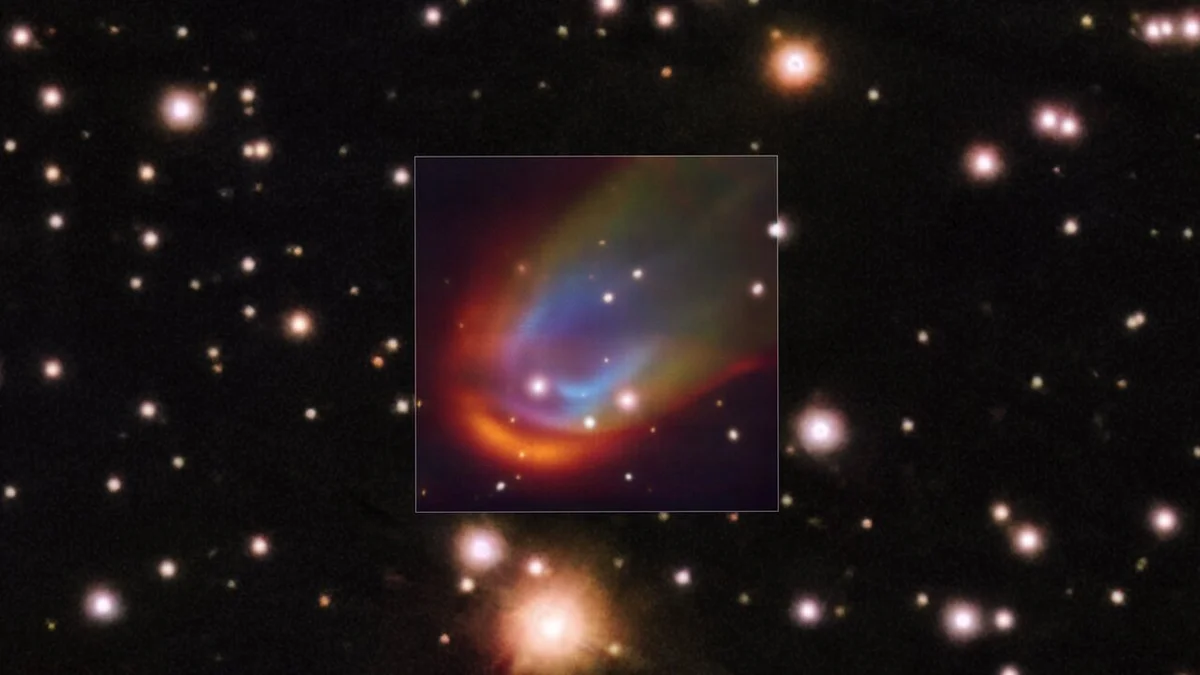
VLT image of a dead star creating a shock wave as it moves through space. Credit: ESO/K. Iłkiewicz and S. Scaringi et al. Background: PanSTARRS
Astronomers using the European Southern Observatory’s Very Large Telescope have discovered a large, persistent shock wave surrounding the white dwarf RXJ0528+2838, a finding that defies established models of how dead stars interact with their environment. The system lies at a distance of 224 pc (730 light-years), close enough that its surroundings can be studied in exceptional detail.
The structure is a bow shock, a curved arc of glowing gas formed when material flowing away from a star collides with the interstellar medium as the system moves through space. Such structures are well known around massive stars and some energetic binaries, but RXJ0528+2838 belongs to a class of systems that should not be able to produce one at all.
The shock front extends up to 0.018 pc from the star, roughly 570 billion km (355 billion miles). Its smooth shape and clear alignment with the star’s motion show that it is not a relic of a brief explosion but the result of a long-lived and ongoing interaction.
Measurements of the star’s motion indicate a velocity of about 142 km/s (88 miles/s) relative to the surrounding gas. Combined with the length of a faint emission tail trailing behind the system, this implies that the outflow shaping the bow shock has persisted for at least 1 000 years. Maintaining such a structure requires a continuous power input of approximately 8.2 × 1032 erg per second, around three times higher than the energy released by accretion onto the white dwarf itself.
RXJ0528+2838 is a white dwarf, the compact remnant left when a low-mass star exhausts its nuclear fuel. It forms part of a close binary system in which material is pulled from a companion star. In many such systems, the transferred gas forms a rotating accretion disk around the white dwarf, and winds launched from that disk can drive extended nebulae.
This system is different. RXJ0528+2838 is a polar-type cataclysmic variable, meaning its white dwarf has a very strong magnetic field that prevents an accretion disk from forming. Instead, material flows directly along magnetic field lines onto the white dwarf’s surface. Without a disk, there is no accepted mechanism capable of producing a sustained, high-power outflow.
Alternative explanations have been carefully tested and ruled out. The nebula does not resemble the expanding shells left behind by classical nova explosions, which detach from their parent stars and expand roughly symmetrically. Winds from the companion star would need to reach unrealistically high speeds to supply the required energy. Spin-down of the white dwarf and losses of orbital energy also fall far short of what is needed. Radio observations exclude the presence of a hidden neutron star or pulsar that might otherwise power such a shock.
What makes the discovery especially striking is how rare such structures are in magnetic systems. Extended bow shocks around accreting white dwarfs are already uncommon, with only a small number known across the Galaxy. All previously confirmed examples that are not linked to nova explosions occur in systems with accretion disks. Even though roughly one-third of accreting white dwarfs are strongly magnetised, extended nebulae around polars are almost entirely absent from observational surveys.
RXJ0528+2838 is therefore the first confirmed case of a diskless, synchronised polar system hosting a persistent bow shock powered by an ongoing energy source. This places it in a category of its own and strongly suggests that an additional channel of energy loss is operating in at least some magnetic binaries.
Detailed spectroscopy reveals that the white dwarf’s magnetic field strength lies between about 42 and 45 megagauss. Such intense fields are capable of controlling the flow of matter and may also play a role in launching material away from the system. However, estimates of the available magnetic energy show that the present-day field could only sustain the observed shock for a few hundred years, far shorter than the minimum age implied by the nebula’s structure.
The observations, therefore, point to a hidden or more efficient mechanism for extracting energy from the system, potentially linked to magnetic processes or past phases of the binary’s evolution that are not yet included in standard models.
The implications extend beyond this single object. Models of cataclysmic variable evolution rely on well-defined sources of angular momentum and energy loss, such as gravitational radiation, magnetic braking, accretion luminosity, and episodic nova eruptions. RXJ0528+2838 requires a persistent energy output that exceeds these channels and operates over millennia.
If similar outflows occur in other magnetic binaries, even intermittently, they could alter predicted evolutionary timescales, affect orbital period changes, and influence how such systems transition between active and quiescent states. The bow shock around RXJ0528+2838 may therefore represent the first clear observational signature of a broader, previously overlooked process that shapes the long-term evolution of compact binary stars.
Future observations with ESO’s upcoming Extremely Large Telescope will allow astronomers to search for fainter and more distant examples of similar structures. Whether RXJ0528+2838 is truly unique or simply the first detected member of a hidden population, it already demonstrates that even the final stages of stellar evolution can still deliver fundamental surprises.
References:
1 Astronomers surprised by mysterious shock wave around dead star – ESO – January 12, 2026
2 A persistent bow shock in a diskless magnetized accreting white dwarf – Krystian Iłkiewicz et al. – Nature Astronomy – January 12, 2026 – https://doi.org/10.1038/s41550-025-02748-8

I’m a science journalist and researcher at The Watchers, contributing to the Epicenter edition, where I cover peer-reviewed scientific research and emerging discoveries across Earth and space sciences. With a background in astronomy and a passion for environmental science, I’ve worked in shark and coral conservation in Fiji, conducting reef and shark-behavior research, contributing to mangrove restoration, and earning PADI Open Water and Coral Reef Certifications. I bring a blend of scientific rigor and storytelling to illuminate the discoveries shaping our planet and beyond.

Commenting rules and guidelines
We value the thoughts and opinions of our readers and welcome healthy discussions on our website. In order to maintain a respectful and positive community, we ask that all commenters follow these rules.