• First-of-its-kind deep-Earth conductivity map reveals ancient continental fragments beneath the United States

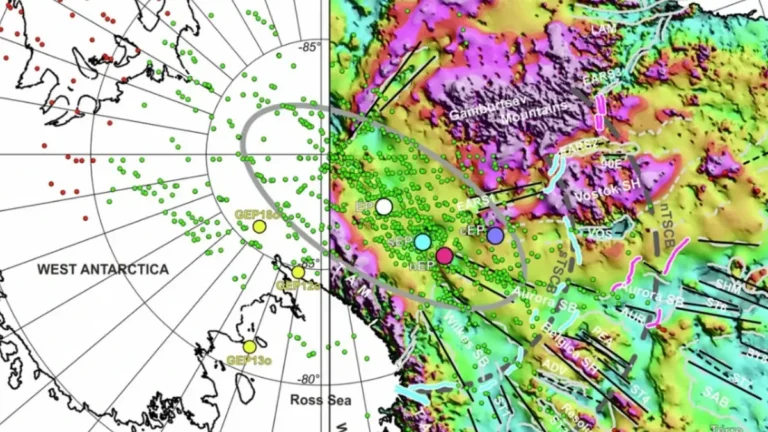
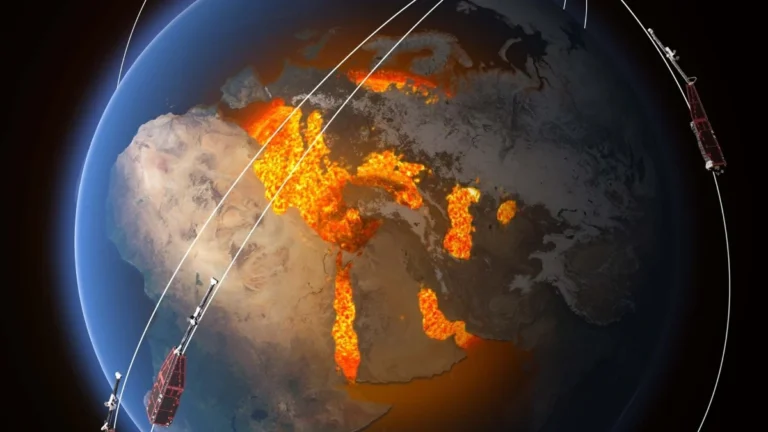
    A first-of-its-kind continent-scale conductivity map made using over 1 700 magnetotelluric stations deployed across the United States has revealed buried tectonic fragments beneath eastern North America, allowing researchers to reconstruct the continent’s deep electrical structure while exposing conductive regions linked to ancient continental collisions, mineral systems, and geomagnetic storm hazard propagation.

  • New York and New Orleans among most flood-prone U.S. cities, new study shows

    Flood risk along the U.S. Gulf and Atlantic coasts affects a disproportionate share of the population, with 16.7% living in very high-risk zones that cover just 1.1% of land, according to a new study. New York City and New Orleans rank among the most exposed urban areas, with up to 4.75 million residents at risk in New York and nearly 99% of New Orleans’ population located in flood-prone zones. High-risk areas account for another 3.5% of land but include 16.21% of residents.

  • NASA and JAXA data show another record-low Arctic winter sea-ice season

    Arctic winter sea ice remained at record-low levels in March 2026, with NASA and the National Snow and Ice Data Center (NSIDC) reporting a statistical tie with the 2025 minimum winter maximum and Japan’s NIPR/JAXA dataset reporting a new record low. Despite differences in measurement methods, both datasets place the 2026 maximum among the lowest observed since satellite monitoring began in 1979.

  • Previously unmapped island discovered in Antarctica’s Weddell Sea

    Scientists aboard the RV Polarstern discovered and surveyed a previously unmapped island in the Weddell Sea, Antarctica, during a February 2026 expedition, confirming a rocky landmass about 130 m (426 ft) long that had previously appeared only as an undefined danger zone on nautical charts.

  • Strong El Niño possible from mid-2026 as forecast confidence increases, WMO reports

    El Niño conditions are likely to develop in the equatorial Pacific by mid-2026, with climate models showing strong agreement on onset timing, the World Meteorological Organization (WMO) reported on April 24, 2026. The transition window spans May–July, following neutral conditions at the start of the year, and forecasts do not exclude the development of a strong event.

  • Grand Canyon origin tied to ancient lake spillover, new geological evidence shows

    An ancient lake that filled, pooled, and ultimately spilled over may hold the answer to one of geology’s most debated questions: how did the Colorado River carve the Grand Canyon? New evidence published April 16, 2026, in Science supports spillover flooding from Lake Bidahochi as a key mechanism in the river’s integration and the canyon’s formation, with mineral grain analysis placing Colorado River sediment in the Bidahochi Basin of northern Arizona by approximately 6.6 million years ago.

  • North Atlantic circulation shows signs of weakening, studies point to major decline by 2100

    A pair of studies published in April 2026 in Science Advances report a consistent decline in observed western-boundary overturning transport across the North Atlantic and suggest that future weakening of the Atlantic Meridional Overturning Circulation (AMOC) could be stronger than standard climate model estimates.

  • Large magma reservoir discovered deep beneath southern Tuscany

    Scientists have reported evidence of a vast deep magma reservoir beneath southern Tuscany after analyzing seismic data from more than 60 stations across the region. The study links the hidden melt system to the intense heat flow beneath Larderello geothermal system, one of Europe’s best-known high-enthalpy geothermal fields.

  • Earth’s 40 000-year axial tilt cycle influenced subtropical marine productivity during early Antarctic ice sheet expansion

    A 40 000-year cycle in Earth’s axial tilt influenced subtropical marine productivity about 34 million years ago, during the early expansion of the Antarctic ice sheet, according to a study published in PNAS. The authors link this signal to obliquity-driven Antarctic ice-sheet variability that affected ocean circulation and nutrient delivery far from the polar region.