• High radiation levels measured at sunken Soviet submarine K-278 Komsomolets site

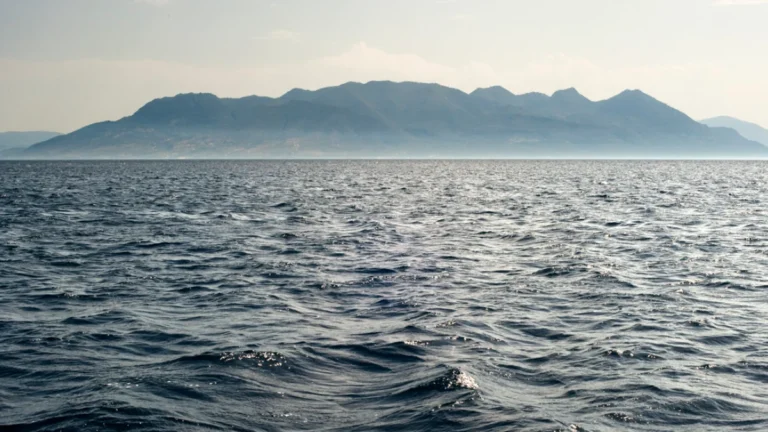
    Sunken Soviet submarine K-278 Komsomolets in the Norwegian Sea continues to release radioactive material more than three decades after sinking on April 7, 1989, according to a 2026 study. Measurements show extremely high concentrations of radionuclides near the wreck, while rapid dilution in surrounding seawater limits broader environmental impact.

  • Rare marine asteroid impact crater confirmed beneath the North Sea after decades-long debate

    A team of researchers has confirmed that the Silverpit structure beneath the southern North Sea is an ancient asteroid impact crater formed approximately 43–46 million years ago. The finding resolves a long-standing geological debate and identifies one of the best-preserved marine impact structures known on Earth.

  • How disruption in the Strait of Hormuz threatens fertilizer supply and global food prices

    Shipping through the Strait of Hormuz sharply declined in early March after escalating conflict in the Gulf disrupted commercial navigation through the narrow corridor between Iran and Oman. While the strait is widely known as one of the world’s most important oil routes, it also connects natural gas exports from Gulf producers to global fertilizer production and agricultural supply chains. Disruptions affecting this corridor can therefore propagate beyond energy markets and influence fertilizer availability, agricultural input costs, and ultimately food prices worldwide.

  • Earth’s magnetic power is shifting from Canada to Siberia

    Satellite measurements from 2014 to 2025 show that the northern hemisphere’s strongest magnetic field region is shifting from Canada toward Siberia as the Canadian lobe weakens and the Siberian lobe intensifies. The redistribution is directly linked to the continued eastward drift of the north magnetic pole, now moving at about 36 km/h (22 mph), and requires updates to global navigation models. Over the same 11-year interval, the southern hemisphere’s strong-field region between Australia and Antarctica remained largely stable.

  • Scientists resolve origin of the King’s Trough Complex, the “Grand Canyon of the Atlantic”

    An international research team led by the GEOMAR Helmholtz Centre for Ocean Research Kiel has resolved how the King’s Trough Complex formed between 37 and 24 million years ago. The study shows it originated along a temporary plate boundary guided by an early branch of the Azores mantle plume.

  • Adaptive kernel density estimation reveals possible gaps in geomagnetic reversal record

    A revised statistical reconstruction of Earth’s magnetic polarity history suggests that some short-duration geomagnetic reversals may be absent from the Geomagnetic Polarity Time Scale, particularly during four intervals following the Cretaceous Normal Superchron approximately 83 million years ago. The study, published in Geophysical Research Letters in 2026, applies a cross-validated adaptive-bandwidth kernel density estimation method to analyze reversal frequency in the GPTS 2020 dataset. The results identify localized dips in modeled reversal frequency that may correspond to undocumented short-lived polarity switches.

  • Researchers connect Antarctic gravity low to past Antarctic climate and ice-sheet evolution

    Using earthquakes to ‘see’ into the interior of our planet, scientists were able to reconstruct the three-dimensional structure of the Antarctic gravity hole and reveal its development over millions of years, establishing a link with major climate changes in Antarctica.

  • Geodetic strain data confirm Iberia’s slow clockwise rotation relative to Eurasia and Africa

    A new geophysical model integrating GNSS velocity data and earthquake focal mechanisms reveals that the Iberian Peninsula is rotating slowly clockwise relative to both Eurasia and Africa. The analysis, published in Gondwana Research in January 2026, maps present-day stress and strain-rate fields across Iberia and north-western Africa, refining the geometry of the diffuse Eurasia–Africa plate boundary.