
Strong El Niño possible from mid-2026 as forecast confidence increases, WMO reports
El Niño conditions are likely to develop in the equatorial Pacific by mid-2026, with climate models showing strong agreement on onset timing, the World Meteorological Organization (WMO) reported on April 24, 2026. The transition window spans May–July, following neutral conditions at the start of the year, and forecasts do not exclude the development of a strong event.

Image credit: The Watchers
El Niño conditions are forecast to develop in the equatorial Pacific during mid-2026 as sea-surface temperatures rise and subsurface heat accumulates, according to the World Meteorological Organization (WMO). The agency’s latest Global Seasonal Climate Update places the transition window between May and July 2026.
Model guidance from multiple global producing centers shows strong alignment on the onset of El Niño, with several systems projecting further strengthening after development. WMO states that a strong event remains possible, while forecast certainty is reduced during the boreal spring due to the spring predictability barrier.
“After a period of neutral conditions at the start of the year, climate models are now strongly aligned, and there is high confidence in the onset of El Niño, followed by further intensification in the months that follow,” said Wilfran Moufouma Okia, Chief of Climate Prediction at WMO.
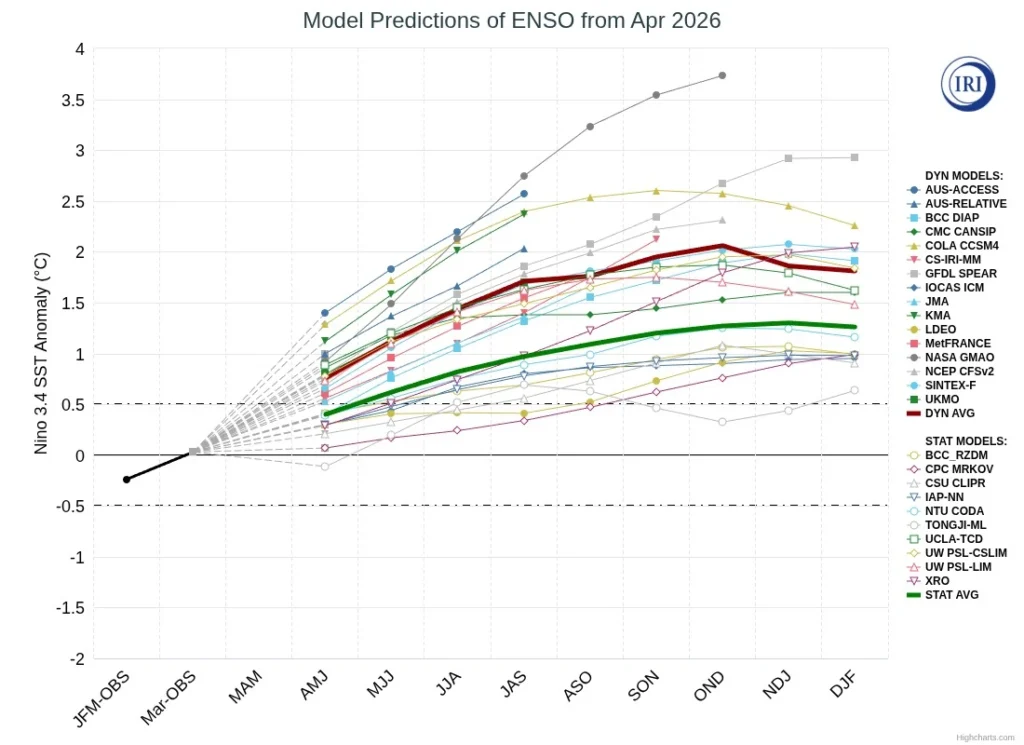
“Models indicate that this may be a strong event – but the so-called spring predictability barrier is a challenge for the certainty of forecasts at this time of year. Forecast confidence generally improves after April,” Okia said.
NOAA Climate Prediction Center (CPC) assigned a 61% probability to El Niño development during May–July 2026. The International Research Institute (IRI) for Climate and Society indicates higher probabilities later in 2026, while regional centers such as ASEAN’s Specialized Meteorological Center report similar model consensus with caution on early-season forecasts.
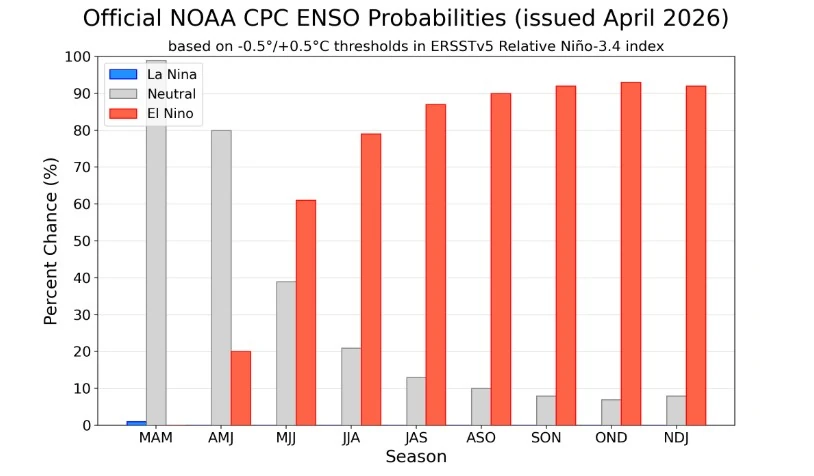
The El Niño–Southern Oscillation (ENSO) is a coupled ocean–atmosphere system in the equatorial Pacific. El Niño phases are defined by sustained warming of the central and eastern Pacific Ocean, which alters atmospheric circulation and shifts rainfall patterns across multiple regions.
WMO forecasts show that land surface temperatures for May–July 2026 are expected to be above normal across most land areas, with the strongest signals over southern North America, Central America, the Caribbean, Europe, and northern Africa. Rainfall patterns are expected to vary regionally, with increased precipitation in parts of southern South America and the Horn of Africa, and drier conditions over Australia and parts of Southeast Asia.
El Niño also affects tropical cyclone activity through changes in atmospheric wind shear. Warmer conditions in the central and eastern Pacific can support increased cyclone activity in that basin, while increased wind shear in the Atlantic suppresses hurricane formation.
The current outlook follows the end of the 2025–26 La Niña and a return to neutral ENSO conditions earlier in 2026. Observations show near-average surface temperatures in the equatorial Pacific combined with increasing subsurface heat content, a known precursor for El Niño development.
WMO is expected to issue an updated ENSO outlook in late May 2026, incorporating additional observational data and improved model confidence beyond the spring forecast barrier.
References:
1 Global Seasonal Climate Update – WMO – April 24, 2026
2 ENSO Diagnostic Discussion – NOAA/CPC – April 9, 2026
3 ENSO Forecast Update – IRI – April 20, 2026

I'm a dedicated researcher, journalist, and editor at The Watchers. With over 20 years of experience in the media industry, I specialize in hard science news, focusing on extreme weather, seismic and volcanic activity, space weather, and astronomy, including near-Earth objects and planetary defense strategies. You can reach me at teo /at/ watchers.news.

Commenting rules and guidelines
We value the thoughts and opinions of our readers and welcome healthy discussions on our website. In order to maintain a respectful and positive community, we ask that all commenters follow these rules.