• Long-term correlation found between Earth’s magnetic field strength and atmospheric oxygen

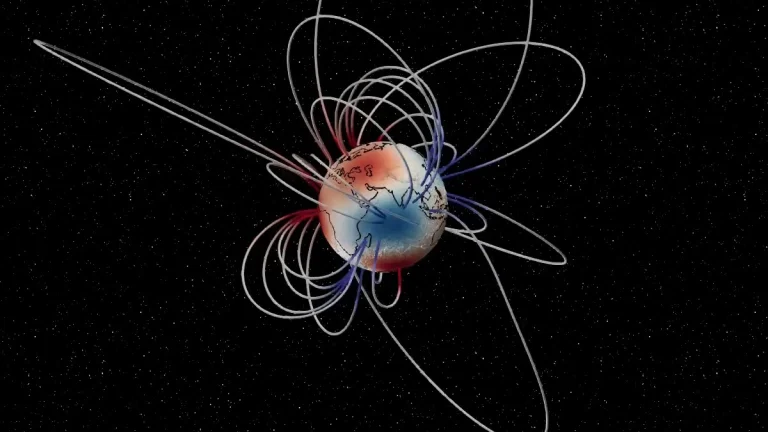
    An analysis of paleomagnetic and geochemical proxy records shows that Earth’s geomagnetic field strength and atmospheric oxygen levels followed closely correlated trends over the past 540 million years. The findings show that both variables increased through the Phanerozoic and peaked together during the late Paleozoic.

  • Scientists discover deep-Earth structures influencing the planet’s magnetic field

    Scientists from the University of Liverpool and the University of Leeds discovered that two massive hot rock structures located about 2 900 km (1 800 miles) beneath Africa and the Pacific Ocean have been influencing Earth’s magnetic field for millions of years. Published in Nature Geoscience on February 5 2026, the study combines palaeomagnetic records and numerical geodynamo models to reveal that uneven heat flow at the core–mantle boundary controls long-term magnetic stability.

  • Ionospheric disturbances from solar flares modeled as possible secondary triggers for large earthquakes

    A team of scientists from Kyoto University has developed a capacitive-coupling model linking the ionosphere and Earth’s crust, showing that enhanced electron density during strong solar-flare activity could induce measurable electrostatic pressure inside fractured rock. The findings, published February 3, 2026, suggest space-weather disturbances may act as an additional stress factor when faults are critically loaded.

  • New data refine the number of eruptions within the Yellowstone caldera

    Scientists at the Yellowstone Volcano Observatory have identified at least 28 eruptions within the Yellowstone Caldera since it formed 631 000 years ago, a minimum estimate based on preserved geologic evidence. Ongoing work is focused on refining this count by identifying older eruptions whose deposits were buried or obscured by younger lava flows.

  • Rare gulf-effect snow setup appears in model guidance for Florida this weekend

    Forecast models are indicating a rare possibility of gulf-effect snow developing over parts of the Florida Gulf Coast during the weekend of January 31 – February 1, 2026. The setup could briefly produce isolated snow flurries near Tampa and along the coast as Arctic air flows across the warm Gulf of Mexico. The probability remains very low and is dependent on the precise alignment of wind, temperature, and moisture conditions.

  • Extreme drought and rainfall years in the western Mediterranean now occur about ten times more often

    A five-century precipitation record reconstructed from tree rings in eastern Spain shows that extreme drought and rainfall years have become roughly ten times more frequent since 2000 than at any point since the early 1500s.

  • Deep-ocean sediments chronicle thousands of years of Cascadia megathrust earthquakes

    A study of deep-sea sediments offshore the Pacific Northwest,  published in Science Advances on January 14, 2026, shows that repeated megathrust earthquakes along the Cascadia subduction zone triggered widespread submarine landslides over the past ~7 500 years, leaving a detailed geological record preserved on the abyssal plain.

  • Seismic ‘snapshot’ reveals new insight into how the Rocky Mountains formed

    A new seismic imaging study reveals that the Rocky Mountains formed through the stacking of two massive layers of continental lithosphere beneath western Canada, overturning the long-held view that the range sits above a sharp vertical boundary in the deep Earth.