
Kikai Caldera magma system shows signs of refilling after VEI 7 eruption 7 300 years ago
A new seismic study of the Kikai Caldera in Japan, published on March 27, 2026, finds that a large shallow magma reservoir beneath the volcano has been replenished by newly injected melt since the giant eruption 7 300 years ago.
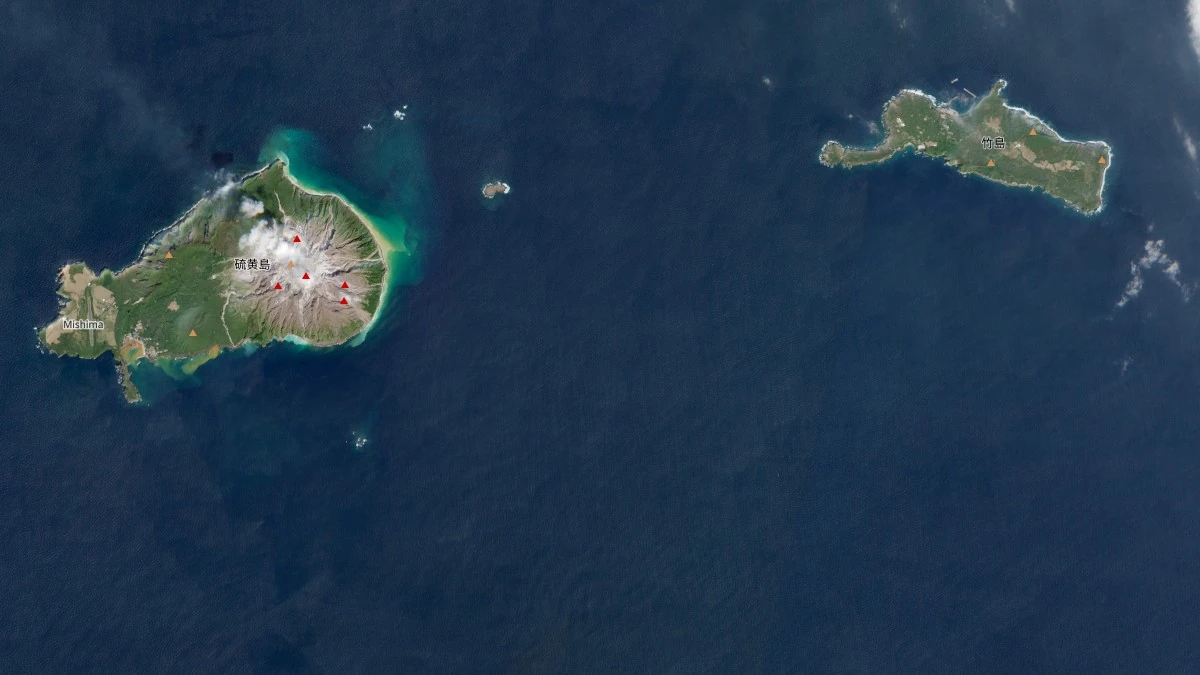
Satellite image of Mishima, Takeshima and Osumi Islands, Japan acquired on March 16, 2026. Credit: CopernicusEU/Sentinel-2, The Watchers
About 7 300 years ago, a rare Volcanic Explosivity Index (VEI) 7 eruption at Kikai Caldera in southern Japan expelled more than 100 km³ (24 mi³) of magma and created a large submarine caldera. While the eruption itself is well documented in the geological record, the long-term evolution of the underlying magma system has remained uncertain.
A new study led by Akihiro Nagaya, published today in Communications Earth & Environment, addresses this question and proposes that the system has been replenished by newly injected melt.
The research presents evidence for a magma body at depths of about 2.5–6 km (1.6–3.7 miles) beneath the caldera, directly below the central lava dome. Based on its position, size, and depth, the authors propose that this is the same storage zone involved in the Kikai-Akahoya eruption, one of the largest volcanic events of the Holocene.
“We must understand how such large quantities of magma can accumulate to understand how giant caldera eruptions occur,” Kobe University geophysicist and one of the authors of the new study, Seama Nobukazu, said.
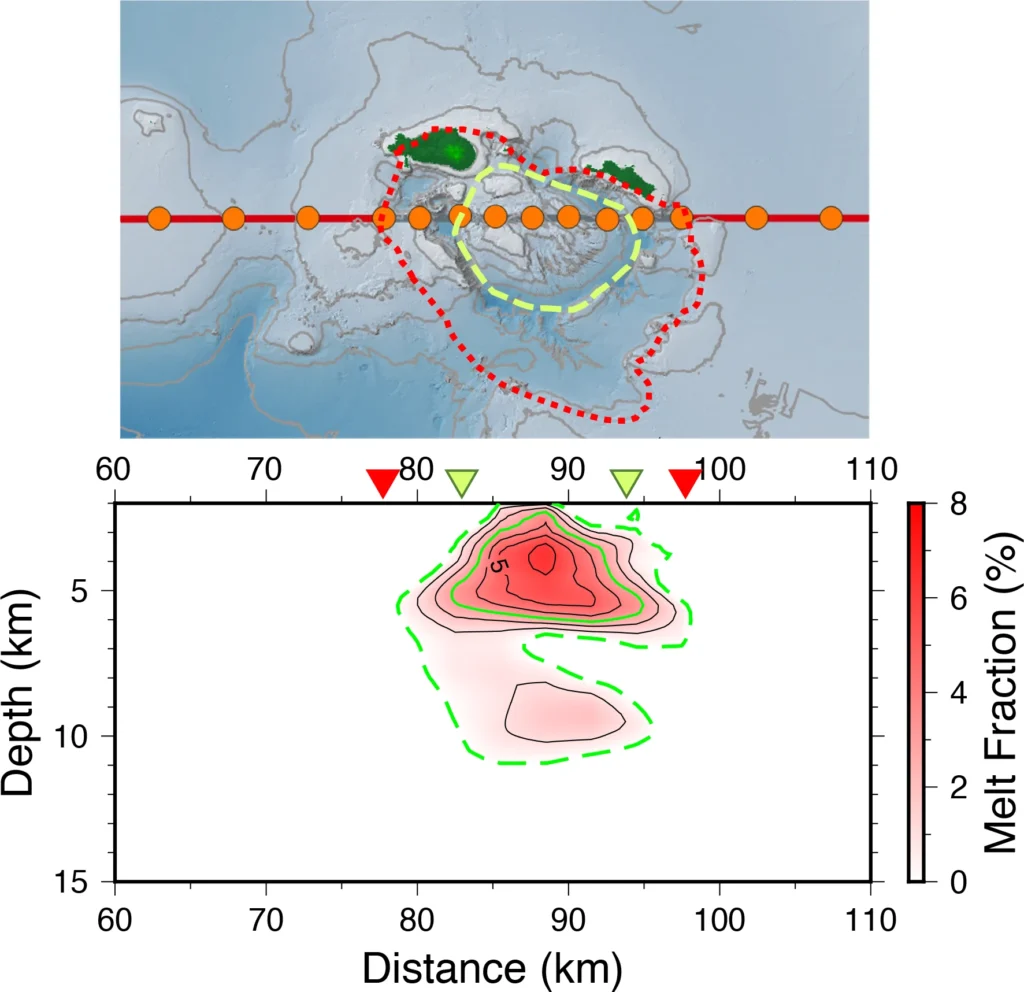
The findings are based on a marine seismic refraction survey conducted across the mostly submarine caldera. The survey used 39 ocean-bottom seismometers and an airgun array along a 175 km (109 miles) profile to image subsurface velocity structures.
The researchers identified a pronounced low-velocity anomaly beneath the caldera and interpreted it as a magma reservoir. The imaged structure is described as a trapezoidal body in cross-section, extending laterally at least as wide as the inner caldera.
Its melt fraction is estimated at approximately 3–6%, with an upper limit near 10%, based on the relationship between seismic velocity reduction and melt content.
The authors argue that the reservoir contains newly injected melt, rather than simply magma left over from the caldera-forming eruption. Their interpretation is based on geological and geochemical evidence showing that material erupted after the caldera event, including the central lava dome that formed over roughly the past 3 900 years, differs in composition from the magma involved in the Kikai-Akahoya eruption.
The study notes that the post-caldera central lava dome has a volume of more than 32 km³ (7.7 mi³). From this and earlier petrological work, the authors infer that at least this amount of melt associated with later volcanism was supplied to the system after the giant eruption, consistent with long-term recharge of the shallow reservoir.
Their proposed model suggests that after a giant eruption and caldera collapse, the same shallow magma reservoir can remain the main locus of magma accumulation, receiving new melt from deeper sources over thousands of years.
In that interpretation, caldera formation does not necessarily eliminate the underlying storage system, but may instead represent one stage in a longer cycle of magma replenishment.
The authors also look at Kikai in the context of Yellowstone and Toba, where shallow magma reservoirs have been identified at depths of a few kilometers. They suggest Kikai may offer another example of a broader post-caldera process.
References:
1 Nagaya, A., Seama, N., Fujie, G. et al. Melt re-injection into large magma reservoir after giant caldera eruption at Kikai Caldera Volcano. Commun Earth Environ 7, 237 (2026). https://doi.org/10.1038/s43247-026-03347-9
2 How do giant caldera volcanoes fill up? – Kobe University – March 27, 2026

I'm a dedicated researcher, journalist, and editor at The Watchers. With over 20 years of experience in the media industry, I specialize in hard science news, focusing on extreme weather, seismic and volcanic activity, space weather, and astronomy, including near-Earth objects and planetary defense strategies. You can reach me at teo /at/ watchers.news.

Commenting rules and guidelines
We value the thoughts and opinions of our readers and welcome healthy discussions on our website. In order to maintain a respectful and positive community, we ask that all commenters follow these rules.